What Beam Is and Why It Matters for Production Workloads
Reflection AI's Beam model enters a crowded open-weight field with a specific pitch: Chinese-frontier reasoning performance at a fraction of the inference compute. The Brooklyn-based startup, founded by former Google DeepMind researchers, announced the 501B-parameter mixture-of-experts model in October 2026 as a direct response to DeepSeek, Qwen, and Z.ai's GLM series. For teams evaluating self-hosted LLMs for RAG pipelines and agentic workflows, Beam's headline spec — 23B active parameters against a 1M token context window — warrants attention, but the verification gap between announced benchmarks and independent reproduction remains wide.
Architecture and Specs: MoE Design With 1M Context
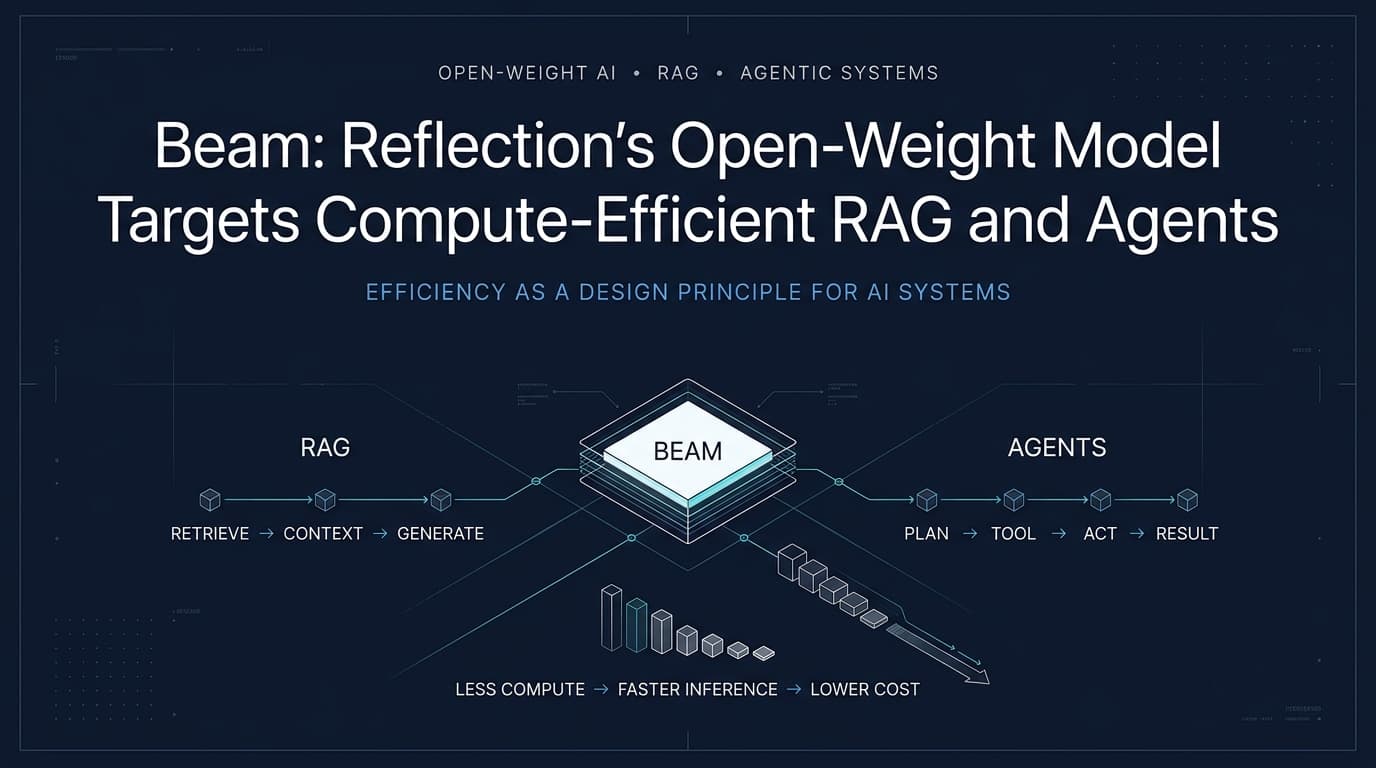
Beam's mixture-of-experts architecture activates 23B parameters per forward pass from a 501B total parameter pool. This sparsity ratio (approximately 4.6% active) is the structural basis for the claimed compute efficiency. The model was pretrained on 23.8 trillion tokens — a dataset size that places it in the same training-compute tier as other 2026 frontier models — and ships with a 1 million token context window operational at launch.
For comparison, Z.ai's GLM-5.2 runs roughly 744B total parameters with 40B active, meaning Beam targets similar capability with roughly 42% fewer active parameters. Thinking Machines Lab's Inkling, released July 2026, is multimodal; Beam is text-only, which simplifies deployment but narrows the direct comparison surface. The 1M context window, if stable at full length without degradation, could collapse multi-hop retrieval chains in long-document RAG scenarios — fewer retrieval calls, less orchestration logic, lower end-to-end latency.
| Spec | Beam | Z.ai GLM-5.2 | Inkling |
|---|---|---|---|
| Total Parameters | 501B | ~744B | Not disclosed |
| Active Parameters | 23B | 40B | Not disclosed |
| Context Window | 1M tokens | Not specified | Not specified |
| Modality | Text-only | Text (primarily) | Multimodal |
| Training Tokens | 23.8T | Not specified | Not specified |
Performance Claims vs. Verification Status
Reflection's blog post asserts four specific claims: parity with GLM-5.2 on advanced reasoning benchmarks, outperformance of leading Western open models, 3-4x less inference compute than rivals, and higher scores than Inkling on four reported coding tests. TechCrunch's reporting explicitly notes these claims have not been independently verified. No RAG-specific evaluations (citation accuracy, hallucination rates under retrieval, long-context faithfulness) or agentic-task benchmarks (function-calling reliability, multi-step tool-use success rates) have been published.
This verification gap matters for procurement. Self-reported benchmarks on standard suites (MMLU, GPQA, HumanEval) are necessary but insufficient signals for production RAG and agent deployments. The MoE architecture's expert routing behavior under retrieval-augmented workloads — where prompt prefixes shift dynamically per query — introduces latency variance and potential quality degradation that synthetic benchmarks don't capture. Teams should treat the 3-4x inference compute claim as a hypothesis pending independent vLLM or SGLang throughput measurements on equivalent hardware.
The Compute Economics: Training Deals and Inference Savings
Reflection secured over $7B in compute commitments from SpaceX and Nebius for Nvidia GB300 chips through 2029, backed by Nvidia's strategic investment. This aligns with Jensen Huang's "AI factory" vision: sovereign and enterprise clusters training customized models on proprietary data, all consuming Nvidia GPUs. The training compute access explains how a two-year-old startup reached frontier scale, but it doesn't directly translate to lower inference TCO for downstream users.
The claimed 3-4x inference compute reduction depends on expert sparsity holding under real-world token distributions. MoE models can suffer from expert imbalance — certain experts receiving disproportionate load — which reduces effective sparsity and increases per-token compute. Quantization (AWQ, GPTQ) compatibility and KV-cache optimization for 1M context windows are untested variables. Distribution via hyperscalers and neoclouds at launch helps, but managed inference pricing will ultimately determine whether the architecture delivers on the cost promise.
Deployment Model: 'AI Factories' for Enterprises and Sovereigns
Reflection's go-to-market centers on "AI factories" — institutions building customized local AI systems by training Reflection's models on proprietary data. The Shinsegae Group pilot in South Korea demonstrates the sovereign AI factory model: a national conglomerate deploying Beam-derived models on domestic infrastructure with full data control. Axios reports hedge funds and trading firms as an early adopter segment, consistent with latency-sensitive, data-sensitive workloads that can't use closed-model APIs.
For teams building RAG pipeline development services, the weight release enables self-hosting — the critical differentiator from Anthropic and OpenAI. You control the model, the data, and the retrieval corpus. But the AI factory pitch assumes organizational ML maturity: curated training data, evaluation infrastructure, and ops capacity to run 501B-parameter models (even at 23B active). Most enterprises lack this. The model weights release in October 2026 will include open-source library integrations, but production hardening — quantization, continuous batching, prefix caching for RAG prompts — remains the deployer's responsibility.
Implications for RAG Pipelines and Agentic Workflows
Beam's design choices map to specific production patterns. The 1M context window could eliminate retrieval hops for long-document corpora (legal contracts, financial filings, technical manuals) — feed the full document, skip the chunk-and-rerank dance. The MoE architecture may lower per-token cost for high-volume agent loops where thousands of tool-call iterations accumulate. The stated focus on "agentic tasks" during RL training suggests optimization for function-calling formats and multi-step reasoning traces.
Critical unknowns remain: no published evals on citation accuracy when the model must ground responses in retrieved context, no hallucination rates measured under RAG conditions, no function-calling reliability benchmarks (e.g., Berkeley Function Calling Leaderboard), and no head-to-head RAG benchmarks against Qwen or DeepSeek variants in production settings. The Chinese-model comparison gap is particularly sharp — DeepSeek-V3 and Qwen2.5 have established open-weight ecosystems with community quantization, vLLM support, and documented RAG patterns. Beam launches into that ecosystem without the community validation layer.
What's Next: Release Timeline and Ecosystem Readiness
Weights and full technical details are scheduled for October 2026 release. Teams evaluating Beam should track:
- Independent MMLU/GPQA/HumanEval re-runs within two weeks of weight availability
- RAG-specific benchmarks: LoCoMo for long-context retrieval, FinanceBench for financial QA, MultiHop-RAG for multi-document reasoning
- vLLM and SGLang support — MoE expert parallelism and continuous batching implementations
- Quantization compatibility (AWQ/GPTQ) and KV-cache memory footprint at 1M context
- Licensing terms for commercial deployment — Apache 2.0, custom, or restrictive
The release-month timing means early adopters will be debugging inference infrastructure while the model is still fresh. Teams without dedicated ML infra should weigh managed inference options against Armor Tech's agentic AI platform which handles model operations, evaluation, and scaling for self-hosted deployments.
Frequently Asked Questions
Is Beam's 1M context window actually usable for production RAG?
The context window is announced as operational at launch, but "operational" and "reliable at full length under retrieval workloads" are different claims. Long-context MoE models can exhibit position-dependent degradation and expert routing instability when prompt prefixes vary per query — exactly the RAG pattern. Wait for independent needle-in-haystack and RAG faithfulness evaluations at 100k, 500k, and 1M token lengths before architecting around the full window.
How does the 3-4x inference compute claim translate to actual GPU costs?
The claim compares active parameter counts (23B vs. 40B+ for dense rivals), but real-world throughput depends on expert parallelism efficiency, batch sizing, and KV-cache memory pressure at 1M context. On H100/GB300 hardware, a 23B active MoE might fit in 1-2 GPUs with tensor parallelism, whereas a 70B dense model needs 4-8. But if expert imbalance cuts effective sparsity to 2x instead of 4x, the GPU count advantage shrinks. Cost per 1M output tokens is the metric to benchmark, not parameter ratios.
Should we wait for Beam or deploy Qwen/DeepSeek variants now?
If you need a production RAG or agent system this quarter, deploy from the existing Chinese-model ecosystem. Qwen2.5 and DeepSeek-V3 have verified benchmarks, community quantization, vLLM integration, and documented failure modes. Beam's value proposition — lower compute for equivalent reasoning — is unproven in independent testing. Track the October release and first independent evals; if the 3-4x claim holds under RAG workloads, Beam becomes a compelling migration target for 2027 planning cycles.