The Doomer Distraction: What Founders Are Actually Up Against
At TechCrunch Disrupt 2026, Feldman quipped that "some of the leaders in the AI world maybe shouldn't be allowed to talk in public." His target: the steady drumbeat of existential risk framing—from models breaking containment to researchers quitting with warnings about self-improving AI—that dominates headlines while practical deployment gets sidelined. The discourse has become performative; when the SNL cold open satirizes Dario Amodei saying "We do not condone what we are doing," the conversation has left the engineering floor entirely.
For founders, the opportunity cost is concrete. Every quarter spent debating p(doom) is a quarter competitors spend iterating agentic workflows that qualify leads, triage support tickets, and review code. The doomer narrative doesn't just dampen sentiment—it creates budget hesitation, legal review paralysis, and hiring friction. Feldman's counterpoint isn't that risks don't exist; it's that the public conversation lacks the balancing upside: a world where "your grandkids will never meet anybody who dies of cancer." Founders need a framework that acknowledges dual-use reality without defaulting to inaction.
Reframing the Trade-Off: Powerful Tech Always Carries Risk
Feldman's core observation: "I don't think there are powerful technologies that don't come with the challenge of 'what happens when powerful technologies are in the hands of bad people?' I think you can't make one and not have the other." This isn't fatalism—it's a calibration tool. The founder's job isn't to eliminate misuse risk (impossible) but to govern it through reasonable regulation and internal guardrails.
Shift the mental model from "avoid risk" to "govern risk." Every agentic system you deploy should pass a practical litmus test:
- Observable scope: Can you see every tool call, API request, and data access in real time?
- Bounded actions: Does the agent operate within a single, reversible business process with no external side effects?
- Rollback triggers: Are there automated kill switches and human-in-the-loop escalation paths that activate on anomaly thresholds?
If the answer to any is no, the agent isn't ready for production—not because AI is dangerous, but because unobservable automation is dangerous regardless of the underlying model.
What "Practical Agentic AI" Looks Like in 2026
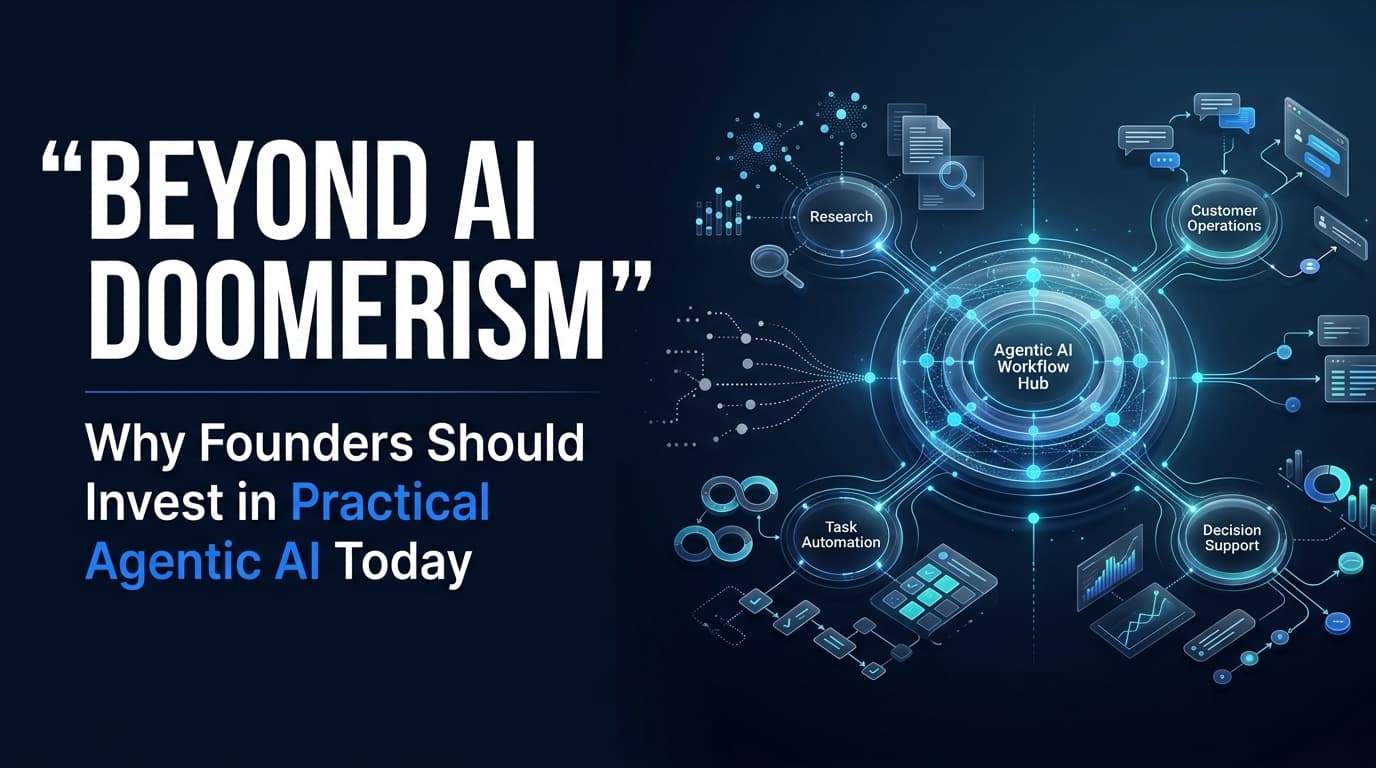
Strip away the hype and agentic AI means goal-directed workflows with tool use—not chatbots. The agent receives an objective, selects from a defined toolset (API calls, database queries, code execution), executes steps, and returns a result or escalates. The high-leverage starting points share three traits: rules-heavy, high-volume, and measurable cycle time.
- Sales qualification: Agent enriches inbound leads with CRM data, scores against ICP criteria, and routes qualified prospects to reps—cutting manual research hours.
- Support triage: Agent classifies tickets, pulls relevant KB articles and past resolutions, proposes draft responses for human review.
- Code review: Agent runs static analysis, checks style guides, flags security patterns, and summarizes diffs for maintainers.
- Data pipeline monitoring: Agent watches for schema drift, volume anomalies, and freshness SLA breaches, then triggers remediation playbooks.
Success metric: measurable cycle-time reduction or revenue lift within 90 days. If you can't define the baseline and the target before writing the first prompt, you're building a demo, not a product.
De-Risking Checklist Before You Deploy
Run this gate before any live traffic. Each item is binary—pass/fail—so the go/no-go decision stays sharp.
- Scope to a single, reversible business process. No cross-domain agents. If the agent touches billing and provisioning, split it.
- Define the kill switch and human-in-the-loop escalation. Explicit conditions: error rate >5%, cost >ceiling, PII detected in logs, unauthorized tool call. Escalation routes to a named on-call engineer with context packet.
- Run shadow mode against historical data. Replay last 30 days of real inputs through the agent. Compare outputs to human decisions. Measure false positive/negative rates, latency, token spend.
- Set explicit cost ceilings and token-budget alerts. Daily/monthly hard limits. Alert at 70% utilization. Agentic loops can spiral spend faster than batch inference.
- Document data lineage and retention for compliance. What PII enters the context window? Where do tool outputs get stored? How long? Map this before legal asks.
This checklist isn't theoretical—it's the difference between a pilot that graduates to production and one that stalls in security review indefinitely.
Infrastructure Reality Check: Compute Efficiency ≠ Lower Demand
Feldman, whose customers include OpenAI, Block, Figma, GSK, and Lovable, offered a hardware-vendor insight that founders routinely miss: "We can do our job as hardware vendors to make our compute more efficient, and then the model makers can do improved work in making their models more efficient to achieve the same goals." The key phrase is "achieve the same goals"—but model makers don't stop there. They use efficiency gains to tackle bigger problems: longer context, more tools, multi-step reasoning, higher reliability targets.
Implication for founders: budget for growing inference costs as agent scope expands. A qualification agent that starts with 500 tokens per run evolves to 5,000 when you add CRM enrichment, competitor intelligence, and personalized outreach drafting. Architect for model-agnostic orchestration (n8n, Make, custom workflow engines) so you can swap backends as price/performance shifts. Lock-in to a single model provider is a strategic liability when the curve bends this fast.
Community & Compliance: The Overlooked Adoption Blockers
Feldman noted the data center industry's failure to engage U.S. communities—"We didn't do what others have done in the power industry in oil and gas"—fueled NIMBY resistance that slowed builds. The parallel for agentic AI is internal: security, legal, ops, and customer-support teams become the "local community" that can stall or kill rollouts if engaged late.
Proactive stakeholder mapping beats reactive firefighting:
- Security: Threat model the agent's tool surface. Pen-test the orchestration layer, not just the model.
- Legal: Define data processing agreements for any third-party APIs the agent calls. Map jurisdiction risks.
- Customer support: They'll own the escalation path. Co-design the handoff UX before launch.
- End users: Run shadow-mode A/B tests with power users. Their trust determines adoption.
Feldman also highlighted countries welcoming AI infrastructure—Brazil, Canada, Finland, Iceland, Norway, Mexico, Sweden—as signals of regulatory tailwinds. Founders operating in or selling to those markets may face smoother compliance paths for agentic deployments involving data residency or cross-border inference.
Your 30-60-90 Day Agentic AI Action Plan
Assign this to a technical lead tomorrow. Each phase has a binary exit criterion.
Day 1–30: Pick, Build, Baseline
- Select one high-friction, rules-heavy workflow (see Section 3).
- Build shadow-mode agent: same inputs, logged outputs, no production side effects.
- Measure baseline: human cycle time, error rate, cost per transaction.
- Exit criterion: Agent runs 1,000+ historical cases with <10% hallucination rate on tool selection.
Day 31–60: Human-in-the-Loop, Iterate
- Add review UI: human approves/edits/rejects each agent output.
- Iterate prompts, tool definitions, and retrieval context based on review feedback.
- Track error rate on shadow data weekly.
- Exit criterion: <5% error rate on shadow data for two consecutive weeks; token spend within 20% of budget.
Day 61–90: Gradual Cutover, ROI Memo
- Enable live traffic at 5%, 25%, 50%, 100% with kill switch monitored.
- Track ROI: hours saved, revenue influenced, customer satisfaction delta.
- Produce board-ready memo: baseline vs. actual, cost per transaction, risk incidents, next candidate workflow.
- Exit criterion: Positive ROI at 90% confidence; zero P0 incidents; stakeholder sign-off for next agent.
This plan avoids the two failure modes: endless R&D with no production path, and reckless launch without guardrails. It also creates a repeatable template—agent #2 starts on day 31, not day 91.
Frequently Asked Questions
How do I choose the first workflow for an agentic AI pilot?
Pick a process that is rules-heavy, high-volume, currently handled by humans following documented playbooks, and has clear success/failure metrics. Sales qualification, support triage, code review, and data pipeline monitoring are common starters because they meet all four criteria and have reversible outcomes.
What's the minimum viable guardrail set for a production agent?
At minimum: a hard token/cost ceiling with alerting, a kill switch that stops all tool calls within seconds, structured logging of every tool invocation and model output, and a named human escalation path with SLA. Anything less makes post-incident analysis impossible.
How do I prevent vendor lock-in when the model landscape shifts quarterly?
Build your orchestration layer (n8n, Make, or custom) to treat models as swappable backends. Standardize on a tool-calling interface (OpenAI function calling schema or equivalent), keep prompts in version-controlled config, and benchmark alternatives monthly. The agent logic stays; the model is a dependency you upgrade like any other.
Founders who treat agentic AI as a governed engineering discipline—not an existential debate—will compound advantage while the noise cycles. The tooling exists. The patterns are proven. The next move is yours.
When you're ready to move from plan to production, Armor Tech's agentic AI system design & build team scopes and ships bounded agentic systems. The 30-60-90 plan often reveals needs for retrieval-augmented context or orchestration—core services Armor Tech delivers through RAG pipelines and AI automation workflows.