Why Generic LLMs Fail at Strategic PR Workflows
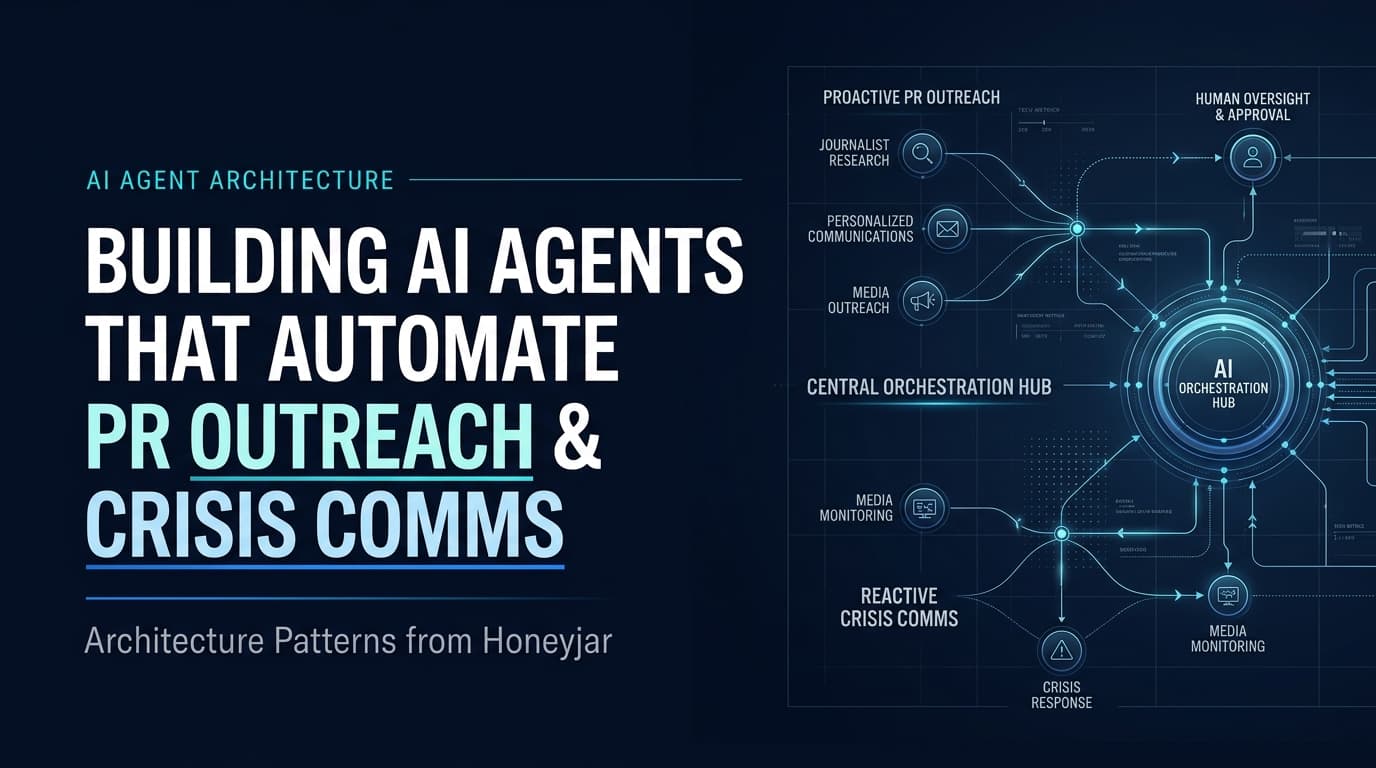
Raw generation covers maybe 20% of a communications workload. The rest—signal detection, context retrieval, strategic judgment, timing decisions, and gated execution—requires architecture that treats PR as a closed-loop control system, not a prompt-response slot machine. Honeyjar's founders frame the work as "signals, context, strategy, judgment, timing, and execution," a definition that maps directly to agent components: perception (monitoring), memory (company goals, voice, reporter history), policy (judgment rules), and actuators (draft → human review → send).
Masek and Jamshidi encoded decades of senior-level judgment rather than shipping templates. That distinction matters: a template fills blanks; a policy evaluates conditions (crisis signal + no prepared statement → escalate; speaking opportunity + founder availability → draft outreach) and produces a refusal when preconditions aren't met ("not ready for coverage"). The horizontal pain they cite—millions of unassigned communicators without formal titles—means the agent must operate with minimal setup, learning voice from existing content and proactively surfacing opportunities rather than waiting for prompts.
Agent Architecture for PR: Memory, Tool Use, and Eval Loops
Memory Layer
The memory system stores retrievable context that persists across interactions: company goals and messaging pillars, founder voice profiles (learned from past blogs, tweets, interviews), journalist relationship maps (beat, contact preferences, past coverage), and historical coverage with outcome labels. This isn't a static knowledge base—it's a RAG corpus updated per engagement, with versioned snapshots so the agent can reference "our Series A announcement voice" versus "current crisis tone."
Tool Orchestration
Honeyjar's described capabilities map to a toolset the agent selects conditionally:
- Media monitoring APIs (Google News, GDELT, specialized feeds) for signal ingestion
- Journalist databases (Muck Rack, Cision, or custom scraped lists) for list building and beat matching
- Social listening (Brandwatch, Talkwalker, or X/LinkedIn APIs) for sentiment and conversation mapping
- Calendar and speaking opportunity feeds (event aggregators, CFP trackers) for proactive outreach
- Coverage tracking (backlink monitors, mention alerts) for closed-loop reporting
The agent doesn't call all tools every turn. A classifier routes the signal: breaking news → monitoring + journalist lookup; speaking deadline → calendar + founder availability check; inbound request → relationship map + historical context pull. This conditional orchestration keeps latency and cost bounded.
Eval Loops: Judgment as Scoring Function
"Judgment" operationalizes as a multi-objective scoring function evaluated before any draft reaches a human. Inputs include: relevance to company goals (0–1), risk level (legal, reputational, timing), journalist fit confidence, voice alignment score, and strategic priority weight. The agent produces a recommended action (draft pitch, hold, escalate, decline) with an attached confidence interval. Human reviewers see the score breakdown, not just the output, creating a feedback signal for the next eval cycle.
Human-in-the-Loop Gate
Honeyjar's explicit design: the agent drafts, the human approves send/publish. This isn't a UX concession—it's a safety architecture. The gate logs every decision (approve, edit, reject) with the agent's original score, creating a labeled dataset for policy improvement. Over time, the confidence threshold for auto-execution rises on low-risk actions (social posts, calendar accepts) while high-risk actions (crisis statements, exclusive pitches) stay gated.
Encoding Judgment: From Comms Lab to Agent Policy
Honeyjar's Comms Lab initiative—training on expert PR pros' decisions—is a concrete pattern for encoding judgment: collect structured decision traces (situation → expert action → rationale → outcome), then distill into conditional policies the agent can evaluate. The trace schema captures:
- Situation vector: signal type, urgency, stakeholder map, available assets
- Expert action: what they did, what they explicitly didn't do, timing decision
- Rationale tags: goal alignment, risk factors, relationship leverage, precedent
- Outcome label: coverage secured, relationship deepened, crisis averted, opportunity passed
From these traces, you derive policies like:
IF crisis_signal AND no_approved_statement THEN escalate_to_legal_leadIF speaking_opportunity AND founder_available AND beat_match > 0.8 THEN draft_outreachIF announcement_ready_score < 0.6 THEN respond "not ready for coverage" WITH gaps_list
The refusal skill—telling a founder they're not ready—is a distinct capability. It requires the agent to evaluate completeness against a checklist (key messages approved, metrics verified, spokesperson briefed, FAQ drafted) and surface specific gaps rather than generating a weak pitch. This negative constraint prevents the "PR slop" problem journalists dread.
Human-in-the-Loop Patterns for Communications Agents
Three patterns keep humans accountable without becoming bottlenecks:
- Draft → Review → Send for all outbound communications. The review surface shows the agent's score breakdown, source citations (journalist beat, past coverage), and editable draft. One-click approve, inline edit, or reject-with-reason.
- Confidence thresholds tiered by risk: auto-execute social posts above 0.9 confidence; escalate crisis responses below 0.95; require explicit approval for exclusive pitches regardless of score.
- Audit trail logging every agent action (tool calls, scores, drafts, human decisions) with timestamps and user IDs. This serves compliance (regulated industries), iterative improvement (fine-tuning data), and stakeholder transparency (board reports).
The audit trail also enables "shadow mode" deployment: the agent runs alongside existing workflows, logging what it would have done, while humans continue manual work. After sufficient comparison data accumulates, you promote specific action types to assisted or auto mode.
Scaling Across Personas: Founder, In-House Team, Agency
One agent architecture serves Honeyjar's horizontal base through persona-specific configuration, not code forks:
| Persona | Memory Config | Tool Access | Approval Flow | Key Differentiator |
|---|---|---|---|---|
| Founder | Minimal setup; voice learned from public content; goals inferred from deck/website | Monitoring, journalist lookup, social listening | Single approver (founder) | Proactive opportunity surfacing; "not ready" guardrails |
| In-House Comms | Brand governance rules; multi-stakeholder messaging matrix; crisis playbooks | Full suite + internal comms channels (Slack, Notion) | Multi-stage: drafter → manager → legal → exec | Coverage tracking dashboards; approval routing |
| Agency | Multi-client isolation; shared reporter relationship graph; template libraries | Full suite + client-specific media lists | Account lead approves; client visibility optional | "Third client without scaling cost" via reusable memory/tool sets |
The agency mode is where compounding value appears: each new client adds to the shared reporter relationship graph (beat changes, preference updates, response patterns) without linear headcount growth. The memory isolation layer ensures client-confidential context never leaks cross-account.
Build vs. Buy: When to Customize a PR Agent Stack
Honeyjar as a product makes sense when you need speed to value, standard workflows cover your use cases, and you lack proprietary data that creates a moat. Customize or build when:
- You have unique crisis playbooks requiring legal/regulatory review chains that off-the-shelf tools can't model
- Proprietary media relationships (exclusive reporter access, private analyst networks) are a competitive asset you won't share with a SaaS vendor
- Regulatory constraints (FINRA, HIPAA, GDPR) mandate data residency and audit controls beyond vendor certifications
- You need to own the eval loops—scoring functions, confidence thresholds, refusal policies—because judgment is your differentiator
A hybrid approach works for many teams: use Honeyjar (or similar) for monitoring, list building, and coverage tracking—commoditized data ingestion—while running a custom agent for judgment-heavy execution (crisis response, exclusive outreach, narrative strategy). The custom agent pulls Honeyjar's structured outputs via API, applies proprietary policy, and gates execution through your approval flows.
Armor Tech's studio model builds exactly this split: agentic AI systems and RAG pipelines for the judgment layer, AI automation workflows (n8n/Make) for the orchestration glue, with eval loops you own and iterate.
Prototype a PR Agent in n8n This Week
A minimal viable agent doesn't require a custom framework. n8n (or Make) handles the orchestration; you supply the policy logic and memory. Here's a starter workflow:
- Trigger: RSS webhook (Google News alert for company name + competitors) or scheduled media monitoring API poll
- Classify: LLM node evaluates relevance (0–1), sentiment, urgency, signal type (crisis, opportunity, noise)
- Route: IF relevance > 0.7 AND urgency > 0.6 → crisis branch; ELSE IF relevance > 0.5 AND type == "opportunity" → outreach branch; ELSE log and exit
- RAG Lookup: Query vector store for company voice, key messages, spokesperson bios, journalist history (pinecone/weaviate/chroma)
- Draft: LLM node with few-shot examples from your approved communications generates response/pitch/statement
- Score: Deterministic function checks completeness (spokesperson named? metrics cited? legal cleared?) + LLM judge scores voice alignment
- Human Gate: Post to Slack/email with draft, score breakdown, source citations. Buttons: Approve, Edit, Reject
- Execute: On approve → send via Gmail/Outlook API or post via LinkedIn/Twitter API; log full trace to Postgres/Supabase
Add the eval loop: each human edit creates a (situation, draft, edit, final) tuple. Weekly, feed new tuples into few-shot examples or fine-tune a small classifier for the relevance/urgency scoring. The RAG schema for comms context includes: voice_samples, key_messages, journalist_profiles, crisis_playbooks, approved_statements, coverage_history.
We've packaged the n8n templates, RAG schema, and starter few-shot sets as an Armor Tech starter kit—deployable in an afternoon, extensible for your specific judgment policies.
Frequently Asked Questions
How do I prevent the agent from hallucinating journalist preferences or beating information?
Ground every journalist claim in the RAG corpus: store verified beat assignments, contact preferences, and past coverage as structured records with source URLs and timestamps. The draft node retrieves only cited records; the scoring function penalizes unsourced assertions. Run a nightly verification job that cross-references journalist moves (masthead changes, beat shifts) via public signals.
What's the minimum viable memory to start seeing value?
Three artifacts: (1) 10–20 voice samples (founder blogs, interviews, tweets) for tone embedding, (2) a one-page messaging matrix (pillars, proof points, forbidden phrases), (3) a journalist list with beat, outlet, and last contact date. The agent can operate on this; enrich incrementally from each engagement's audit trail.
When does fine-tuning beat few-shot prompting for the judgment layer?
When you have 500+ labeled decision traces (situation → expert action → outcome) and the policy space has high-dimensional interactions (e.g., crisis type × stakeholder sentiment × regulatory window × spokesperson availability). Below that threshold, few-shot with curated examples and a deterministic scoring rubric outperforms fine-tuning and stays auditable.
Building a PR agent that earns trust—rather than generating slop—means encoding the judgments your best communicators make implicitly. The architecture isn't novel; the discipline is. If you're ready to prototype a system tailored to your crisis playbook and reporter relationships, book a 30-minute architecture review with Armor Tech.