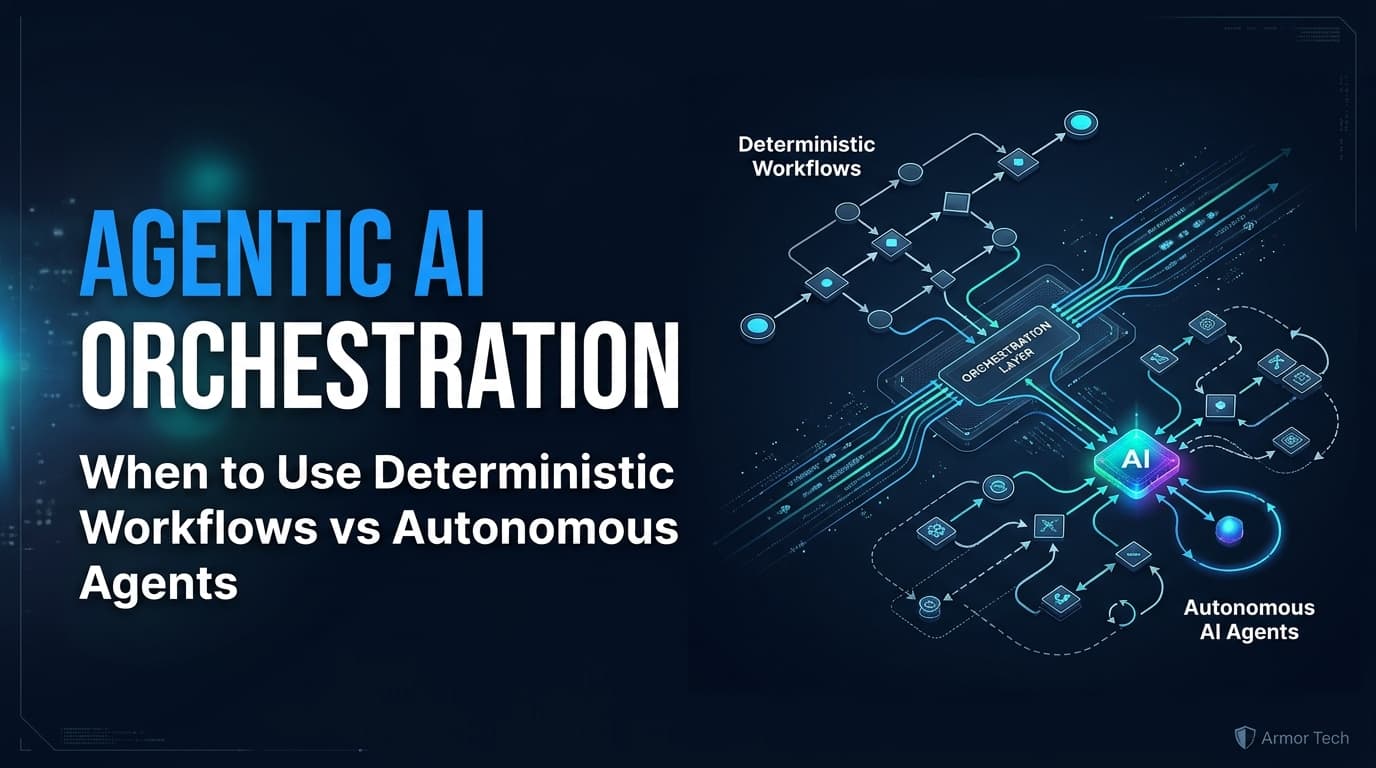
Agentic AI orchestration provides a decision framework for architects selecting between deterministic workflows and autonomous agents. This article outlines the core differences, a practical checklist, code-level patterns, n8n integration, and risk considerations.
Agentic AI vs Deterministic Workflows: Core Differences
Agentic AI enables adaptive decision-making and goal-directed action, allowing the system to modify its steps based on context. Deterministic workflows follow pre-defined logic and fixed sequences, executing each step in a predetermined order. The choice between these approaches depends on task variability, required autonomy, and reliability constraints.
When the underlying process is stable and well understood, deterministic workflows often provide higher predictability. In contrast, tasks that involve ambiguous inputs, evolving objectives, or the need for on‑the‑fly adjustments benefit from agentic AI that can re‑evaluate its plan.
Key distinctions include:
Goal orientation – agentic AI pursues a high‑level objective, while deterministic workflows execute a list of actions.
Flexibility – agents can branch, retry, or invoke external tools, whereas deterministic flows are linear.
State handling – agents maintain internal memory to track progress, while deterministic steps typically rely on explicit data structures passed between steps.
These differences shape the architectural choices described later.
Reliability considerations also influence the decision. Deterministic flows can be made highly available through redundancy, whereas agentic systems must incorporate retry logic and fallback strategies to maintain availability under uncertain conditions.
Error handling – deterministic steps can be designed with explicit exception paths, while agentic agents require programmed retry mechanisms.
Decision Framework: Choosing the Right Orchestration Model
A practical checklist helps architects evaluate which model aligns with project requirements. The following items guide the assessment:
Assess task complexity, state requirements, and failure tolerance. Complex tasks with changing conditions often merit agentic AI, while simple, repeatable steps suit deterministic flows.
Identify latency and throughput constraints for the use case. Deterministic sequences can achieve lower latency when the path is known, whereas agentic loops may introduce additional overhead.
Consider hybrid approaches that combine deterministic scaffolding with agentic loops for incremental autonomy. This balance can deliver reliability while enabling adaptability.
For organizations seeking professional support, the AI Automation Services page offers consulting expertise to design and implement the appropriate model.
Explore real‑world examples in the Case Studies section to see how different architectures have been applied.
Code-Level Orchestration Patterns for Agentic Systems
Implementation patterns determine how agents interact with tools, data, and each other. Selecting the appropriate pattern reduces development effort and improves maintainability.
Three primary patterns are commonly observed:
Tool use pattern – the agent selects and invokes external APIs or functions based on the current goal. This pattern supports dynamic decision making and is suitable for tasks that require external data or services.
Sequential processing pattern – the agent follows a fixed series of steps, each producing output that feeds the next. This pattern works well when the workflow is well‑defined and changes are infrequent.
Adaptive reasoning pattern – the agent continuously evaluates its plan, potentially revisiting earlier steps or introducing new branches. This pattern is appropriate for open‑ended problems where the solution space is not known in advance.
Modular agent design supports iterative refinement from deterministic scaffolds. By separating concerns such as planning, execution, and state management, developers can replace components without disrupting the overall flow.
Effective state management and memory design are critical for multi‑step agent behavior. Persistent storage, short‑term context windows, and versioned memory schemas help maintain consistency across restarts and retries.
To see how these patterns are productized, visit the Agentic AI Product page.
AI Automation Architecture with n8n and Make
Visual workflow editors accelerate prototyping and reduce custom code overhead. Both n8n and Make provide drag‑and‑drop interfaces that map directly to code‑level patterns.
Integration points connect AI agents to APIs, databases, and legacy systems. Triggers based on schedule, webhook, or file arrival enable predictable repeatable tasks, while event‑driven agent loops handle variable inputs.
For enterprise deployments, the AI Automation Services page describes how professional teams can extend n8n workflows with custom nodes, monitoring, and governance features.
Review the Case Studies section to examine how n8n‑powered automations have been combined with AI agents in production environments.
Risk, Reliability & Governance in Orchestrated AI
Observability, audit trails, and human‑in‑the‑loop checkpoints are essential at scale. Logging each agent decision, tool invocation, and data transformation supports troubleshooting and compliance.
Governance frameworks should evolve with agent autonomy levels. Early stages may require strict approval workflows, while later stages can incorporate self‑validation mechanisms.
Failure modes differ between brittle deterministic chains and probabilistic agent behavior. Deterministic failures are often due to missing data or configuration errors, while agent failures may stem from incorrect reasoning or unexpected external responses.
Implementing robust monitoring and alerting reduces downtime and ensures that corrective actions can be taken promptly.
Prototyping Your First Agentic Workflow
Begin with a deterministic scaffold that defines the basic sequence of steps. Once the scaffold is stable, introduce agentic loops to handle variations or decision points.
Measure outcomes and reliability before scaling autonomy. Early metrics such as success rate, latency, and error frequency provide insight into whether additional agency is justified.
Common pitfalls include over‑engineering agency for static tasks and underestimating state management needs. Keeping the initial design simple and iterating based on measurement mitigates these risks.
Ready to experiment? Contact Armor Tech for a consultation or explore the Agentic AI Product to see how the platform can accelerate your prototype.
How Armor Tech Can Help
Armor Tech can help businesses design and implement effective AI orchestration architectures by identifying which processes require deterministic execution and which benefit from autonomous agent capabilities. For predictable, rule-based operations, Armor Tech can develop structured workflows with predefined steps, validation rules, and reliable execution paths. For more dynamic tasks, it can build AI agents capable of reasoning, selecting tools, handling changing inputs, and coordinating multi-step operations. Armor Tech can also integrate both approaches into hybrid architectures, allowing deterministic workflows to manage critical operations while autonomous agents handle tasks requiring flexibility and contextual decision-making. Through API integrations, permission controls, monitoring, error handling, and human approval mechanisms, businesses can maintain control while benefiting from AI-driven automation. The result is an orchestration strategy designed around business requirements, operational risk, reliability, and scalability rather than unnecessary autonomy.
Frequently Asked Questions
What is the difference between agentic AI and deterministic workflows?
Agentic AI operates with a high‑level objective and can modify its plan dynamically, while deterministic workflows follow a fixed sequence of steps that are defined in advance.
When should I choose a hybrid approach?
Hybrid approaches are appropriate when a task has both stable components and variable elements, allowing deterministic parts to provide reliability and agentic parts to handle uncertainty.
How does n8n support agentic AI orchestration?
n8n offers visual nodes that map to tool‑use, sequential, and adaptive patterns, enabling rapid prototyping and integration with external services without extensive custom coding.