Introduction: The Best AI Model Is Not Always the Biggest One
For the past few years, choosing an AI model has largely meant comparing large language models (LLMs). Businesses evaluated models on reasoning, writing quality, coding, context windows, and API costs. The underlying assumption was straightforward: a more capable language model could handle more of the work.
That assumption is becoming less useful as AI systems move from answering questions to making decisions inside production software.
Consider a customer support platform receiving 50,000 messages a day. It needs to identify each customer's intent, assign a priority, route the conversation to the correct team, and determine whether a human should intervene. Most of these tasks do not require a lengthy explanation. They require a dependable decision in a format the application can use immediately.
This is where a different category of AI model enters the picture.
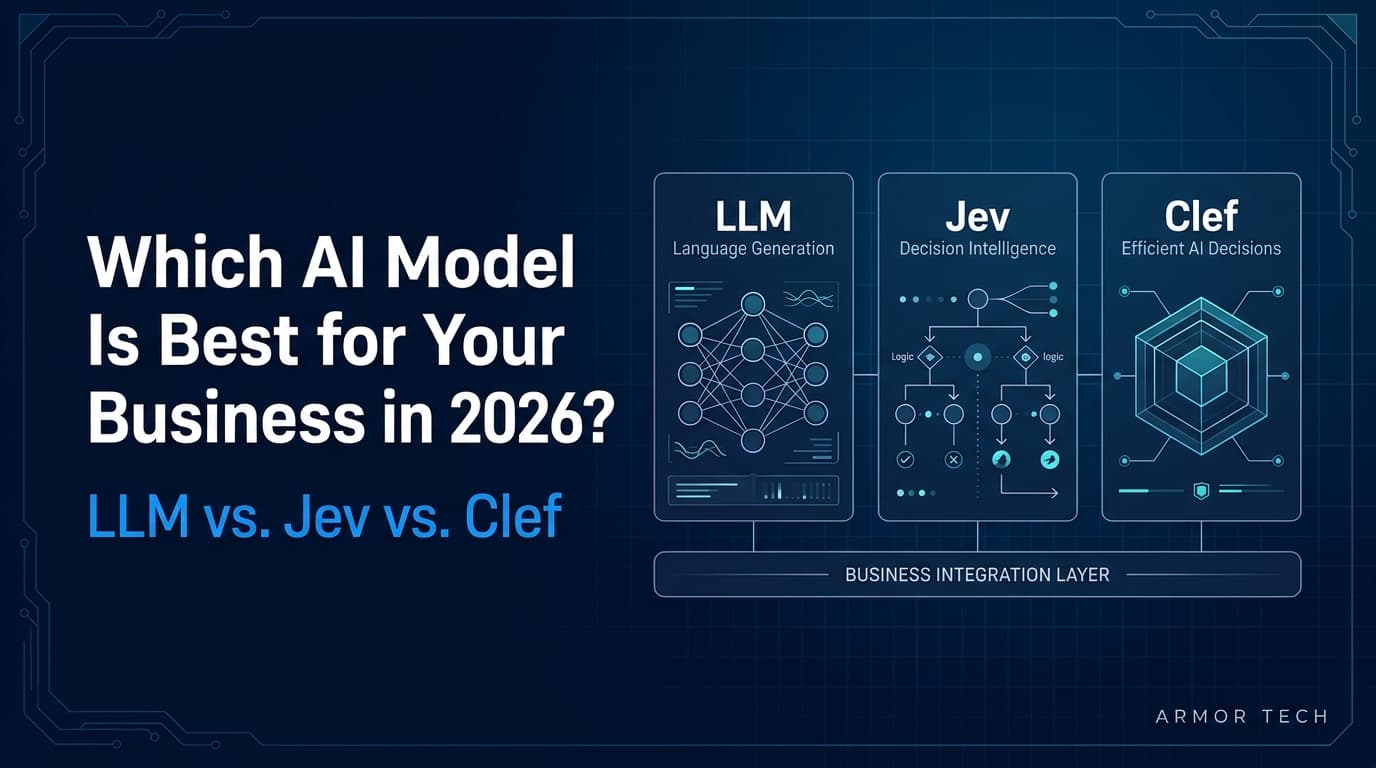
LLMs generate language and can perform a broad range of tasks. Jev, developed by TypeSafe AI, and Clef, developed by Cloudflare, belong to an emerging category of decision models designed to return structured answers to predefined questions.
Cloudflare introduced Clef and Clef-flash on October 1, 2026, positioning them as open-source alternatives in the same general decision-model family as Jev. The announcement also published comparisons across decision benchmarks and latency tests.
The important question is therefore not simply which model wins overall. It is which model is best suited to a particular business problem?
The answer depends on what your application needs to produce, how quickly it must respond, what evidence supports its decisions, and how much control your team needs over the resulting workflow.
1. What Is an LLM, and When Is It the Best Choice?
A large language model is trained to process and generate language. Depending on its architecture, training, and available tools, an LLM can summarize documents, answer questions, write code, extract information, analyze customer feedback, and support multi-step reasoning.
Modern LLM-powered applications can also call external tools, retrieve information from company knowledge bases, and interact with business systems.
This flexibility makes LLMs useful when the desired output cannot be reduced to a small set of predefined answers.
Where LLMs perform best
Content generation and communication
Marketing teams can use LLMs to develop campaign drafts, personalize customer communications, summarize research, and produce first drafts of technical documentation.
Complex questions and synthesis
An LLM can combine information from several documents, identify relationships, explain trade-offs, and prepare an answer in natural language. With retrieval-augmented generation (RAG), it can also use relevant information retrieved from approved knowledge sources.
Software development
LLMs can assist with code generation, debugging, test creation, documentation, and code review. Their usefulness depends on the model, the programming language, the complexity of the task, and the quality of verification.
AI agents
When connected to tools, an LLM can help an agent decide which action to attempt, interpret tool results, and produce a response. The surrounding application must still enforce permissions, validate inputs, and control consequential actions.
The limitations businesses should consider
An LLM's flexibility comes with operational trade-offs.
Output variability: The same task can produce different answers across runs or model versions.
Validation requirements: Even well-written responses can contain factual errors or incorrect classifications.
Latency and cost: Generating a long response can be more expensive and slower than returning a small structured decision.
Integration overhead: Applications may need to validate JSON, handle malformed outputs, retry failures, and enforce business rules.
Structured-output features can make LLM responses easier to integrate, but they do not automatically make every prediction correct or every confidence estimate reliable.
For example, a business may ask an LLM to classify a support ticket as billing, technical support, or sales. It can do this effectively, but the application must still validate the response and decide what happens when the classification is uncertain.
Best fit: Choose an LLM when the task requires language generation, open-ended analysis, document synthesis, coding, or flexible reasoning.
For implementation details, see the OpenAI API documentation and Anthropic's Claude documentation.
2. What Is Jev? Understanding System One Decision Models
Jev is a decision model from TypeSafe AI. Rather than generating a paragraph of text, it receives a state—the information relevant to a decision—and a set of typed questions.
It then returns answers in predefined formats, including choices, scores, and yes-or-no probabilities.
This is the central distinction between a conventional generative LLM and a System One decision model: the application defines the answer space before the model responds.
Imagine an e-commerce platform evaluating an incoming support request.
The application supplies the customer's message and relevant order information. It asks which department should handle the case, how urgently it should be reviewed, and whether the request matches a defined escalation condition.
Instead of generating a free-form explanation for each question, a decision model returns values the application can consume directly.
What makes Jev useful?
1. Structured decisions by design
Jev's documented question types include choice, score, and noul. These allow an application to request a selection from predefined options, a score on a defined scale, or a probability that a statement is true.
2. A more direct application interface
When the answer space is defined in advance, developers can build their routing and decision logic around known output types rather than relying on generated prose.
3. Multiple questions in one request
Jev's documented interface supports asking several typed questions against the same state. This can be useful when a workflow needs several related judgments before proceeding.
4. A decision-focused design
Jev is intended for tasks such as classification, routing, scoring, and other bounded decisions. It is not a general-purpose replacement for a model that writes articles, generates code, or produces conversational responses.
What businesses should know before adopting Jev
Jev is not automatically the best decision model for every workload. Its usefulness depends on how closely the task fits its supported output types and how accurately it performs on the company's own data.
A probability should not be treated as a guarantee. Developers should measure whether confidence estimates are calibrated on representative examples, establish thresholds for uncertain cases, and monitor performance as the underlying data changes.
Teams should also evaluate current API limits, pricing, data handling, availability, and model-version behavior before committing to a production integration.
For reproducible evaluations, Jev's documentation distinguishes between a pinned model identifier and a rolling alias. A pinned version helps keep comparisons stable; a rolling alias can incorporate future changes. Recording the actual model version makes production results easier to investigate.
Best fit: Consider Jev for structured semantic decisions where typed outputs, probability estimates, and a decision-oriented interface are more useful than generated text.
Official reference: Jev model documentation.
3. What Is Clef? Cloudflare's Approach to AI Decision-Making
Clef is Cloudflare's family of decision models, announced alongside Clef-flash in October 2026. Like Jev, Clef takes an input state and typed questions and returns probabilities for the allowed answers instead of producing free-form text.
Cloudflare makes the models available through Workers AI and has released their weights under the Apache 2.0 license on Hugging Face. This creates options for developers who want a hosted integration and for teams interested in inspecting or deploying open model weights under the applicable license.
Clef is particularly interesting for applications where decision latency and the cost of repeated inference matter.
Why Clef stands out
1. Fast inference for frequent decisions
Cloudflare's published benchmark results report a median latency of 209.3 milliseconds for Clef and 38.8 milliseconds for Clef-flash, compared with 524.1 milliseconds for Jev in the company's test setup.
These figures make Clef-flash especially worth evaluating for high-volume, latency-sensitive workloads.
However, latency results are not universal. Hardware, hosting, network conditions, input length, concurrency, and measurement methodology can all affect production performance.
2. Published results across different decision tasks
Cloudflare reports that Clef-family models achieved the highest score on seven of the ten decision benchmarks in its comparison. The announcement includes results for tasks involving tool-use decisions, intent classification, and other predefined-choice problems.
This is meaningful evidence for teams deciding which models to test. It is not proof that Clef will outperform every alternative on every business dataset.
3. Open weights and integration flexibility
Clef's official model card on Hugging Face describes its model architecture, supported inputs, output structure, and Apache 2.0 license. The release provides more visibility into the model than a purely closed API would.
Open weights can give technical teams greater control over deployment and experimentation, although infrastructure, operational expertise, and licensing review remain important.
4. A smaller, faster variant
Clef-flash offers another option for teams balancing speed and decision quality. Cloudflare's results show that its performance varies by benchmark, which is precisely why businesses should evaluate both the full model and the smaller variant rather than assuming one is universally superior.
What are Clef's limitations?
Clef is a decision model, not a complete business automation system.
It does not replace the orchestration layer that connects a model to databases, ticketing platforms, payment systems, or internal applications. Developers still need to implement authentication, authorization, input validation, error handling, logging, and escalation policies.
The model's output also needs to be interpreted in the context of the task. A high probability for a particular option does not establish that the underlying business action is safe or legally authorized.
Best fit: Clef is a strong candidate for fast, repeated, structured decisions, particularly when open weights, Cloudflare's hosting ecosystem, or low-latency inference are priorities.
Official references: Cloudflare's Clef announcement and the Clef model card.
4. LLM vs. Jev vs. Clef: A Practical Comparison
The three approaches solve related but different problems. The table below compares their intended roles rather than treating them as interchangeable products.
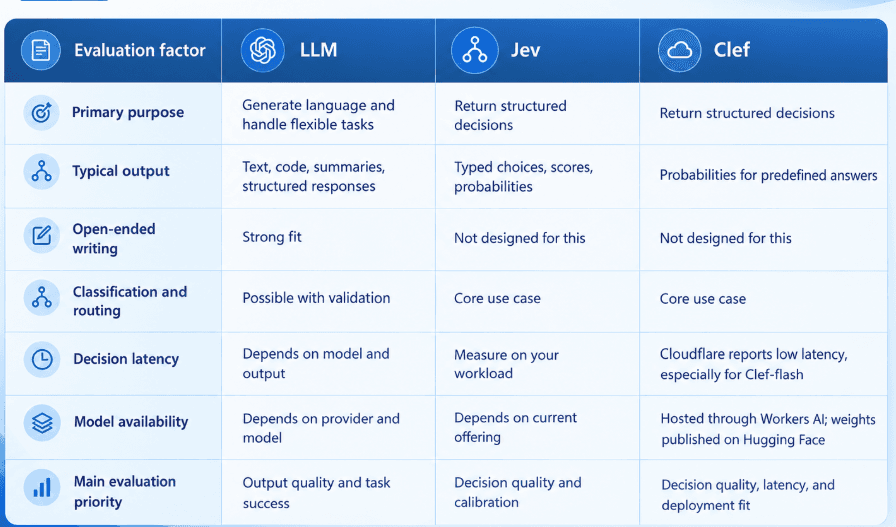
The most important distinction is that an LLM is a broad model category, whereas Jev and Clef are specific decision-model offerings. A fair comparison must therefore specify the LLM being tested, the decision task, the evaluation dataset, and the deployment conditions.
Which is best for business automation?
For writing customer responses, summarizing contracts, producing code, or synthesizing information, an LLM is the natural starting point.
For high-volume ticket classification, routing, and other predefined decisions, Jev and Clef deserve direct evaluation.
Between Jev and Clef, the answer depends on the workload. Clef's published results make it a compelling candidate when latency is critical, while Jev may be a suitable choice for teams already using its decision interface or whose evaluations demonstrate better results with it.
There is no responsible basis for naming a universal winner without considering the specific task, operating cost, reliability requirements, and measured performance.
5. Why the Best Architecture May Combine All Three
Businesses do not necessarily have to choose a single model for an entire application.
A more practical approach is to assign different responsibilities to the models best suited to them.
Consider an AI-powered customer support workflow:
Receive the request. The system retrieves the customer message and relevant account or order information.
Make a structured decision. Jev or Clef classifies the request, estimates urgency, and identifies whether it meets a defined escalation condition.
Apply business rules. The application checks permissions, account status, refund policies, and other constraints.
Use an LLM where language is needed. The LLM drafts a personalized response, summarizes the case, or prepares a handoff for a human agent.
Validate and execute. The application checks the output and only performs authorized actions. Uncertain or sensitive cases are escalated.
Monitor the result. The system records latency, decision outcomes, error rates, costs, and human corrections.
This architecture separates classification from language generation and action execution. It also gives engineering teams a clearer way to measure each component independently.
The same pattern can apply to lead qualification, invoice processing, document intake, security alert triage, and internal knowledge workflows.
The important caveat is that adding more models does not automatically improve a system. Each additional component introduces latency, cost, dependencies, and potential failure points. A hybrid architecture is worthwhile only when its measurable benefits justify that complexity.
Conclusion: Choose the Model That Fits the Job
LLMs, Jev, and Clef represent different approaches to building useful AI systems.
LLMs remain the natural choice for open-ended language generation, coding, synthesis, and flexible reasoning. Jev provides a decision-oriented interface for structured choices, scores, and probabilities. Clef adds another option in this category, with published benchmark results, a fast variant, and open model weights.
For companies building AI agents and workflow automation, the opportunity is not necessarily to replace every LLM with a decision model. It is to stop using a general-purpose generative model for every small task when a narrower interface may be faster, easier to validate, or more economical.
Start with the business requirement, compare models on your own workload, and use the simplest architecture that meets your quality, latency, security, and cost targets.
How Armor Tech Can Help
At Armor Tech, we help businesses explore and implement AI solutions that fit their operational needs from AI-powered workflow automation and intelligent assistants to LLM integrations and agentic systems.
Whether you are evaluating decision models for a high-volume workflow or planning a broader AI automation strategy, the first step is to identify the right use case, establish measurable success criteria, and validate the architecture before scaling.
Explore Armor Tech to discuss how AI automation can support your business.