Why Traditional SecOps Tooling Fails Against Agentic AI Threats
Security operations teams are running signature-based playbooks against opponents that don't follow signatures. Agentic AI systems chain tools, escalate permissions, and mutate their own execution paths in ways that static rules cannot anticipate. The velocity gap is measurable: Pluto Security's CEO reports that newly announced AI tools appear inside enterprise environments within two hours of release. By the time a detection rule ships, the agent has already moved.
The attack surface has shifted from user behavior to agent behavior. Non-developers in finance, marketing, and legal are "vibe-coding" applications—Pluto's telemetry shows roughly 60% of detected risks originate from these business-unit-built tools. A finance employee at a Fortune 500 company built a customer churn application and left it exposed to the internet. Traditional CSPM and EDR tools saw a web server; they missed the context that an autonomous agent had deployed it without security review.
Shadow AI isn't a governance problem—it's a visibility problem. When agents operate through MCP servers, browser extensions, and custom skills, the telemetry streams bypass conventional log sources. Security teams need a context layer that understands agent intent, not just network flows.
Architecture: RAG-Powered Context Layer for Security Agents
The retrieval backbone must fuse heterogeneous knowledge sources into a single queryable corpus. Start with these corpus components:
- Threat intelligence & frameworks: MITRE ATT&CK, CVE databases, vendor advisories—normalized into a common schema with technique IDs as primary keys
- Internal runbooks & policies: Incident response procedures, least-privilege matrices, data classification labels, approval workflows
- Asset & identity graphs: CMDB data, cloud resource inventories, IAM role graphs, service-account mappings
- Agent manifests: Skill definitions, prompt templates, permission scopes, versioned tool registries
- Telemetry streams: Endpoint sensor events (process trees, network connections, file writes), MCP server logs, identity provider audit logs
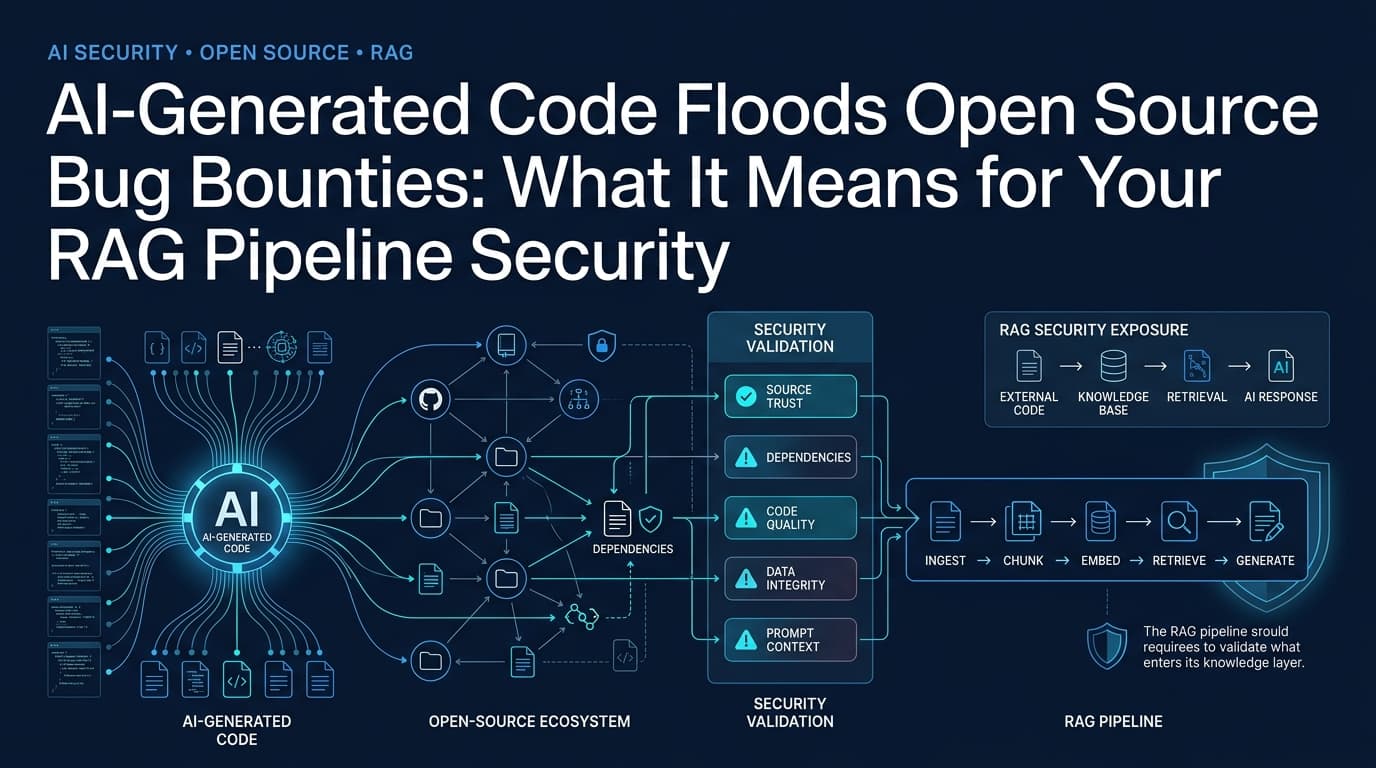
Retrieval strategy: hybrid search combining dense embeddings (for semantic similarity across runbooks and threat reports) with sparse BM25 (for exact technique IDs, CVE numbers, asset tags). Normalize security events into structured documents at ingest—each alert becomes a retrievable unit with extracted entities (host, user, technique, MITRE ID). For teams needing custom retrieval corpus build-out, RAG pipeline development can accelerate the normalization and indexing work.
Freshness is non-negotiable. Incremental indexing pipelines must handle:
- New CVEs and vendor advisories within minutes of publication
- Config drift detections from infrastructure-as-code state files
- Agent skill manifest updates pushed by developers or business units
- Real-time endpoint telemetry buffered in a write-ahead log before vectorization
Agentic Loop: From Alert Ingestion to Autonomous Response
The observe-retrieve-reason-act loop runs continuously. Here's where RAG injects grounding at each step:
Observation: Normalize Telemetry
Pull raw events from endpoint sensors (process execution, DLL loads, network sockets), MCP server request/response logs, and identity provider token exchanges. Enrich each event with asset context (owner, environment, data sensitivity) and identity context (human vs. service account, group memberships, conditional access policies). The agentic AI platform capabilities orchestrate this normalization layer, mapping disparate schemas to a unified event model.
Retrieval-Augmented Reasoning
Given an enriched event, the agent queries the RAG corpus for:
- Matching MITRE techniques and sub-techniques with associated detection logic
- Applicable runbook sections filtered by asset criticality and data classification
- Historical analyst dispositions on similar alert patterns
- Current permission scopes for the acting identity vs. least-privilege baseline
- Blast-radius calculations: downstream dependencies, data stores, interconnected services
The retrieved passages become the context window for the reasoning model. This is where grounded reasoning diverges from raw LLM inference—the model cannot hallucinate a runbook step that doesn't exist in the corpus.
Action Space: Graded Autonomy
Define three tiers of automated action:
| Tier | Actions | Gate |
|---|---|---|
| Safe automation | Ticket enrichment with retrieved context, correlation ID tagging, timeline reconstruction | Always-on |
| Containment | Network quarantine, session termination, token revocation, skill disablement | Policy-as-code allowlist + confidence threshold |
| Remediation | Config rollback, secret rotation, agent version pinning | Human-in-the-loop approval |
Pluto's endpoint models demonstrate live intervention: when an agent attempts permission escalation beyond the user's intent, the system injects context back into the session, prompting the agent to request confirmation. This pattern—real-time context injection—should be a standard capability in the action tier.
Reducing False Positives with Grounded Reasoning
False positives explode when detectors lack context about agent intent. A RAG-backed agent reduces noise by baseline reasoning against three evidence sources:
Intent Baseline via Skill Manifests
Every deployed agent should register a skill manifest: declared tools, required permissions, expected data flows, and prompt templates. At inference time, the retriever pulls the manifest for the acting agent and compares observed behavior against declared intent. An agent calling an undocumented MCP server or requesting a permission not in its manifest triggers a deviation score.
Least-Privilege Cross-Reference at Inference Time
When an agent requests a permission (e.g., "write to S3 bucket X"), the retriever fetches the current least-privilege policy for that identity and resource. If the request exceeds the policy, the agent flags it with the specific policy clause violated. This retrieval happens at inference time—not at deploy time—so config drift is caught immediately.
Case Pattern: Finance-Built App Exposed to Internet
Consider the Pluto-observed case: a finance employee builds a customer churn app and deploys it publicly. A grounded agent's reasoning trace:
- Observation: New public endpoint detected, owner=finance service account, no change ticket
- Retrieval: Asset policy shows finance workloads must be internal-only; runbook section 4.2 requires WAF and auth gateway for external exposure
- Reasoning: Agent manifest (if registered) declares internal-only data access. Observed behavior violates both policy and manifest.
- Action: Tier 1—enrich alert with policy citations. Tier 2—quarantine endpoint pending review. Tier 3—notify finance lead and security owner with exact policy clauses.
Without retrieval, this looks like "new web server." With retrieval, it's "policy violation by unauthorized agent deployment."
Integration Patterns: Embedding Into Existing SecOps Stack
No rip-and-replace. The RAG-backed agent sits as an enrichment and decision layer between detection sources and response targets.
Read Path: Alert Ingestion
- SIEM APIs: Pull correlated alerts from Splunk, Sentinel, or Elastic via scheduled queries or webhook pushes. Normalize to the unified event model.
- EDR/XDR: CrowdStrike, SentinelOne, Defender for Endpoint—subscribe to detection streams via OAuth or API keys. Fetch full process trees and network artifacts on demand.
- OpenTelemetry: Instrument custom collectors for MCP servers, agent orchestrators, and identity providers. Push spans to the normalization pipeline.
- Cloud trail logs: CloudTrail, Audit Logs, Activity Logs—filter for agent-relevant actions (IAM changes, resource deployments, secret access).
Write Path: Response & Audit
- Ticketing: Enrich ServiceNow, Jira, or Linear tickets with retrieved runbook steps, blast-radius diagrams, and confidence scores. Add correlation IDs linking back to the retrieval trace.
- Containment: Push quarantine commands to EDR APIs, revoke tokens via IdP APIs, disable skills via agent orchestrator APIs. Every write action logs the retrieved passages that justified it.
- Audit trail: Immutable log (append-only store, signed) recording: event ID, retrieved passages, reasoning trace, action taken, analyst disposition. This becomes the feedback dataset.
Feedback Loop: Analyst Dispositions Retrain Retrieval
When an analyst marks a ticket "false positive" or "true positive," that label flows back to:
- Retrieval ranking: boost/demote passages for similar future queries
- Agent policy: adjust confidence thresholds for containment actions
- Corpus quality: flag outdated runbook sections or missing MITRE mappings
This closes the loop—analyst time improves the system instead of just clearing a queue.
Governance, Safety, and Rollout Strategy
Trust barriers are legitimate. Address them with three structural controls:
Policy-as-Code Boundaries
Define allow/deny/ask boundaries in version-controlled repositories (Rego, CEL, or YAML policies). Each policy rule references retrievable corpus entries—runbook sections, compliance controls, asset tags. Policy changes go through PR review; the agent reloads policies on merge. No hidden logic in model weights.
Simulation Mode Before Live
Replay the last 30-90 days of historical alerts through the full observe-retrieve-reason-act loop in shadow mode. Measure:
- Precision: of alerts the agent would have auto-contained, what percentage were true positives per analyst disposition?
- Recall: of true positives analysts handled, what percentage would the agent have caught at each confidence threshold?
- Action accuracy: for containment actions, what percentage matched the analyst's actual response?
Only promote to live after simulation metrics meet defined thresholds (e.g., >95% precision on Tier 2 actions).
Explainability: Every Action Cites Sources
No black-box decisions. Every automated action emits a decision record containing:
- The triggering event (normalized)
- Retrieved passage IDs with relevance scores
- The reasoning trace (which passages supported which conclusions)
- Confidence score per action tier
- Policy rule IDs that authorized the action
Analysts can audit any decision in seconds. Regulators get a complete evidence chain.
Measuring Impact: Metrics That Matter for Leadership
Translate technical outcomes into the language of budget renewal:
| Metric | Definition | Target Signal |
|---|---|---|
| Mean Time to Acknowledge (MTTA) | Alert creation → first analyst view OR agent enrichment complete | Delta vs. baseline; agent enrichment should be <2 minutes |
| Mean Time to Respond (MTTR) | Alert creation → containment action complete | Delta vs. baseline; tiered automation should compress Tier 1/2 to minutes |
| Autonomous Handling Rate | Alerts resolved (enriched, contained, or closed) without human touch / total alerts | Increasing trend; target >40% for Tier 1, >15% for Tier 2 |
| False Positive Reduction | (Baseline FP rate - Current FP rate) / Baseline FP rate | Driven by grounded reasoning; track per detection rule |
| Analyst Hours Reclaimed | Baseline analyst minutes per alert × alert volume × (1 - autonomous handling rate) | Direct input to headcount planning |
For a real implementation with measurable MTTR improvement, see this security automation case study.
Frequently Asked Questions
How does RAG prevent the security agent from hallucinating response actions?
The reasoning model only generates actions grounded in retrieved passages. Each candidate action must map to a runbook step, policy rule, or MITRE mitigation present in the corpus. If no supporting passage exists, the agent escalates to human review instead of acting. The retrieval step acts as a hard constraint on the action space.
What's the incremental indexing latency for new CVEs or agent skill updates?
Depends on your pipeline architecture. A practical target: CVE advisories ingested and vectorized within 5-15 minutes of vendor publication; agent skill manifest updates indexed within 1-2 minutes of registry push. This requires a write-ahead log buffering telemetry and a streaming indexer (e.g., Flink, Bytewax, or custom consumer) feeding the vector store. Batch nightly rebuilds are insufficient for agent-speed threats.
Can this architecture work with our existing SIEM and SOAR, or does it require a new platform?
It works as an enrichment layer. The RAG-backed agent reads from SIEM/SOAR via API or OpenTelemetry, writes enriched context back to tickets, and pushes containment actions to EDR/IdP APIs. No data lake migration required. The integration surface is read-path (alert ingestion, telemetry subscription) and write-path (ticket enrichment, containment APIs, audit logging). Start with one detection source and one response target; expand incrementally.
Ready to prototype a RAG-grounded security agent? Book a 30-min architecture review with our team—no slideware, just code and questions.