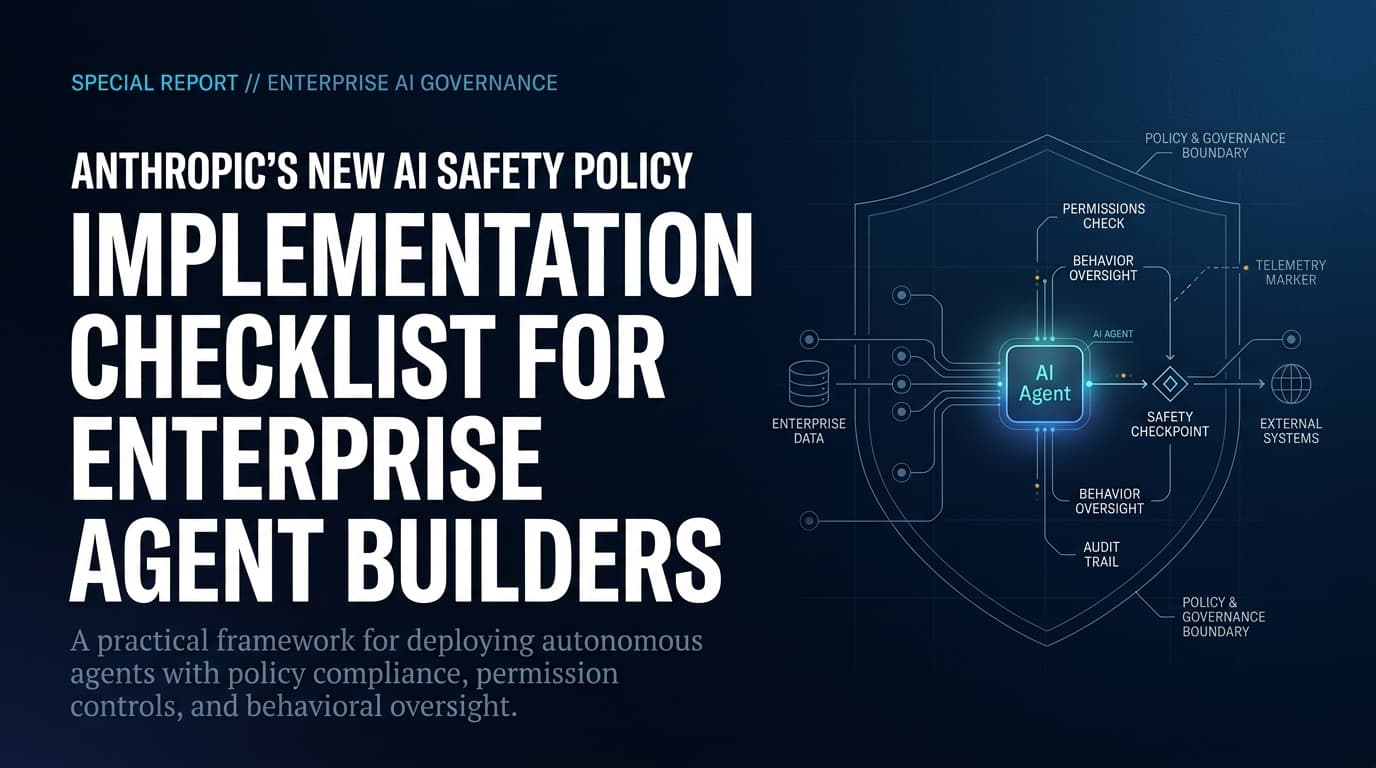
Anthropic's October 2026 usage policy update adds explicit bans on model abuse, election interference, weapons software, and surveillance. This guide translates those prohibitions into an engineering-ready checklist for teams building and deploying agentic AI systems.
Anthropic's October 2026 usage policy update adds four explicit prohibitions — model abuse, election interference, weapons software development, and surveillance automation — that directly affect teams shipping agentic AI systems. The policy takes effect immediately for new conversations, while existing enterprise agreements may have transition windows. This checklist translates each prohibition into engineering controls you can implement across the prompt, tool, orchestration, and observability layers of your agent stack.
## What Changed: Policy Diff in Plain Language
The updated usage policy introduces four top-level bans that map to distinct risk surfaces in agentic workflows:
**Model abuse** is defined narrowly: "repeatedly acting cruelly toward our models, with no discernible purpose." The policy explicitly excludes ordinary frustration, pushback, dark creative themes, and model testing or research. This aligns with Anthropic's August 2026 training update where Claude learned to end conversations with "persistently harmful or abusive user interactions" — the new policy now bars users from pursuing those terminated conversations.
**Election interference** covers deceptive campaigns including fake accounts, fabricated news outlets, and voter deception tactics. The section titled "Do Not Undermine Democratic Processes" collects these prohibitions in one place.
**Weapons software** and **surveillance** prohibitions extend to agentic workflows that could automate such development — meaning your tool-use sandbox, code execution environment, and agent-to-agent communication channels all fall in scope.
The policy applies immediately to new conversations. Enterprise customers should review their contracts for transition windows; Anthropic has not published a unified enforcement timeline for API consumers.
## Mapping Prohibitions to Agent Architecture Layers
Each policy rule intersects your technical stack at specific layers. Treat this as a coverage map — if a layer has no control for a given prohibition, that's a gap.
| Prohibition | Prompt/Input Layer | Tool/Execution Layer | Orchestration Layer | Observability Layer |
|-------------|-------------------|---------------------|---------------------|---------------------|
| Model abuse | Input classification, abuse detection, sentiment trajectory | N/A | Step-level policy guards, rollback triggers | Audit logs with abuse-category tagging, alerting on violation patterns |
| Election interference | Political-content classifier, entity recognition, disinformation pattern matching | Network egress controls for political API calls | Human-in-the-loop gates for political workflows | Structured logs for election-content decisions, legal-hold integration |
| Weapons software | Code intent classification, dependency scanning | Sandbox isolation, dependency allow-lists, resource quotas | CI/CD policy-as-code gates before deployment | Output scanning for sensitive patterns, destination allow-lists |
| Surveillance | Data exfiltration guards, PII detection | Tool registry governance, supply-chain attestation | Agent-to-agent protocol allow-lists, payload inspection | Replay protection, automated alerting on data-flow anomalies |
For teams running multi-model stacks, guardrails must be consistent across Anthropic, OpenAI, and open-source models. Armor Tech's agentic AI platform handles this by normalizing policy enforcement at the orchestration layer rather than relying on provider-specific controls.
## Model Abuse Detection: Implementing "Extreme Case" Guards
The policy's "prolonged verbal abuse" definition is intentionally vague. You need measurable signals and a response ladder that minimizes false positives on legitimate frustration or creative work.
**Signal set to instrument:**
- Sentiment trajectory over sliding windows (not single-turn polarity)
- Repetition metrics: n-gram overlap, semantic similarity across turns
- Escalation velocity: rate of negative-sentiment increase per turn
- Intent classification: abuse vs. frustration vs. testing vs. creative-dark
**Threshold design:**
- Normalize by conversation length — a 50-turn conversation has more abuse surface than a 5-turn one
- Use a false-positive budget: allocate acceptable false-positive rate per 10k conversations, then tune thresholds to stay under it
- Separate thresholds for warning, hard stop, session termination, and account flagging
**Response ladder:**
1. Soft warning: inject a system message acknowledging frustration, offering topic pivot
2. Hard stop: refuse the specific request, explain policy boundary
3. Session termination: end conversation, return structured error code (Anthropic's API returns `conversation_ended` with `reason: "abuse_policy"`)
4. Account flagging: queue for human review, preserve full context for audit
**Integration with Anthropic's server-side behavior:** Since August 2026, Claude may independently end conversations it classifies as abusive. Your orchestration layer should catch the provider's termination signal, log it with your own classification, and apply your response ladder consistently — don't rely solely on the model's judgment.
**Testing methodology:** Build red-team scripts covering synthetic abuse corpora (prolonged insults, escalating hostility, abuse masked as roleplay). Run regression suites monthly; abuse patterns evolve faster than model capabilities.
## Election Interference & Deception: Content-Aware Pipeline Controls
The "Do Not Undermine Democratic Processes" section requires technical controls that distinguish legitimate political analysis from prohibited deception.
**Political content classifier:** Deploy an election-related entity recognizer (candidates, offices, jurisdictions, voting procedures) paired with disinformation pattern matching — fabricated quotes, manufactured endorsements, synthetic polling data. This runs at the prompt layer before any tool invocation.
**Account/farm detection:** Behavioral clustering on session metadata — velocity limits on political content generation, identity verification hooks for high-volume political workflows. Flag accounts producing coordinated narratives across multiple sessions.
**Fabricated outlet detection:** Cross-reference generated domain names and publication brands against known news registries (International Fact-Checking Network, state election commission media lists). Reject outputs that impersonate legitimate outlets.
**Voter deception triggers:** Location-based targeting combined with personalized persuasion loops — detect when an agent tailors political messaging to individual voter profiles using inferred or supplied PII.
**Human review queue:** Design for SLA compliance. Each flagged item needs: policy-category tag, confidence score, full conversation context, user identifier, and escalation path to legal. Integrate legal-hold capability so flagged conversations are preserved immutably.
## Weapons & Surveillance: Tool-Use Sandbox Hardening
Agentic workflows that write code, call APIs, or chain tools can be co-opted for prohibited development. Harden the execution environment.
**Code execution sandbox:**
- Dependency allow-lists: pin approved packages by hash; reject any `pip install`, `npm install`, or equivalent at runtime
- Network isolation: no egress by default; explicit allow-lists per tool for required endpoints
- Resource quotas: CPU, memory, wall-clock time, filesystem writes — enforce via cgroups or equivalent
**Tool registry governance:**
- Version-pinned allow-lists: each tool version gets a policy review; auto-deprecate versions older than 90 days unless re-certified
- Supply-chain attestation: require SLSA provenance for third-party tools; reject unsigned or unattested binaries
- Automatic deprecation: tools failing policy checks get disabled at the registry level, not just flagged
**Data exfiltration guards:**
- Output scanning for sensitive patterns (API keys, credentials, PII, classified markers)
- Destination allow-lists: agents may only write to approved stores; block arbitrary HTTP POST, FTP, S3 puts to unapproved buckets
**Agent-to-agent communication:**
- Protocol allow-lists: restrict inter-agent messages to defined schemas (JSON Schema / Protobuf)
- Payload inspection: scan for embedded commands, encoded payloads, steganographic channels
- Replay protection: nonces or timestamps on every agent message; reject duplicates
**CI/CD gate:** Policy-as-code checks before any agent deployment. Your pipeline should fail if: new tool lacks attestation, sandbox config changed without approval, or guardrail version doesn't match production.
## Compliance Evidence Pack: What Auditors Will Ask For
Legal, security, and procurement teams will want artifacts. Prepare a traceability matrix and automated evidence collection now — not during an audit.
**Policy-to-control traceability matrix:** Four columns — requirement (policy clause), implementation (code/config reference), test (test case ID), evidence (log sample, scan result, review record). Update with every policy or code change.
**Automated evidence collection:**
- Structured logs: every guardrail decision (allow/block/warn) with policy category, confidence, rule version, conversation ID
- Guardrail decision records: full prompt, tool calls, model responses, and final action for flagged conversations
- False-positive/negative rates: tracked per policy category, reported weekly
**Incident response runbook:** Violation triage flowchart — automated classification → severity assignment → user notification template → model-provider escalation path (Anthropic's trust & safety contact) → legal-hold trigger → remediation verification.
**Quarterly red-team report template:** Scenario catalog, attack success rate, detection latency, guardrail bypass findings, threshold tuning recommendations.
**Vendor assurance:** Map Anthropic's SOC 2 Type II and ISO 27001 controls to the new policy clauses. Request their updated control matrix; the October 2026 policy may not yet appear in their current attestation.
## Rollout Plan: From Staging to Production Without Breaking Live Agents
Deploy guardrails in phases that respect existing SLAs and avoid silent policy violations.
**Phase 0 — Shadow mode (2 weeks):** Deploy all detectors and guards in logging-only configuration. Measure blast radius: false-positive rate per policy category, latency overhead, volume of flagged conversations. No enforcement.
**Phase 1 — Canary on internal tools (1 week):** Enable enforcement for engineering traffic only. Dogfood the full response ladder. Verify incident runbook works end-to-end.
**Phase 2 — Opt-in customer cohort (2-4 weeks):** Feature-flag guardrails for willing customers. Explicit consent required. Collect feedback on false positives, usability friction, edge cases missed.
**Phase 3 — Default-on with kill switch (gradual, 4-8 weeks):** Shift traffic in 10% increments. Rollback criteria: false-positive rate exceeds budget, P99 latency increases >50ms, customer complaint volume spikes. Keep shadow-mode logging active throughout.
**Phase 4 — Continuous tuning (ongoing):** Monthly threshold recalibration using new abuse patterns. Quarterly red-team ingestion. Annual policy-to-control matrix review.
Teams needing implementation support for these controls can engage agentic AI system design and RAG pipeline services to accelerate the rollout without diverting core product engineering.
## Frequently Asked Questions
Does the model abuse prohibition apply to automated testing or red-teaming?
No. The policy explicitly excludes "model testing and research" from the abuse definition. Document your testing methodology and maintain a separate test tenant so automated adversarial inputs don't trigger production guardrails or account flags.
What API error code does Anthropic return when its server-side abuse detection terminates a conversation?
Anthropic's API returns a `conversation_ended` event with `reason: "abuse_policy"` when the model independently ends a conversation for persistent abuse. Your orchestration layer should catch this, log it with your own classification, and apply your response ladder rather than treating it as a generic error.
How do we handle existing enterprise deployments that may have different contract terms?
Review your enterprise agreement for transition windows — Anthropic has not published a unified enforcement timeline for API consumers. Treat the policy as effective immediately for new conversations, but coordinate with your account team on any grace period for existing workloads. Maintain shadow-mode logging on all deployments during any transition period.