Why the Ring Form Factor Changes the Agent Equation
A smart ring is not a phone without a screen. It is a continuous-wear sensor platform with a tiny battery, no keyboard, and a single intentional input—press to talk. That constraint rewrites every architectural decision.
Twenty-four-hour wearability (shower, sleep, workout) means the wake-word detector cannot run on the application processor. It must live on a sensor-hub co-processor that draws microamps while the main core sleeps. Press-to-talk replaces hot-word activation, which eliminates false-accepts during conversation but shifts the voice-activity detection (VAD) burden to the press event itself. The ring has zero visual feedback; every error state—misrouted intent, transcription failure, agent timeout—must resolve through audio cues, haptics, or a Live Activity on the paired phone.
The six-to-twelve-day battery claim implies an average current draw around one milliampere from a ~20 mAh cell. That budget forces aggressive duty-cycling: the radio sleeps until a press event, the NPU power domain gates off between inferences, and sensor fusion for health metrics runs on a dedicated low-power block that never wakes the main core.
On-Device Inference: What Actually Fits in a 99-Dollar Ring
The TechCrunch piece notes manufacturing costs comparable to Oura or Samsung Galaxy Ring, which points to a Cortex-M33 or M55 class SoC with 1–2 MB SRAM, 8–16 MB flash, and a tiny NPU or DSP extension. That envelope rules out full automatic speech recognition (ASR) on-device for anything beyond a quantized keyword spotter.
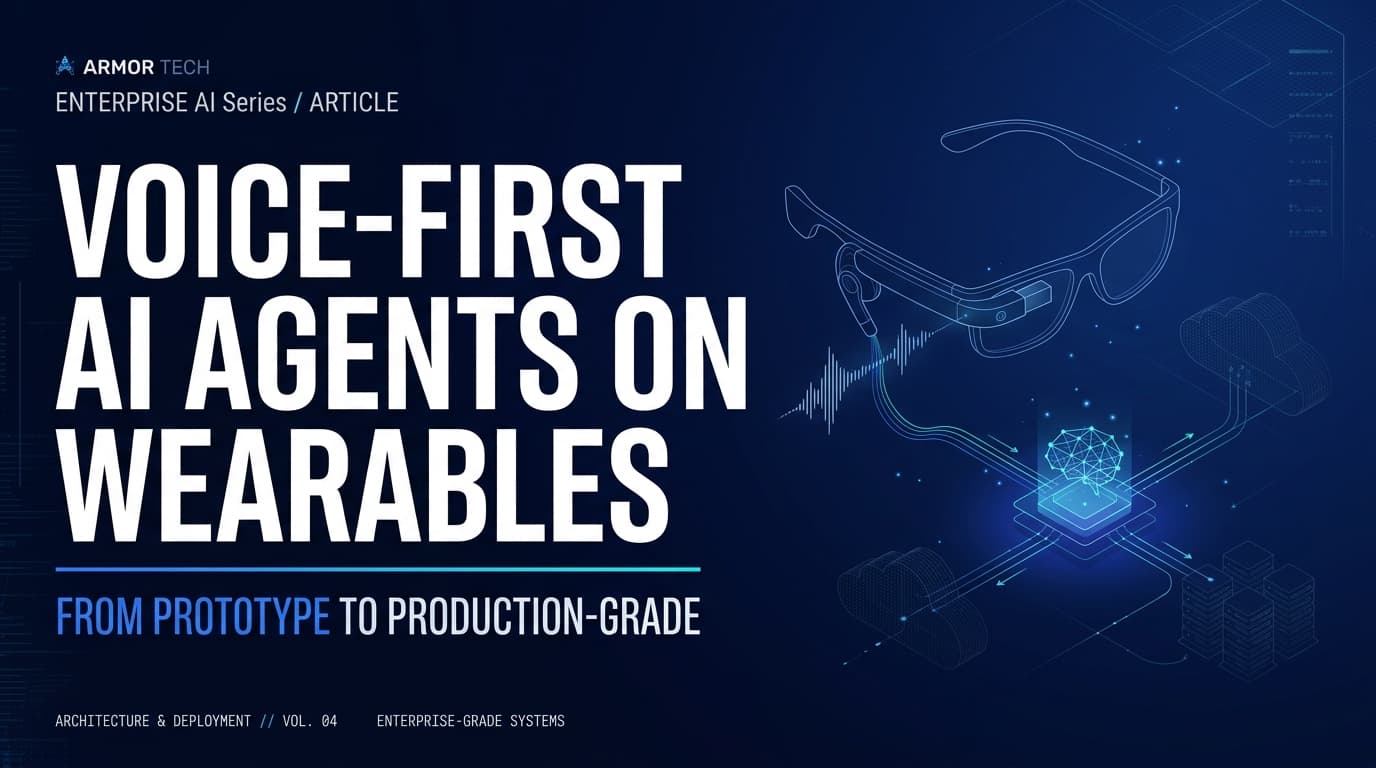
A realistic split: the ring stores a distilled keyword spotter (~200 KB int8) plus a tiny intent classifier (few hundred KB). Press-to-talk means the ring only wakes the heavy ASR path when the user intends to speak. The audio frames (Opus at 16 kHz) stream over BLE 5.3 to the phone, where a quantized Whisper.tiny (39 M parameters, ~40 MB int8) or equivalent runs STT. The LLM call—Claude, Grok, Instinct—hits the cloud from the phone. The ring's job is capture, VAD segmentation, and streaming; the phone handles the compute-heavy stages.
Fallback matters. When the phone is offline, the ring can replay cached skills: timers, offline notes, previously synced calendar reads. This requires an agentic AI systems and edge RAG pipelines approach where the phone pre-caches embeddings and tool manifests during the last sync.
Multi-Agent Routing on the Edge: Orchestrating Claude, Grok, and Instinct
Natura's demo shows users assigning tasks to specific agents—code to Claude, reservations to Instinct, "something else" to Grok. Doing this without a central cloud orchestrator means the routing logic lives on the phone (or ring, if the phone is unreachable).
The architecture looks like an agent manifest registry: each agent publishes a capability schema (intents, required slots, authentication scopes). On press, the local intent classifier produces a ranked list. Routing rules—user-defined preferences, confidence thresholds, recency—pick the winner. If two agents claim the same intent (e.g., both handle "book restaurant"), a deterministic tie-breaker runs: explicit user preference > higher confidence > most recently used > alphabetical.
Conflict resolution must be auditable. The NatureOS app should surface the routing decision ("Sent to Instinct because you set dining → Instinct") and let the user override once, creating a new preference rule. Local fallback when offline means the phone keeps a read-only copy of the manifest and runs the same decision tree against cached skills.
Contextual Memory Without a Screen: Meeting Notes, External Memory, and Recall
Meeting recording on a ring means continuous audio capture triggered by press or calendar event. The ring buffers Opus frames in its 8–16 MB flash (roughly two hours at 16 kbps). On press-to-end or calendar end, the ring streams the buffer to the phone via BLE burst transfer.
The phone runs the heavy RAG pipeline: VAD segmentation → speaker diarization (optional) → chunking → embedding generation (e.g., BGE-small-int8, 33 M params) → vector index update. The ring stores only recent chunk pointers (timestamps, offsets) for quick "what did we decide about pricing?" queries.
Recall flow: user presses, asks "what did Sarah say about the budget?" Ring sends intent + query text to phone. Phone retrieves top-k chunks from local vector store, feeds to a small on-phone LLM (Llama-3.2-1B-int4) for answer synthesis, streams TTS back to headphones. Encryption keys for the voice data never leave the phone; the ring holds only an ephemeral buffer encrypted with a session key negotiated at pair time.
This architecture maps directly to the agentic AI systems and edge RAG pipelines pattern where the wearable is a capture node and the phone is the compute node.
Power-Aware Scheduling: Making 6-12 Days Real with Agents Active
The battery claim only holds if the firmware treats every milliamp as a budget line item. Sensor fusion (PPG for HR/HRV, temperature, accelerometer) runs on the always-on sensor hub—typically a separate Cortex-M0+ core that wakes the main MCU only when a threshold crosses (heart-rate anomaly, fall detect, tap gesture).
BLE 5.3 connection intervals are the hidden lever. Health streaming (1 Hz PPG, 25 Hz accel) uses a 500 ms interval with small packets. Agent traffic is bursty: press → 30-second audio stream → response. The stack should negotiate a short interval (15–30 ms) for the burst, then return to the long interval. Connection subrating (Bluetooth 5.3) lets the phone request low latency only when the user presses.
Compute gating: the NPU power domain stays off until the press interrupt. Warm-boot from retention RAM to first inference should target under 200 ms. The charge case delivering full charge in 100 minutes implies a 1C–2C charge rate on a ~20 mAh cell—standard for this form factor.
Firmware telemetry should log per-subsystem active time (radio, NPU, sensor hub, flash) per charge cycle. That data drives the next OTA optimization.
From Prototype to Production: The Hidden Software Checklist
Shipping a voice-first wearable agent means treating the ring as an embedded Linux-class device without the Linux. The checklist:
- Automated on-device regression. Every firmware build runs a CI pipeline: latency bench (press-to-first-token), word-error-rate on a fixed accent-diverse corpus, battery drain simulation (replay recorded press sequences on hardware-in-loop). Gate merge on regression thresholds.
- OTA strategy. A/B partitions with rollback. Delta updates under 500 KB (BLE throughput ~100 KB/s sustained). Signed images, versioned manifests, staged rollout (1% → 10% → 100%) with automatic pause on crash-rate spike.
- Observability. Anonymized telemetry: wake-word false-accept rate (should be near zero with press-to-talk), agent timeout rate, crash counts, BLE disconnection reasons. No raw audio leaves the device.
- Regulatory. BLE RF certification (FCC, CE, IC, TELEC, SRRC). GDPR/CCPA for voice data: user-initiated deletion, data portability, no training on voice without explicit opt-in. Medical disclaimer for health metrics—this is wellness, not diagnosis.
What Armor Tech Brings to Wearable Agent Projects
The stack described above—edge RAG on phone-class hardware, deterministic multi-agent routing with local fallback, voice-agent tooling tuned for latency budgets, automation glue connecting agent actions to SaaS, calendar, IoT, commerce—is what we build. Our AI voice agent development and automation workflows focus on the integration layer that turns a prototype ring into a product that survives real users, real accents, real battery anxiety, and real regulatory reviews.
Frequently Asked Questions
Can the ring run any ASR fully on-device?
Not at the $99 BOM. The MCU-class SoC in this tier has 1–2 MB SRAM and a small NPU—enough for a quantized keyword spotter or tiny intent classifier, but not for a usable vocabulary ASR. The practical split is press-to-talk capture on the ring, Opus streaming to the phone, and quantized Whisper.tiny or equivalent running on the phone's application processor.
How does multi-agent routing work when the phone has no internet?
The phone caches each agent's capability manifest and a set of offline skills (timers, cached calendar, local notes). The same intent classifier and routing rules run locally. If the chosen agent requires cloud (e.g., Claude for code), the phone queues the request and retries when connectivity returns, notifying the user via haptic or Live Activity.
What happens to meeting recordings if the user loses the ring?
Audio buffers are encrypted with a session key derived from the phone-ring pairing. The ring holds only the most recent recording (flash capacity ~2 hours). Older recordings live on the phone and sync to the user's chosen cloud (iCloud, Google Drive, or Natura's encrypted backend) with keys the user controls. Losing the ring exposes at most the last unsynced session.