Introduction: From Answering Questions to Getting Work Done
The next generation of personal AI assistants is competing on something more meaningful than how well it answers a question: how much work it can complete without requiring constant supervision.
A traditional AI chatbot helps you draft an email, summarize a document, or plan your day. An action-taking AI assistant aims to go further. It can inspect connected apps, organize information, carry out multiple steps, prepare deliverables, and return when a decision requires your attention.
For a business owner, that difference could mean the gap between receiving a suggested follow-up email and having an assistant review the sales pipeline, draft personalized follow-ups, prepare a meeting brief, and leave everything ready for approval.
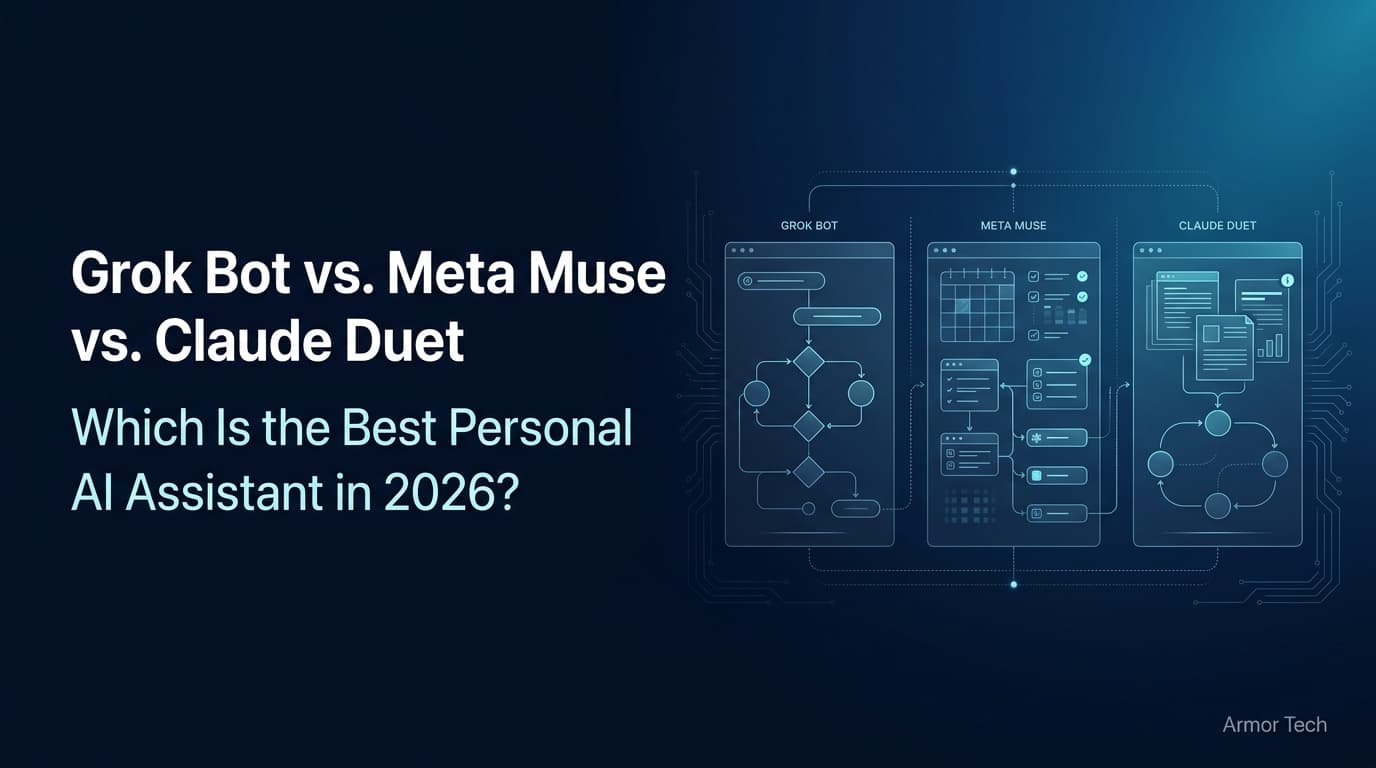
Three products illustrate this shift: Grok Bot from xAI, Muse from Meta, and Claude Duet from Anthropic.
All three are designed to move beyond conventional chat. However, their approaches differ in important ways. Grok Bot emphasizes persistent AI teammates and coordination between bots. Meta Muse focuses on proactive assistance, personal context, and an isolated cloud environment. Claude Duet is built around identifying what deserves your attention and completing work through connected applications.
What Is Grok Bot?
Grok Bot is an AI agent from xAI that allows users to create persistent bots with specific roles, responsibilities, and context.
Instead of starting every task with a blank conversation, you can create a bot for a recurring responsibility and interact with it through messages or voice. According to the official Grok Bot documentation, each bot operates using a persistent cloud computer with a browser, filesystem, and terminal.
This allows it to work across websites and applications, continue tasks when your own computer is closed, and retain relevant context between sessions.
What makes Grok Bot useful?
Persistent AI teammates
You can assign different responsibilities to different bots. For example, one might help research prospective customers, another might prepare a weekly pipeline review, and a third might organize information for internal reports.
The benefit is continuity. A bot can retain its role, relevant files, browser sessions, and learned preferences rather than treating every interaction as an isolated task.
Multi-step task execution
Grok Bot can work across apps and websites to complete a sequence of actions. A sales workflow might involve researching a company, finding relevant information, reviewing a CRM record, and drafting an outreach message.
The system can also ask for approval when an action requires your authorization.
Coordination between bots
One of Grok Bot's distinguishing features is the ability for bots to work in parallel, communicate, and hand tasks to one another.
This could be useful for entrepreneurs managing several workstreams. A research bot could gather account information while another prepares a competitive summary, allowing the main bot to bring the results together.
Reusable workflows
The documentation describes how users can demonstrate a multi-step process and save it as a skill or routine for reuse. This can reduce repeated setup for recurring tasks.
Where Grok Bot has an advantage
Grok Bot is particularly interesting for people who want to delegate work to persistent AI teammates instead of managing every action through a single chat window.
Its combination of computer use, retained context, and bot coordination makes it worth evaluating for research, sales operations, reporting, and repetitive browser-based tasks.
What should you consider before using it?
Persistent access to websites, files, and connected applications requires careful permission management. A bot may encounter a website that blocks automation, an expired login, or a task that requires human intervention.
Its ability to coordinate multiple bots also does not guarantee better results. More parallel work can introduce additional complexity, duplicated effort, and review requirements.
Best for: Users who want persistent AI teammates, reusable workflows, and the ability to delegate multi-step work across applications.
Official source: Grok Bot documentation.
What Is Meta Muse?
Muse is Meta's personal AI agent, designed to understand a user's goals and carry out tasks across connected services.
Rather than limiting itself to conversational answers, Muse can browse the web, fill out forms, manage certain customer-service tasks, prepare documents, and work toward longer-term goals in the background.
Meta describes Muse as an agent that operates through a dedicated cloud virtual machine with its own browser and tools. Users can interact with it through the Muse app or WhatsApp, according to its official product page.
What makes Muse different?
Proactive assistance
Muse is designed to keep track of goals and tasks instead of waiting for a new instruction for every small step.
For example, a user could ask it to monitor a particular goal, organize information related to a project, or suggest the next actions needed to move the work forward.
This approach is useful when the challenge is not just completing a task but maintaining progress over time.
A dedicated cloud environment
Meta's technical explanation of Muse's security architecture describes an isolated virtual machine that separates the agent's working environment from sensitive system components.
The architecture includes controls designed to prevent the agent from directly accessing real credentials and to restrict actions involving external services.
This is a significant design consideration for an assistant that may interact with email, calendars, websites, and other personal accounts.
Action approvals and auditability
Muse uses a separate permission system to govern actions through connected services. Depending on the action and its permissions, it can ask the user for approval before proceeding.
Its product page also describes an activity trail so users can review what the agent has done and what it intends to do.
These controls matter because a capable agent needs more than intelligence. It needs boundaries that determine what it is allowed to do.
Personalized assistance
Muse is designed to adapt to a user's goals and context. It can connect with supported apps and services, track progress, and suggest relevant next steps.
For someone managing both personal responsibilities and a business, this may offer a more goal-oriented experience than a conventional chatbot.
Where Muse has an advantage
Muse is a compelling option for people who want a personal agent that works toward ongoing goals rather than handling only isolated requests.
Its focus on a dedicated working environment, explicit permission controls, and proactive assistance makes it worth considering for personal productivity, web-based tasks, and recurring administrative work.
What are its limitations?
A proactive assistant can still misunderstand a request, misinterpret information, or take an incorrect step. Security controls reduce the consequences of certain failures, but they do not eliminate the need for oversight.
The quality of the experience also depends on supported integrations and the services the user connects.
Best for: Users who want a proactive personal agent that tracks goals, handles web-based tasks, and works across connected services with permission controls.
Official sources: Meta Muse and How Meta built safety into Muse.
What Is Claude Duet?
Claude Duet is Anthropic's proactive personal AI agent, designed to help users manage work that requires attention across multiple applications.
Rather than expecting users to initiate every conversation, Duet can prepare a morning brief, identify important items, work on delegated tasks in the background, and notify users when something needs their input.
Anthropic announced Claude Duet as a research preview on October 21, 2026. The product is designed around Claude Opus 5.5 and is intended for professionals and small business owners who need help managing complex workloads.
Its official announcement describes tasks ranging from scheduling meetings and drafting emails to preparing dashboards, sales forecasts, and web applications.
What makes Claude Duet stand out?
Attention management
Many professionals do not struggle with a lack of information. They struggle with deciding what deserves their attention.
Claude Duet aims to help by reviewing connected information, preparing a morning brief, and highlighting items that may need action.
For a founder, that could mean identifying a meeting conflict, preparing context for a prospective customer, or surfacing an outstanding invoice that needs follow-up.
Business-focused task execution
Duet can work with connected applications to prepare documents, draft communications, and coordinate tasks that involve multiple steps.
Anthropic's announcement describes integrations involving services such as Gmail, Slack, QuickBooks, Stripe, HubSpot, and DocuSign, among others.
The practical advantage is the possibility of moving from scattered information toward a prepared business deliverable without manually switching between every application.
Work that continues in the background
Claude Duet operates through its own cloud computer and can continue working after the user leaves the app.
You can delegate a task and return when it is finished or when a decision is required. This makes it different from a workflow in which every step depends on the user actively prompting the assistant.
Approval before consequential actions
Anthropic says Duet waits for user approval before actions such as sending messages, making payments, signing documents, or deleting information.
The product also includes safeguards intended to protect credentials and reduce the risks of malicious instructions embedded in emails or webpages.
These protections are important for any assistant that reads business communications and can act on their contents.
Where Claude Duet has an advantage
Claude Duet is particularly attractive to professionals who want help deciding what matters, preparing business work, and coordinating tasks across connected apps.
Its focus on attention management and work-oriented tasks makes it a strong candidate for founders, consultants, and small-business operators.
What should you consider before adopting it?
Claude Duet is still a research preview, and its availability is restricted. According to Anthropic's official help documentation, access is currently limited to invited Pro and Max subscribers in the United States. Team and Enterprise plans are not yet included in the preview.
Anthropic also acknowledges that Duet may misjudge urgency or misunderstand a thread. It checks connected accounts at intervals rather than continuously, and its background activity consumes the user's existing Claude usage limits.
For businesses outside the United States, availability is an immediate practical consideration—not a minor detail.
Best for: Professionals and small-business owners who want proactive briefings, connected-app workflows, and delegated work with approval checkpoints.
Official sources: Introducing Claude Duet and Claude Duet Help Center.
Which Assistant Is Best for Different Business Needs?
The most useful comparison is not which assistant has the longest feature list. It is which one best fits the work you want to delegate.
Best for entrepreneurs managing multiple workflows: Grok Bot
Suppose you run a small software company and need to research prospective customers, review pipeline information, prepare weekly reports, and maintain recurring operational routines.
Grok Bot's persistent bots and coordination features make it a logical candidate for a pilot.
You could assign recurring responsibilities to separate bots, define what each should deliver, and review the completed work before using it in production.
Recommendation: Start with Grok Bot if reusable workflows and coordination between AI teammates are your main priorities.
Best for personal productivity and ongoing goals: Meta Muse
Suppose you want an assistant to help organize personal and professional responsibilities, monitor progress toward goals, and carry out web-based tasks.
Muse's emphasis on proactive assistance and personalized context makes it worth testing.
Its security architecture is also relevant when an assistant interacts with connected accounts. However, you should still inspect permissions and establish boundaries around purchases, messages, and other sensitive operations.
Recommendation: Consider Muse if you want an assistant centered on your goals and ongoing personal productivity.
Best for managing business priorities: Claude Duet
Suppose your day involves email, meetings, customer follow-ups, financial administration, and preparing documents for decisions.
Claude Duet's attention-management approach may fit this workflow particularly well. Rather than merely responding to questions, it aims to surface important items and prepare work across connected applications.
The major caveat is access. Its research-preview restrictions mean it may not be available to your team, depending on your location and subscription.
Recommendation: Consider Claude Duet if proactive briefings and business-oriented task execution are your priorities and you can access the preview.
Security and Privacy: What Businesses Should Check
An AI assistant that can read email, browse websites, and interact with business applications introduces a different risk profile from a chatbot that only produces text.
The central question is no longer just whether the assistant can generate a correct answer. It is whether it can take the correct action, using the right information, under the right permissions.
Before adopting any of these products, review five areas.
1. Access permissions
Connect only the accounts and services needed for the task. Avoid granting broad access simply because it makes setup easier.
2. Approval policies
Require human confirmation for payments, external communications, account changes, contract execution, and destructive actions.
3. Sensitive information
Review how the provider handles credentials, business data, retention, and information sent to external services. Do not assume that a dedicated cloud environment automatically satisfies your company's compliance requirements.
4. Prompt injection
An assistant may read malicious instructions embedded in emails, documents, or webpages. Ask how the system isolates untrusted content and prevents it from overriding your instructions or permissions.
5. Auditability and recovery
Check whether you can review actions, identify errors, revoke access, and recover from unintended changes.
Meta and Anthropic have published technical descriptions of their agent safety approaches, while Grok Bot's documentation includes dedicated security and privacy guidance. Those are useful starting points, but product documentation is not a substitute for testing a system against your own security requirements.
For business-critical workflows, begin with low-risk tasks and keep consequential decisions under human control.
Conclusion: Which Is the Best Personal AI Assistant in 2026?
Grok Bot, Meta Muse, and Claude Duet represent three approaches to a common goal: helping people delegate work instead of managing every step themselves.
Grok Bot is the candidate to evaluate for persistent AI teammates and reusable workflows. Meta Muse is worth considering for proactive personal assistance and goal-oriented tasks. Claude Duet is particularly promising for professionals who want help prioritizing business responsibilities and coordinating work across connected apps.
None should be treated as a universal winner. Performance depends on the task, integrations, permissions, access availability, and how much review the workflow requires.
For business owners, the better question is not which assistant has the most impressive demonstration. It is which one reliably saves time on work that matters, without creating more errors or oversight than it removes.
Start with a real workflow, measure the results, and expand only when the evidence supports it.
How Armor Tech Can Help
At Armor Tech, we help businesses explore AI automation, intelligent assistants, and agentic workflows that address real operational needs.
If you are evaluating personal AI agents for research, customer operations, reporting, or internal productivity, we can help identify suitable use cases, design the workflow, and assess where automation adds measurable value.
Explore Armor Tech to learn more about our AI solutions and discuss your automation goals.