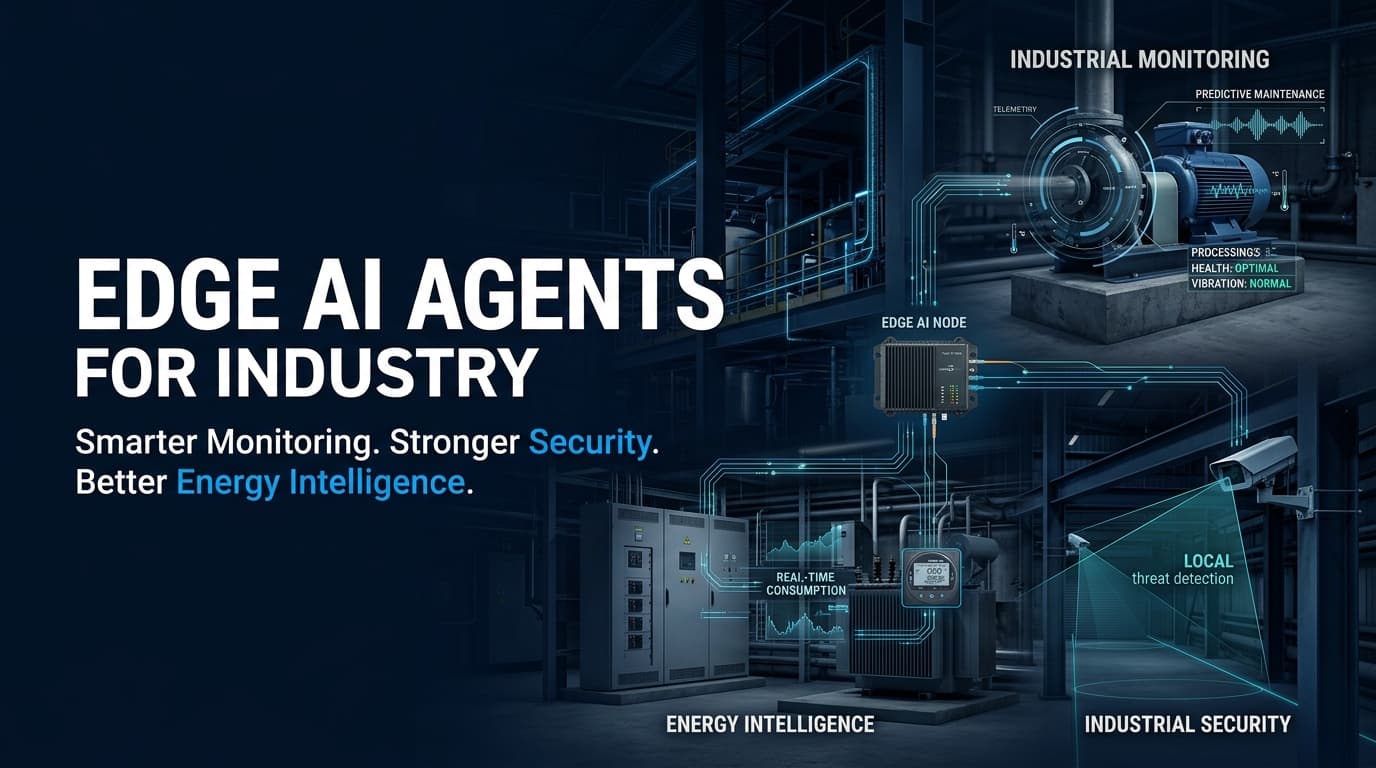
Edge AI agents shift industrial intelligence from centralized clouds to the machines and processes generating data. This matters because operational technology environments demand millisecond responses, operate on constrained bandwidth, and cannot expose proprietary process data to external networks. The following sections break down where these agents fit, how they work, and what mid‑market teams should evaluate before deploying.
Why Edge AI Matters for Industrial Operations
Industrial control systems — PLCs, SCADA, historians, and safety instrumented systems — produce high‑frequency telemetry that cloud round‑trips cannot serve. A vibration sensor sampling at 50 kHz generates megabytes per second per bearing; streaming that to a remote inference service adds latency, consumes costly uplink capacity, and creates a compliance surface for IT/OT segmentation policies. Edge inference keeps the data local, reduces the attack surface, and lets control loops close within the scan cycle of the underlying automation hardware.
Cloud‑centric architectures also struggle with intermittent connectivity. Remote wellheads, mobile equipment, and plants with legacy networking often lose upstream links for minutes or hours. An agent that can classify anomalies, trigger local actuators, and queue summaries for later sync maintains situational awareness during outages. This autonomy is not optional for safety‑critical or regulatory‑driven processes.
Privacy and intellectual property concerns reinforce the edge case. Process recipes, quality signatures, and proprietary control logic leave the facility only when explicitly exported. Running model inference on‑premises — whether on a rugged gateway, an industrial PC, or a module inside the controller — satisfies data‑residency requirements without sacrificing analytical depth.
Core Use Cases: Monitoring, Security, Energy Optimization
Continuous Equipment Monitoring and Anomaly Detection
Traditional condition monitoring relies on threshold alarms and periodic route‑based vibration analysis. Edge agents replace static limits with learned baselines that adapt to operating context — load, speed, recipe, ambient temperature. A convolutional model running on a Jetson Orin can ingest multi‑axis accelerometer streams, extract spectral features in real time, and flag bearing defects weeks before they cross ISO alarm bands. The agent also correlates vibration with current signature analysis from the VFD, reducing false positives caused by process transients.
Deployment pattern: the agent subscribes to OPC UA or MQTT topics published by the historian, maintains a sliding window of normalized features, and writes anomaly scores back to the same namespace. Maintenance planners consume the scores through their existing CMMS integration — no new dashboard required.
OT Cybersecurity with Autonomous Threat Response
Network intrusion detection in OT has traditionally been passive: mirror ports feed a sensor that alerts a SOC. Edge agents extend this by executing predefined response playbooks locally. When a controller receives an unexpected write to a safety‑critical register, the agent can isolate the offending HMI port, revert the register from a known‑good snapshot, and generate a signed audit record — all within the controller’s watchdog window.
The agent’s policy engine runs a lightweight decision tree derived from MITRE ATT&CK for ICS mappings. Rules are version‑controlled alongside PLC logic, so changes go through the same change‑management workflow. This avoids the "shadow IT" problem where security tools operate outside the engineering change process.
Energy Consumption Analysis and Demand Response
Energy optimization at the edge combines real‑time power metering (Modbus TCP, PROFIenergy, or IEEE 1815/DNP3) with production scheduling data. The agent forecasts near‑term demand per cell, compares it against utility tariff signals — critical peak pricing, demand charges, or automated demand response events — and adjusts non‑critical loads: compressor staging, HVAC setbacks, or batch sequencing.
Because the agent holds the process model locally, it can simulate the impact of a load shed before committing. If a 15‑minute curtailment would push a heat‑treat furnace out of spec, the agent rejects the utility signal and logs the rationale. This closed‑loop negotiation is impossible when the optimizer lives in a cloud tenant with 200 ms round‑trip latency.
Agentic AI Architecture: How Edge Agents Operate
Self‑Directed Task Execution via Agentic Loops
An edge agent is not a single model; it is a loop: observe → plan → act → reflect. The observation stage ingests telemetry, logs, and configuration state. Planning uses a small language model (e.g., a quantized Llama‑3‑8B or Phi‑3) fine‑tuned on the facility’s standard operating procedures to propose actions. Actuation writes setpoints, triggers scripts, or publishes commands via the same industrial protocols the control system already speaks. Reflection logs the outcome, updates the agent’s episodic memory, and adjusts confidence scores for future plans.
The loop runs on a deterministic schedule — typically 100 ms to 1 s — synchronized with the slowest control cycle it influences. This cadence prevents the agent from racing the PLC scan and ensures watchdog timers remain valid.
Integration with Retrieval‑Augmented Generation Pipelines
When the planner encounters an unfamiliar fault code, it queries a local vector store containing equipment manuals, past work orders, and vendor bulletins. The retrieval step uses sentence‑transformer embeddings (e.g., all‑MiniLM‑L6‑v2) quantized to INT8 for sub‑millisecond latency on an ARM Cortex‑A78. The generator then produces a ranked list of diagnostic steps with citations back to the source documents. Operators see the same references they would find in the DMS, but surfaced in context.
The knowledge base is updated during scheduled maintenance windows via a signed OTA bundle, ensuring the agent never hallucinates a procedure that contradicts the current revision of the safety manual.
Orchestration Using n8n or Make for Workflow Automation
Cross‑system workflows — ticket creation in Maximo, notification to Teams, parameter push to a historian — are orchestrated outside the agent’s real‑time loop. A lightweight workflow engine (n8n self‑hosted on the same gateway, or Make scenarios triggered by webhook) consumes the agent’s structured event payloads. This separation keeps the agent’s latency budget intact while still connecting to enterprise IT systems that lack deterministic timing guarantees.
Technology Stack: NVIDIA and Schneider Electric Integration
NVIDIA Jetson and GPU Platforms for On‑Device Inference
The Jetson Orin NX 16 GB delivers up to 100 sparse TOPS in a 15 W envelope, sufficient for simultaneous vibration CNN inference, a quantized LLM planner, and the vector search index. For higher density — e.g., a gateway serving 20 cells — the Orin AGX 64 GB or an IGX Orin with functional‑safety certification provides headroom for redundant model ensembles. TensorRT optimization (FP16/INT8 calibration, layer fusion, dynamic batching) reduces per‑inference latency to the low single‑digit millisecond range.
Model deployment uses the Triton Inference Server running in a container managed by Balena or k3s. This gives rolling updates, health checks, and GPU metrics without requiring a full Kubernetes cluster on the shop floor.
Schneider Electric Controllers and Edge Gateways
Schneider’s M580 and M262 PACs expose a native OPC UA server with companion specification support for device identity and alarm conditioning. The Edge Box (formerly ETG) runs Linux on an Intel Atom or ARM SoC and can host the agent containers alongside EcoStruxure Machine Advisor connectors. For brownfield sites, the agent can also read Modbus/TCP maps from legacy Quantum or Premium PLCs through the gateway’s protocol translation layer.
Integration points: the agent writes anomaly tags to the PAC’s %MW memory area using OPC UA write services; the PAC’s logic then drives physical outputs or HMI alarms without custom code. This keeps the safety case clean — the PLC remains the sole authority on actuator commands.
Pre‑Trained Models and Custom Training Pipelines
Foundational models for bearing fault classification, motor current signature analysis, and thermal anomaly detection are available from NVIDIA’s TAO Toolkit and Schneider’s EcoStruxure AI library. Teams fine‑tune these on site‑specific data using a CI/CD pipeline: data ingestion → label studio → PyTorch Lightning training → ONNX export → TensorRT engine build → staged rollout via the container registry. The pipeline runs on a central GPU server but produces engines that execute entirely on the edge device.
Benefits for Mid‑Market Manufacturers
Large enterprises announce platform‑wide AI strategies with multi‑year roadmaps and dedicated data‑science centers. Mid‑market firms — 200 to 2,000 employees, often with one or two automation engineers — cannot wait for those programs to trickle down. Edge agents deliver value in three ways that align with constrained resources.
Lower entry cost: A single Jetson Orin NX gateway, a few vibration sensors, and a containerized agent cost roughly the same as a mid‑range vibration analyzer, but cover continuous monitoring across dozens of assets instead of monthly routes.
Faster time‑to‑value: Pre‑trained models and protocol‑native integration mean the first anomaly scores appear within days of hardware installation, not months after data‑lake construction.
Tailored to niche processes: Whether the plant runs extrusion, batch pharma, or discrete assembly, the agent’s planner adapts by loading the relevant SOP embeddings — no custom software development required.
These advantages compound when the same gateway hosts multiple agents: monitoring, security, and energy optimization share the hardware, the OS hardening baseline, and the OTA update mechanism.
Implementation Roadmap and Considerations
Data Collection and Labeling Strategy
Start with the historian tags that already exist. Export a representative window (e.g., 30 days at 1 Hz for process variables, 10 kHz for vibration) and run an unsupervised clustering pass to identify operating regimes. Label only the regime transitions and known fault events — typically a few hundred labels per asset class. This semi‑supervised approach avoids the labeling burden of fully supervised training while still producing models that generalize across recipes.
Model Selection and Edge‑Optimized Training
Match model complexity to the target hardware’s compute budget. A 1D‑CNN with 200 k parameters fits comfortably on a Jetson Nano for current‑signature analysis; a ResNet‑18 backbone for spectrogram classification needs an Orin NX. Use quantization‑aware training (QAT) from the start — post‑training quantization often degrades F1 by 2–3 points on imbalanced fault classes. Validate on a held‑out set that includes rare operating modes (startup, grade change, emergency stop) to catch distribution shift early.
Security Policies and Compliance Checks
Treat the agent as a safety‑related component if it can influence physical outputs. Apply IEC 62443‑4‑2 SL‑2 requirements: signed firmware, secure boot, encrypted storage for model weights, and role‑based access to the agent’s configuration API. Network segmentation places the gateway in a DMZ between the OT VLAN and the IT VLAN; only the OPC UA client certificates issued by the plant PKI are trusted. Audit logs from the agent feed the same SIEM that collects PAC diagnostics, ensuring a single pane of glass for compliance reporting.
Monitoring, Logging, and Continuous Improvement
Each agent emits structured telemetry: inference latency, confidence distributions, action taken, and outcome labels confirmed by operators. A nightly batch job computes drift metrics (population stability index on feature distributions, prediction entropy) and raises a ticket when drift exceeds a configurable threshold. Model retraining triggers automatically when accumulated labeled data reaches a minimum batch size (e.g., 50 new fault instances). The updated engine is staged, shadow‑tested against live traffic for 48 hours, then promoted via the OTA pipeline — no plant visit required.
How Armor Tech Can Help
Armor Tech helps organizations explore edge AI solutions that connect industrial data, intelligent analytics, and operational workflows. From developing predictive-maintenance applications and local security-monitoring systems to integrating energy analytics and AI-powered alerts, we help businesses turn real-time data into actionable insights. Our approach emphasizes secure system integration, reliable performance, appropriate human oversight, and practical deployment strategies that support operational efficiency without compromising industrial safety.
Frequently Asked Questions
Can edge agents run on existing PLC hardware without adding a gateway?
Most legacy PLCs lack the compute headroom for neural‑network inference. Some newer PACs (e.g., Schneider M262, Siemens S7‑1500 TM NPU) include an AI accelerator, but their toolchains are vendor‑specific and limit model portability. A dedicated edge gateway decouples the inference lifecycle from the controller firmware cycle and supports heterogeneous model zoos.
How do agents handle conflicting objectives — e.g., energy curtailment vs. quality spec?
The planner encodes a constraint hierarchy: safety > quality > energy cost > throughput. When a demand‑response signal arrives, the agent simulates the proposed load shed against the process model. If any hard constraint would be violated, the agent rejects the signal and logs the constraint that blocked it. Operators can override with a signed authorization, which the agent treats as a temporary constraint relaxation with an expiry timestamp.
What happens when the edge gateway loses power or network?
The agent persists its episodic memory and model weights to eMMC with wear‑leveling. On reboot, it performs a secure‑boot attestation, loads the last known‑good engine, and resumes inference from the local sensor buffers. Queued events for upstream systems are replayed once the MQTT broker acknowledges connectivity. This design targets MTTR under 30 seconds for power‑cycle scenarios.
Mid‑market manufacturers don’t need a corporate AI mandate to start. They need a gateway that speaks their protocols, models that respect their compute budget, and an update path that fits their change‑management process. Learn about our Edge AI platform for industrial operations or Explore our AI services and automation solutions to see how a focused deployment can close the gap between OT data and actionable decisions.