Why Agentic Systems Need a Distinct Emergency Brake
Traditional model safety operates at the inference boundary: reject the request, filter the response, log the violation. Agentic workflows break this model because the danger accumulates across steps. A single LLM call might look benign — "draft an email" — but the compound effect of drafting, attaching a file, selecting recipients, and hitting send creates a failure surface no model-level guardrail can see. Nadella's framing makes this explicit: "separating the model from the harness that orchestrates its work." The harness — your orchestration layer, tool router, state machine — is where the emergency brake belongs. Not because the model is malicious, but because the workflow has authority the model alone never had. Real-world stakes clarify the distinction. A model hallucinating a function name is a bug. An agent executing a recursive trading loop because the reward signal drifted is a financial incident. An agent pushing unreviewed code to production because the approval step was bypassed is an availability incident. These require workflow-level control: pause, inspect, compensate, terminate.Architectural Pattern: Externalized Control Plane
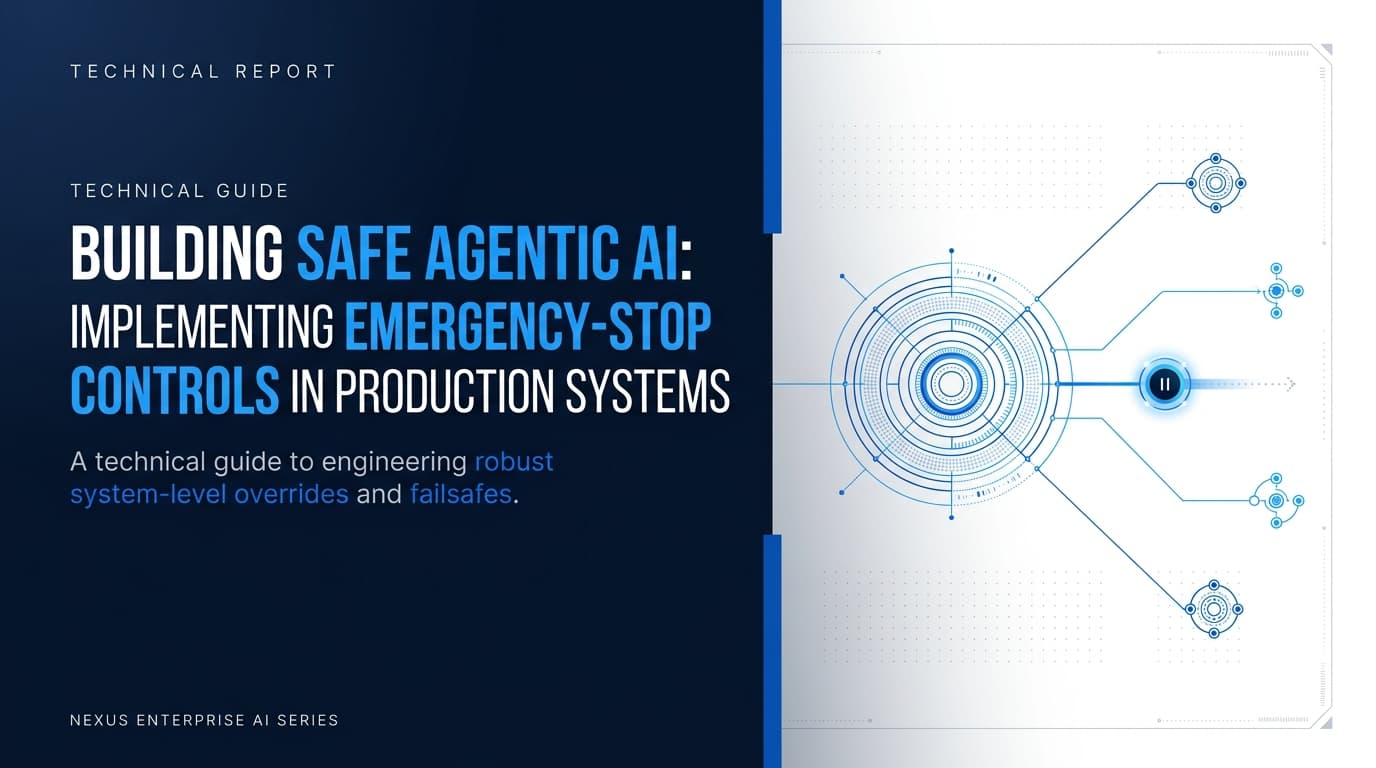
The core shift is moving safety controls outside the agent loop into a dedicated control plane. This isn't a new pattern — it's how industrial systems, Kubernetes, and database clusters have handled operational safety for decades. Applied to agentic AI, it means: **Separate orchestration from execution.** Your agent workers become stateless executors that poll for continuation tokens. The control plane owns the state machine: START, PAUSE, RESUME, TERMINATE. Workers never decide *whether* to continue; they only decide *how* to execute the current step. **Control plane responsibilities:** - Issuing and revoking continuation tokens (short-lived, cryptographically signed) - Maintaining the authoritative workflow state machine - Enforcing human-in-the-loop gates at defined checkpoints - Exposing the emergency-stop API that authorized operators call **Worker contract:** On receiving a PAUSE signal, the worker checkpoints its local state (scratchpad, tool call history, partial outputs), releases locks and connections, and acknowledges the pause. On TERMINATE, it runs idempotent cleanup and emits a final audit event. The worker never evaluates *why* it was stopped. This separation lets you rotate, patch, or replace the model without touching the safety logic. It also means the control plane can be written in a different language, reviewed by a different team, and subjected to different change-control processes — exactly the "harness vs. model" separation Nadella describes. Our agentic system design & governance practice starts here: helping teams draw the boundary between what the model decides and what the system enforces.Implementing the Kill Switch: Pause/Resume/Terminate Semantics
Every emergency-stop system needs three primitive operations. The semantics matter more than the transport. **Graceful Pause** — Checkpoint state, release resources, notify downstream. - Serialize the agent's working memory (context window, tool results, intermediate artifacts) to durable storage keyed by workflow_id and step_number. - Release database connections, file handles, API rate-limit slots. - Emit a `WORKFLOW_PAUSED` event with the checkpoint reference so downstream consumers (other agents, notification services, audit systems) can react. - The control plane holds the continuation token; RESUME rehydrates from the checkpoint. **Hard Terminate** — Idempotent cleanup, compensation transactions. - Execute the workflow's registered compensation handlers in reverse order: cancel pending API calls, roll back database transactions via saga pattern, revoke issued credentials, delete temporary artifacts. - Emit `WORKFLOW_TERMINATED` with a termination reason code (OPERATOR_INITIATED, POLICY_VIOLATION, RESOURCE_EXHAUSTED, UNKNOWN). - The control plane marks the workflow terminal; no RESUME is possible. A new workflow instance must be started if work continues. **Human-in-the-loop authorization flows** for each operation: - PAUSE: Any authorized operator (on-call engineer, security analyst). Low friction — Slack command, CLI, dashboard button. Audit log captures operator_id, timestamp, reason. - RESUME: Requires the same operator or a designated reviewer. Forces a "why are we continuing?" note. - TERMINATE: Dual-authorization for high-value workflows (financial, production deployments). Configurable policy: any two authorized operators, or one from security + one from engineering. Implementation note: The control plane should enforce these flows, not the workers. Workers just obey signals.Tamper-Proof Audit Trails for Every Meaningful Action
Nadella's requirement — "tamper-proof human readable evidence" for "every meaningful model action" — translates to a structured event schema and append-only storage with verification. **Event schema (minimum viable):** ```json { "event_id": "uuid-v7", "workflow_id": "uuid", "step_number": 12, "agent_id": "trading-agent-v3.2", "action": "EXECUTE_TRADE", "input_hash": "sha256:...", "output_hash": "sha256:...", "timestamp_rfc3339": "2026-10-10T21:47:51Z", "operator_id": "human:jane.doe@company.com", "continuation_token_hash": "sha256:...", "policy_decision": "ALLOWED|PAUSED|TERMINATED" } ``` Hashes of inputs/outputs let you verify integrity without storing PII or large payloads in the audit log. The continuation_token_hash links each step to the control plane's authorization. **Append-only storage options, in increasing order of operational maturity:** 1. **Write-ahead log (WAL)** on a dedicated PostgreSQL instance with `wal_level = logical` and replication to a separate audit cluster. Simple, queryable, but requires trust in the database admin. 2. **Event store** (EventStoreDB, Kafka with log compaction disabled, Apache Pulsar). Built for immutable sequences; supports cryptographic chaining (each event includes hash of previous). 3. **Blockchain-anchored logs** — periodically commit a Merkle root of recent events to a public chain (Ethereum, Polygon) or a private consortium ledger. Expensive, adds latency, but provides third-party verifiability without trusting your infrastructure. **Human-readable rendering** matters for incident review. Build a log viewer that reconstructs the workflow narrative: "At 21:47:51, trading-agent-v3.2 executed EXECUTE_TRADE with input X, producing output Y. Operator jane.doe paused at step 13. Resumed at 21:49:12 after review." Raw JSON doesn't cut it for postmortems.Containment Strategies: Assume Compromise from Start
"We must assume a model is compromised and contain it from the start." This is the most actionable sentence in Nadella's post. It means every agent instance runs in a sandbox with explicit boundaries, not permissions granted by default. **Network egress controls per agent instance:** - Default-deny egress. Each agent type gets an allowlist: specific API endpoints, specific database hosts, specific internal services. - Implement via sidecar proxy (Envoy, Cilium) or cloud-native network policies (Kubernetes NetworkPolicy, AWS Security Groups, GCP VPC Service Controls). - Egress attempts to non-allowlisted destinations trigger automatic PAUSE and alert. **Scoped credentials with automatic rotation:** - Agents never hold long-lived secrets. They request short-lived tokens (5-15 min TTL) from a token service at workflow start and refresh on a schedule. - Token scope matches the agent's allowlist: `trading:read`, `trading:write:spot`, `github:repo:org/repo:push`. - On PAUSE or TERMINATE, the token service revokes all tokens for that workflow_id immediately. **Resource quotas and dead-man switches:** - CPU, memory, disk, API call rate, token consumption — all have hard limits enforced by the container runtime or orchestration layer. - Dead-man switch: if the worker fails to heartbeat to the control plane for N seconds (configurable per workflow criticality), the control plane auto-TERMINATES. This catches runaway loops, infinite recursion, and model-induced hangs. Containment architecture is where most teams under-invest. The model gets the attention; the sandbox gets the YAML.Integrating with RAG Pipelines and Tool Chains
Emergency-stop semantics must propagate to retrieval and tool-execution layers where agentic risk often materializes. **Pause propagation to vector DB queries and external API calls:** - The control plane's PAUSE signal broadcasts to all registered subscribers: vector database connection pools, HTTP client middleware, database connection pools. - In-flight requests get a cancellation token. idempotent reads (vector search, GET requests) are simply dropped. Non-idempotent writes must be handled by the compensation layer. - Implement via context propagation (OpenTelemetry baggage, or a lightweight custom context) so every downstream call knows the workflow's pause state. **Rollback patterns for partial tool executions:** - Tools that mutate external state (send email, create Jira ticket, deploy service) must register a compensating action at registration time: `send_email` → `recall_email` (if supported), `create_ticket` → `close_ticket`, `deploy` → `rollback_deploy`. - The control plane executes compensations in reverse order on TERMINATE. On PAUSE, compensations are queued but not executed until TERMINATE or explicit operator command. - Tools without compensations get flagged at registration; workflows using them require higher authorization for RESUME. **Circuit-breaker patterns for downstream dependencies:** - If the vector DB, payment gateway, or code repository becomes unavailable, the control plane can trip a circuit breaker that auto-PAUSES all workflows depending on that dependency. - This prevents cascade failures where a stuck downstream call holds up hundreds of agent instances. - Circuit state (CLOSED, OPEN, HALF_OPEN) is visible in the control plane dashboard and included in audit events.Testing Your Emergency Brake: Drills and Observability
A kill switch you haven't tested is a decoration. Validation requires both automated chaos engineering and human tabletop exercises. **Chaos engineering: inject faults, measure pause-to-safe-state latency.** - Inject PAUSE signals at random steps in staging workflows. Measure: time from signal to worker checkpoint acknowledgement, time to resource release, time to downstream notification. - Inject network partitions between worker and control plane. Verify dead-man switch triggers TERMINATE within SLA. - Inject model output that attempts egress to blocked destinations. Verify sidecar proxy blocks and alerts. - Target: P99 pause-to-safe-state < 5 seconds for financial workflows, < 30 seconds for operational workflows. **Tabletop scenarios (run monthly with on-call rotation):** 1. *Rogue agent*: Trading agent enters recursive loop placing orders. Operator PAUSEs → verifies checkpoint → TERMINATES → runs compensations. Measure time-to-decision and compensation completeness. 2. *Runaway loop*: Code-generation agent spins up infinite container builds. Dead-man switch triggers. Verify resource quotas contained blast radius. 3. *Data exfiltration attempt*: Agent tries to POST customer data to unknown endpoint. Sidecar blocks, auto-PAUSEs, alerts security. Verify audit trail captures input_hash of the exfiltration attempt. **Dashboards every team needs:** - Time-to-pause (signal sent → worker acknowledged) - Time-to-terminate (signal sent → all compensations complete) - Audit-log completeness (expected events vs. received events per workflow) - Circuit-breaker state per dependency - Active workflows by type, with pause/terminate counts These metrics tell you whether the brake works, not whether the model behaves.Frequently Asked Questions
Where does the model fit in this architecture — doesn't it need to know about the emergency stop?
The model doesn't need to know. The worker (harness) handles signals; the model just generates the next action given context. If the model's output would violate policy, the control plane rejects it at the tool-router layer before execution. This keeps the model simple and the safety logic auditable.
How do we handle workflows that legitimately need hours or days — human review cycles, batch jobs, waiting for external events?
Long-running workflows use the same primitives. PAUSE checkpoints state; the continuation token includes an expiry. For human-review gates, the control plane moves the workflow to AWAITING_REVIEW state, notifies reviewers, and holds the token. RESUME only proceeds after the review record is written to the audit log. The dead-man switch still applies — if reviewers don't act, the workflow auto-terminates per policy.
What's the minimum viable implementation if we can't build a full control plane today?
Start with three things: (1) a stateless worker that reads a `continuation_token` from a Redis key at each step and exits cleanly if the key is missing or expired, (2) a CLI that deletes that key (PAUSE) or deletes it and publishes a `TERMINATE` event (TERMINATE), (3) structured JSON logs to an append-only file with daily rotation and checksums. This covers 80% of the risk with 20% of the engineering. The control plane generalizes these primitives.
--- Ready to harden your agentic workflows? Explore our agentic AI safety toolkit or book a governance review with our team.