Why Messaging-Native Agents Are the New Interface for Founders
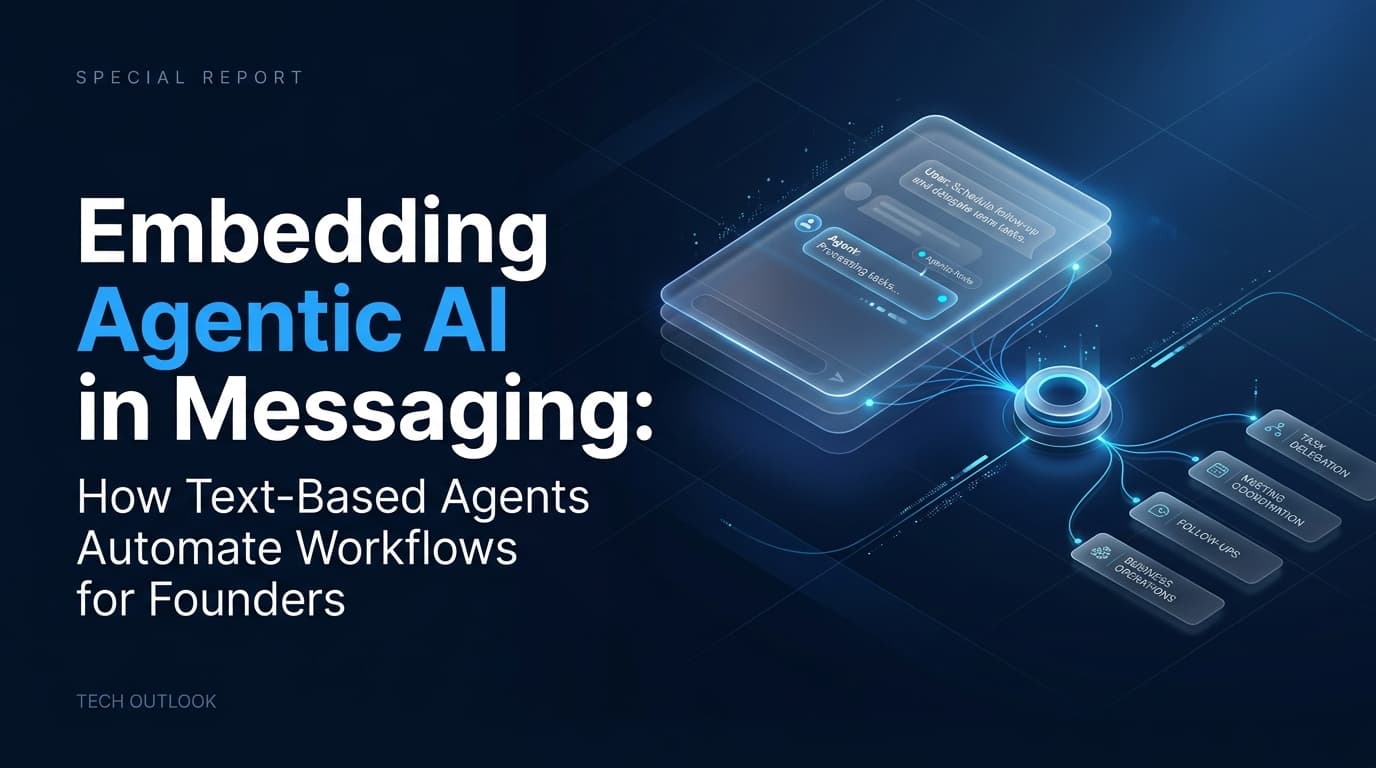
The core value proposition is straightforward: the agent resides where you already communicate. You text a request—“schedule that investor call,” “research the competitor pricing page,” “cancel the unused subscription”—and the agent retains context, reaches into connected services (Google Workspace, calendars, Gmail, Slack, Instagram), and executes write actions: calendar creates, email sends, purchases, phone calls, even code execution. This contrasts with traditional SaaS dashboards that require a separate login, and chatbot widgets that remain read-only or single-turn. For a founder, the friction reduction is measurable: fewer context switches, persistent memory across days, and the ability to delegate while standing in line for coffee.
The research cites founder-relevant tasks explicitly: scheduling, research, email triage, reservations, follow-ups. Yet the agent roster reveals a mismatch. General-purpose assistants (Caddy, Comma, Folk, Instinct, Iris, Martin, Poke, Rene, Tab) optimize for personal life. Family-focused agents (Fambot, Ohai, Ollie, Orbits, Tomo) coordinate households. Travel (Miso), content (Stanley), and proactive homescreen (Skye) agents specialize further. Only Town (“learns how you work, handles recurring professional tasks”) and Szn (“coordinate tasks and follow-ups through a single conversation thread”) position for professional use—and the evidence for B2B impact is thin.
Taxonomy of Text-Resident Agents: Personal, Family, Professional, Niche
Mapping the 20+ agents into decision-relevant categories clarifies where each fits a founder’s stack:
- General-purpose personal: Caddy (iMessage/RCS, public beta since April 2026), Comma (Signal, Telegram, WeChat, open source, free), Folk (iMessage, WhatsApp, Telegram, private cloud, code execution, $8.33/mo Pro), Instinct (text/voice, dedicated email addresses, call rolling, private beta, $1B Series C at $10B valuation per TechCrunch), Iris (iMessage, Hermes Agent), Martin (SMS, WhatsApp, email, Slack, iOS app, $21/mo), Poke (iMessage, Apple Messages for Business approved June 2026, acquired by Cognition July 2026), Rene (iMessage, Telegram, WhatsApp, browser, code, slides, images), Tab (iMessage, WhatsApp, emerged from stealth October 2026 at $300M valuation).
- Family/household: Fambot (SMS, app, web, Gmail/Calendar/Outlook/WhatsApp, $3.5M pre-seed, free beta), Ohai (messages, email forward, voice, free tier, $9.99/mo+), Ollie (SOC 2 compliant, free tier, $25/mo for 150 msgs, $100/mo for 1,000), Orbits (app + text, web search, purchases, bookings, a16z Speedrun), Tomo (iMessage, group conversations, $19.99/mo).
- Travel-specialized: Miso (iMessage, AI planning + human travel team, loyalty points).
- Content-creator: Stanley (iMessage, Telegram, web, Instagram context, voice-to-script, content calendar).
- Professional/B2B-leaning: Town (email, calendars, docs, Slack, $55M Series A led by a16z/Forerunner June 2026), Szn (single thread, calls, emails, follow-ups, claims 7,500 businesses/16 countries/10,000 jobs/95 call hours per company website).
- Privacy-first/on-device: Underdog (Mac/Windows, fully local, open-source intent, invite-only beta October 2026, free, no ads planned).
- Proactive homescreen: Skye (iPhone homescreen cards, audio briefings, $3.6M seed 2025, private beta April 2026).
Integration Depth Checklist: What “Connects to Your Apps” Actually Means
Marketing pages list “integrations.” Technical evaluation requires distinguishing read-only access from write capability, and platform coverage from protocol support. Use this rubric when assessing any agent:
| Dimension | What to Verify | Signals in Research |
|---|---|---|
| Messaging protocols | iMessage, RCS, WhatsApp, Telegram, Signal, SMS, Slack, email gateway | Caddy (iMessage/RCS), Comma (Signal/Telegram/WeChat), Folk (iMessage/WhatsApp/Telegram), Martin (SMS/WhatsApp/email/Slack), Rene (iMessage/Telegram/WhatsApp), Tab (iMessage/WhatsApp), Poke (Apple Messages for Business) |
| App/service connectors | Google Workspace (Calendar, Gmail, Drive), Outlook, Slack, Instagram, custom APIs | Instinct (email, calendar, Google Workspace), Fambot (Gmail, Calendar, Outlook, WhatsApp), Pally (WhatsApp, Gmail, Calendar, Drive), Town (email, calendars, docs, Slack), Szn (email, calls), Stanley (Instagram) |
| Action types | Read-only vs. write: calendar create, email send, purchase, call, code execution | Folk (private cloud, runs code, multi-step tasks), Rene (browser, code, shop, slides), Instinct (dedicated email for signups, calls), Comma (cross-device task completion), Poke (smart-home, photos), Orbits (purchases, bookings, quotes) |
| Cross-device context | Memory persistence across phone, desktop, browser | Comma (explicit), Folk (private cloud), Rene (explicit) |
| Custom execution environments | Self-hosted runners, private cloud, sandboxed code | Folk (private cloud computer), Comma (open source, self-hostable), Rene (browser + code) |
If an agent cannot write to your CRM, ERP, or proprietary API, it stops at the edge of personal productivity. That is the build vs. buy inflection point.
Privacy, Security & Compliance Signals Worth Investigating
Business data in a consumer agent creates liability. The research surfaces three trust markers that deserve scrutiny:
- On-device execution: Underdog runs the model entirely on user hardware (Mac/Windows initially, mobile planned). No cloud egress means no vendor access to message content, contacts, or calendar data. The trade-off: model size constraints, no cross-device sync without user-managed backup.
- SOC 2 compliance: Ollie claims SOC 2—rare for consumer-facing agents. This indicates formalized access controls, encryption, and audit logging. Verify scope: does it cover the agent’s action execution paths or only the data storage layer?
- Dedicated email isolation: Instinct provisions unique email addresses per assistant. This enables autonomous account creation and vendor communication without polluting the user’s inbox, but expands the attack surface: the agent now holds credentials for an unbounded set of third-party services. Ask how OAuth tokens are scoped and rotated.
- Data residency options: Folk’s private cloud computer offers a middle ground—dedicated compute, vendor-managed. Comma’s open-source, self-hostable model shifts full control (and ops burden) to the user.
For any agent handling customer PII, financial data, or IP, request the SOC 2 Type II report, penetration test summary, and data processing addendum before a pilot.
Pricing Models & Sustainability Signals: Free Beta to $100/Month
Pricing reveals target segment and runway assumptions. Founders should read the tea leaves:
- Free tiers (beta or permanent): Comma, Fambot (beta), Folk, Ohai, Ollie, Pally, Rene, Underdog. Free during beta often means the product is pre-revenue and the model is unproven at scale.
- Subscription range: $8.33/mo (Folk Pro) to $100/mo (Ollie 1k messages, Pally 60 call minutes). Martin starts at $21/mo. Tomo at $19.99/mo. Ohai scales with family size from $9.99/mo.
- Usage-based: Pally meters call minutes (15/30/60). Ollie caps messages (150/1,000). This aligns cost with value but introduces unpredictability for high-volume workflows.
- Funding as runway proxy: Instinct ($350M at $2.5B Aug 2026, $1B at $10B Sep 2026 per TechCrunch), Town ($55M Series A Jun 2026), Tab ($300M valuation Oct 2026), Orbits (a16z Speedrun), Skye ($3.6M seed 2025), Fambot ($3.5M pre-seed Sep 2026). Large raises buy time to find product-market fit; they do not guarantee the agent will support your stack.
- Acquisition signal: Poke acquired by Cognition (low nine figures, Jul 2026). The agent may be deprecated, pivoted, or folded into a coding-focused product. Dependency risk is real.
If your workflow requires guaranteed uptime, SLA-backed support, and predictable per-seat pricing, the current consumer pricing models are mismatched.
The B2B SaaS ROI Gap: Why Founders Lack Case Studies for Messaging-Resident Agents
This is the critical gap. The research documents 20+ agents. Two claim professional focus:
- Town: “Learns how you work, handles recurring professional tasks.” Integrations: email, calendars, documents, Slack. $55M Series A. Zero published case studies, time-saved metrics, error-rate reductions, or revenue impact numbers.
- Szn: Website claims 7,500 businesses, 16 countries, 10,000 jobs, 95 call hours. No public case studies, churn data, expansion revenue, or cohort retention. The metrics are cumulative vanity numbers, not SaaS health indicators.
Stanley targets creators, not general B2B workflows. Every other agent in the roundup optimizes for personal or household tasks. The implication is direct: the build vs. buy decision for a founder automating sales follow-ups, support triage, or internal ops lacks an evidence base. You cannot point to a peer company that deployed Instinct or Town and reduced response time by 40% or cut manual data entry by 15 hours/week. That data does not exist in the public record.
Building a Messaging-Resident Agent for Your Stack: n8n, Make, and Custom RAG
When off-the-shelf agents lack your integrations—CRM (Salesforce, HubSpot, Close), ERP (NetSuite, SAP), proprietary APIs, internal databases—the path is a custom agentic system. The architecture pattern emerging from the research (Instinct’s dedicated email, Poke’s Apple Messages for Business, Ohai’s voice-to-text) maps cleanly to components you can own:
- Messaging ingress/egress: Twilio (SMS/WhatsApp/RCS), Apple Messages for Business API, Telegram Bot API, Slack Bot tokens, webhook endpoints for iMessage via Mac relay or third-party gateways.
- Orchestration layer: n8n and Make automation workflows connect messaging webhooks to internal systems without custom glue code. They handle retries, branching, human-in-the-loop approvals, and observability out of the box.
- Agent reasoning + tool use: LangGraph, CrewAI, or custom ReAct loops calling your internal APIs. The agent decides which tool (calendar write, CRM update, SQL query, document generation) based on the message context.
- Institutional knowledge injection: RAG pipelines for institutional knowledge embed your playbooks, pricing sheets, product specs, and past ticket resolutions into the agent’s context window at query time—no fine-tuning required.
- Voice-to-text → agent → action loops: Whisper or AssemblyAI for transcription, agent processes, tool execution, TTS or text reply back to the messaging channel. This mirrors the Instinct/Poke/Ohai pattern but runs on your infrastructure.
- Observability, evals, guardrails: Log every tool call, latency, token count, and outcome. Run regression evals on prompt changes. Enforce PII redaction, rate limits, and approval gates for write actions (payments, contract sends, data exports).
This stack gives you: full integration coverage (any API you can reach), data residency control (your VPC, your keys), predictable cost (infrastructure + model API, not per-message markup), and the ability to measure actual ROI—time saved per workflow, error rate, human escalation frequency. The trade-off is engineering investment: 2-4 weeks for a scoped MVP on n8n/Make, 6-12 weeks for a production-grade custom agentic AI system with evals and guardrails.
Frequently Asked Questions
Can I start with an off-the-shelf agent and migrate to a custom build later?
Yes, but expect friction. Consumer agents rarely export conversation history, learned preferences, or tool-call logs in a portable format. You’ll lose the context memory that makes the agent valuable. A cleaner approach: prototype the workflow in n8n/Make with a simple LLM node, validate the ROI, then promote to a custom agent with RAG and evals.
What’s the minimum viable messaging channel for a B2B agent?
Slack or Teams via bot token is the lowest-friction start—your team already uses it, APIs are documented, and you control the workspace. SMS/WhatsApp via Twilio adds carrier compliance (A2P registration, opt-in management). iMessage requires a Mac relay or Apple Messages for Business approval (Poke is the only agent approved as of June 2026).
How do I prevent a messaging agent from taking destructive actions?
Enforce a policy layer between the LLM and tool execution: classify every tool as read-only or write; require explicit confirmation messages for write actions; maintain an allowlist of approved destinations (specific calendar IDs, CRM record types); log every tool call with input/output for audit. n8n/Make workflows make this explicit with “Require Approval” nodes.
Messaging-resident agents are the first interface that meets founders where they already work. The current market serves consumers well and professionals poorly. If your workflows touch systems the roundup agents don’t reach, the shortest path to measurable automation is a custom build on infrastructure you control.