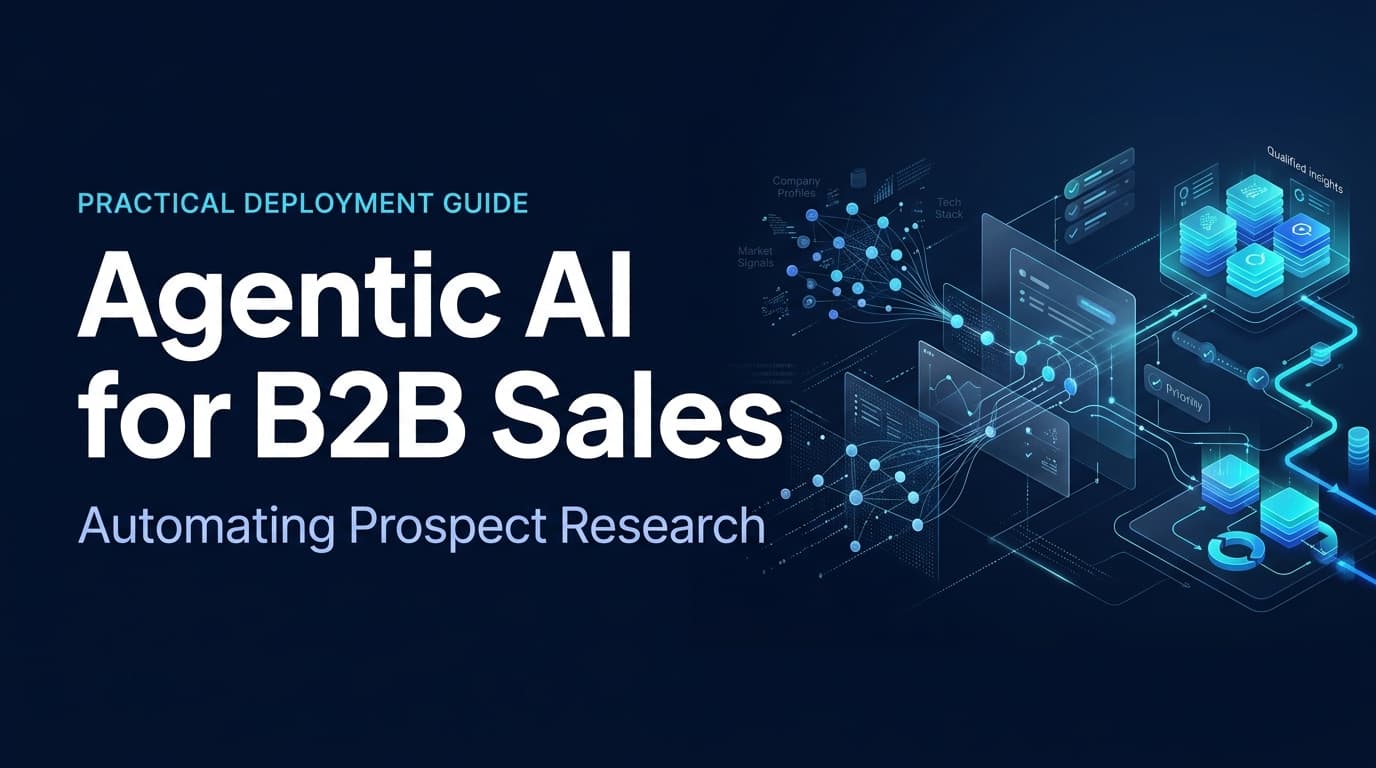
Autonomous agent fleets are replacing manual prospect research in B2B sales not because they're novel, but because the data hygiene problem has outpaced human workflows. Floqer's documented pivot from a ChatGPT Chrome extension to a fleet of agents that continuously research companies, people, and interactions illustrates the architectural shift: from human-in-the-loop tooling to systems that plan, execute, and verify enrichment without daily operator input. This post decomposes that pattern so technical buyers can evaluate coverage, guardrails, and integration effort before committing to build, buy, or wait for open-source.
From Chrome Extension to Autonomous Agent Fleet: The Architectural Pivot
Floqer began as "Super Chat," a Chrome extension that let users log into ChatGPT, extract information, and take notes. The founders noticed enterprise users repurposing it for CRM data hygiene — cleaning records, updating contact details, patching gaps left by stale imports. Conversations revealed the root cause: no established processes existed for keeping customer records current. Most teams relied on quarterly scrubbing or ad-hoc research before outreach.
The pivot moved the product from a human-assisted note-taking tool to an autonomous fleet that continuously researches companies, people, and interactions. Instead of a user prompting an LLM per account, the system accepts a natural-language ideal customer profile (ICP), plans a research strategy across 100+ third-party sources, executes enrichment waterfalls for contact data, and monitors for trigger events — job changes, promotions, funding rounds, tech stack shifts — writing updates back to the CRM without a human clicking "refresh."
This mirrors the build-vs-buy decision many teams face: extend existing CRM automation with custom scripts, or adopt a platform that owns the agent orchestration, source contracts, and freshness SLAs. Floqer's reported $1.2M ARR and 10x year-over-year revenue growth (vendor-reported, per TechCrunch) suggest market pull for the latter, though independent benchmarks don't exist.
Anatomy of an Autonomous Prospect Research Agent
ICP Input → Agent Planning & Source Selection
The entry point is a natural-language description of the target: "Series B SaaS companies hiring for DevOps roles in North America, using Kubernetes, with 50-200 employees." The agent fleet decomposes this into search plans — firmographic filters, technographic signals, intent keywords, hiring patterns — and selects relevant sources from its integrated catalog.
100+ Third-Party Sources: Categorized by Signal Type
Per the research, Floqer integrates over 100 third-party data sources. In practice, these cluster into:
- Firmographic: Company size, revenue estimates, funding history, location, industry classification
- Technographic: Stack detection via job postings, DNS records, browser fingerprinting, public case studies
- Intent: Topic surges from content consumption, review site activity, community engagement
- Contact: Verified emails, direct dials, org chart positioning, tenure
No single provider covers all four categories with fresh data. The agent's value is routing each field to the strongest source at query time.
Waterfall Enrichment for Verified Contact Data
When the system needs a verified email or phone, it runs a sequential fallback chain: Provider A → Provider B → Provider C until a deliverable result returns or the chain exhausts. Each step carries a cost and latency profile. The agent optimizes for "first verified hit" rather than "broadest coverage," reducing bounce rates and API spend. Teams orchestrating this themselves often use AI workflow automation for sales via n8n or Make to stitch provider APIs with conditional logic.
Continuous Monitoring Layer
Post-enrichment, agents watch for changes: LinkedIn profile updates (role, company), SEC filings, press releases, job board postings, GitHub activity, DNS changes. When a signal crosses a confidence threshold, the agent writes the delta to the CRM — new title, new company, new funding round — and can trigger downstream workflows (alert Slack, enroll in sequence, update lead score).
Data Freshness SLAs vs. CRM Sync Frequency
The monitoring cadence defines the freshness SLA. High-value accounts may poll hourly; long-tail accounts daily. CRM sync frequency must match or exceed the monitoring cadence, otherwise the system of record lags behind the knowledge base. Bi-directional sync (covered later) resolves write conflicts when both the agent and a rep update the same field.
Deploying Without Human Oversight: Trust, Guardrails & Rollback
Confidence Scoring Per Field
Not all enriched fields carry equal certainty. A funding amount from an SEC filing scores higher than a headcount estimate from a job board aggregation. The agent assigns a confidence score per field. Above threshold (e.g., 0.9) → auto-write to CRM. Below → flag for review queue. This prevents hallucinated phone numbers or stale titles from polluting the sales pipeline.
Immutable Audit Log
Every agent action — source queried, result returned, confidence scored, field written, field skipped — appends to an immutable log. Compliance teams can replay the log to prove why a record changed. Rollback becomes a point-in-time restore: "Revert Account X to state before 2026-10-14 14:32 UTC."
Sandbox Mode: Shadow-Run Against Live CRM
Before cutover, run the agent fleet in read-only shadow mode against production data. Compare agent-proposed writes against current CRM values. Measure: false positive rate (agent wants to overwrite correct data), false negative rate (agent misses a change), and net new fields populated. Only promote to read-write when metrics meet internal thresholds.
Rate-Limit & Cost Guards Per Agent Type
Web-search agents (cheap, high volume) need different guards than paid-API agents (expensive, rate-limited). Implement per-agent budgets: max calls/hour, max spend/day, circuit breaker on HTTP 429/5xx. Log cost per enriched account to keep unit economics visible.
PII Handling: On-Prem Deployment Path
Floqer's stated open-source driver (targeting early 2027, pending security reviews) addresses the hardest deployment blocker: sensitive customer data leaving the VPC. Self-hosted agent fleets keep PII on-prem while still pulling public/enriched data from external APIs. The trade-off: your team owns source contract management, infrastructure scaling, and model updates.
Build vs. Buy vs. Open-Source: Decision Framework for 2025
| Path | Time-to-Value | Control | Engineering Cost | Freshness & Compliance | Best For |
|---|---|---|---|---|---|
| Buy (SaaS) | Days-weeks | Low (vendor roadmap) | Low (subscription) | Vendor owns SLAs, SOC2, DPA | Teams needing enrichment now, no infra bandwidth |
| Build (Custom Agents) | Quarters | Full | High (3-5 eng + source contracts) | Team owns everything | Proprietary signals, strict data sovereignty, unique ICP |
| Open-Source (Floqer 2027 target) | Months (post-release) | High (forkable) | Medium (self-host + extend) | Team owns infra; community owns core | Security-review-blocked buyers, platform extenders |
| Hybrid | Weeks | Medium | Medium | Split: vendor for commodity, custom for proprietary | Most mature GTM orgs |
Thresholds: Under 10 reps and no dedicated RevOps eng → SaaS. 10-50 reps with 1-2 eng → hybrid. 50+ reps with platform team → evaluate build or open-source once audited. Floqer's Perplexity F7 Fund and Denis Yarats backing signals an LLM-native investor thesis: core enrichment commoditizes; differentiation moves to workflow, UX, and proprietary signal layers.
Measuring ROI Beyond Time Saved: Leading Indicators That Matter
Vendor-reported "70% prospecting time reduction" (Floqer claim, unverified independently) is a vanity metric. Revenue operations teams should track:
- Prospect-to-meeting conversion lift from richer context (tech stack, recent hire, funding) in outreach
- CRM data decay rate before/after autonomous enrichment — measure % of records with stale title, company, or contact info at 30/60/90 days
- Sales rep ramp time reduction via auto-generated account dossiers (tech stack, org chart, recent news) delivered at assignment
- Cost per enriched account vs. manual research hourly rate — include API fees, infra, eng time
- Pipeline attributable to agent-surfaced triggers — deals sourced from funding alerts, job changes, tech shifts the agent caught
Instrument these from day one. The sandbox shadow-run (above) gives you baseline decay and conversion numbers before the agent goes live.
Integration Patterns: Where Autonomous Research Lives in the GTM Stack
CRM Bi-Directional Sync
Salesforce: Custom objects (e.g., Agent_Enrichment_Log__c, Prospect_Signal__c) keep agent writes separate from rep edits. Standard field mapping (Title, Phone, Email) uses last-write-wins with audit log tie-breaker. HubSpot: Custom properties + workflow webhooks. Native integrations reduce mapping effort but limit schema flexibility; API-first gives full control at higher build cost.
Sales Engagement Sequence Triggers
Agent detects VP Engineering hire at target account → webhook to Outreach/Salesloft → enrolls linked contacts in "New Leadership" sequence with personalized battlecard. Requires the engagement platform to accept external trigger payloads and map to sequence templates.
Data Warehouse for Historical Trend Analysis
Stream enrichment logs and signal events to Snowflake/BigQuery. Analyze: which signals precede won deals, optimal monitoring cadence per segment, source accuracy by field type. This turns the agent fleet into a data product for RevOps, not just a CRM filler.
Slack/Teams Battlecards at Moment of Outreach
When a rep opens a contact record, a sidebar or Slack DM surfaces: "Company raised Series B 14 days ago. Hiring for 3 DevOps roles. Uses Databricks + dbt. Decision maker: CTO (promoted 2 months ago)." Context delivered in-context beats dashboard hunting.
API-First vs. Native Integration Trade-offs
Native integrations (managed OAuth, field mapping UI, supported by vendor) accelerate rollout but lock you into the vendor's data model. API-first (webhooks, REST, GraphQL) lets you own the sync logic, transform payloads, and swap vendors — at the cost of maintaining the glue code. Most mature teams start native, migrate to API-first when they hit schema limits.
What Floqer's Open-Source Move Signals for the Category
Floqer's plan to open-source its autonomous customer knowledge database (targeting early 2027, pending security reviews) reflects three converging pressures:
- Data sovereignty demand: Enterprise buyers increasingly require self-hosted options for PII and competitive intelligence. Security reviews gate the timeline — not code readiness.
- Core enrichment commoditization: Firmographic, technographic, and contact waterfalls are becoming utilities. Differentiation shifts to workflow orchestration, UX, and proprietary signal layers (e.g., "this company's GitHub activity suggests they're evaluating vector databases").
- LLM-native investor thesis: Perplexity's F7 Fund and Denis Yarats backing signal that agent infrastructure — planning, tool use, memory, evaluation — is the investable layer, not the data sources themselves.
Watchlist: other agentic sales startups (Clay, Unify, Common Room, Apollo's AI layers) will likely follow open-core strategies. For buyers, this means the "buy" option gains an escape hatch — adopt SaaS now, migrate to self-hosted open-core later if compliance demands it. For builders, the open-source release becomes a reference architecture for agentic AI sales research agents you can extend rather than replicate.
Frequently Asked Questions
How do I prevent autonomous agents from overwriting correct CRM data with stale enrichment?
Run a shadow period where agents propose writes but don't commit. Compare proposals against ground truth (rep-verified records). Tune confidence thresholds per field until false positive rate drops below your tolerance. Use immutable audit logs to roll back any bad writes that slip through.
What's the realistic engineering investment to self-host an open-source agent fleet like Floqer's?
Beyond infra (Kubernetes, vector DB, queue), budget 2-3 engineers for: source contract management (100+ API agreements), model evaluation/updates, monitoring/alerting, and custom signal development. The open-source core handles orchestration; you own the data supply chain.
When does hybrid (SaaS + custom agents) make sense over pure build or buy?
When 80% of your enrichment needs are commodity (firmographics, contact waterfalls) but 20% are proprietary (e.g., "detect when a target evaluates our competitor's API via job postings"). Buy the commodity layer, build custom agents for the proprietary signals, and orchestrate both through a shared workflow layer.
Ready to replace manual prospect research with an autonomous agent fleet? Book a 30-min architecture review with Armor Tech's agentic AI team — we'll map your ICP to a live enrichment waterfall and show the sandbox rollback controls your compliance team will demand.