Introduction: Can AI Agents Really Make Money Automatically?
The idea of an AI system that makes money while you sleep is attractive—but it is often explained incorrectly. Installing an AI agent does not automatically create a profitable business. Revenue still requires a valuable offer, customers willing to pay, reliable delivery, and a way to turn interest into sales.
What AI changes is how much of that process can be automated.
A well-designed network of AI agents can research potential customers, identify buying signals, personalize outreach, qualify leads, schedule sales calls, support customers, and coordinate parts of service delivery. Connected to payment systems, customer relationship management (CRM) software, and business applications, these agents can operate as a revenue-supporting system rather than isolated chatbots.
The practical goal is not to build a machine that magically prints money. It is to build a repeatable business process in which AI handles suitable tasks, software executes approved actions, and people retain control over important decisions.
This guide explains how to design that system, which technologies can power it, how to connect agents to revenue workflows, and how to measure whether the automation is actually making the business more profitable.
What Is an AI Money Machine?
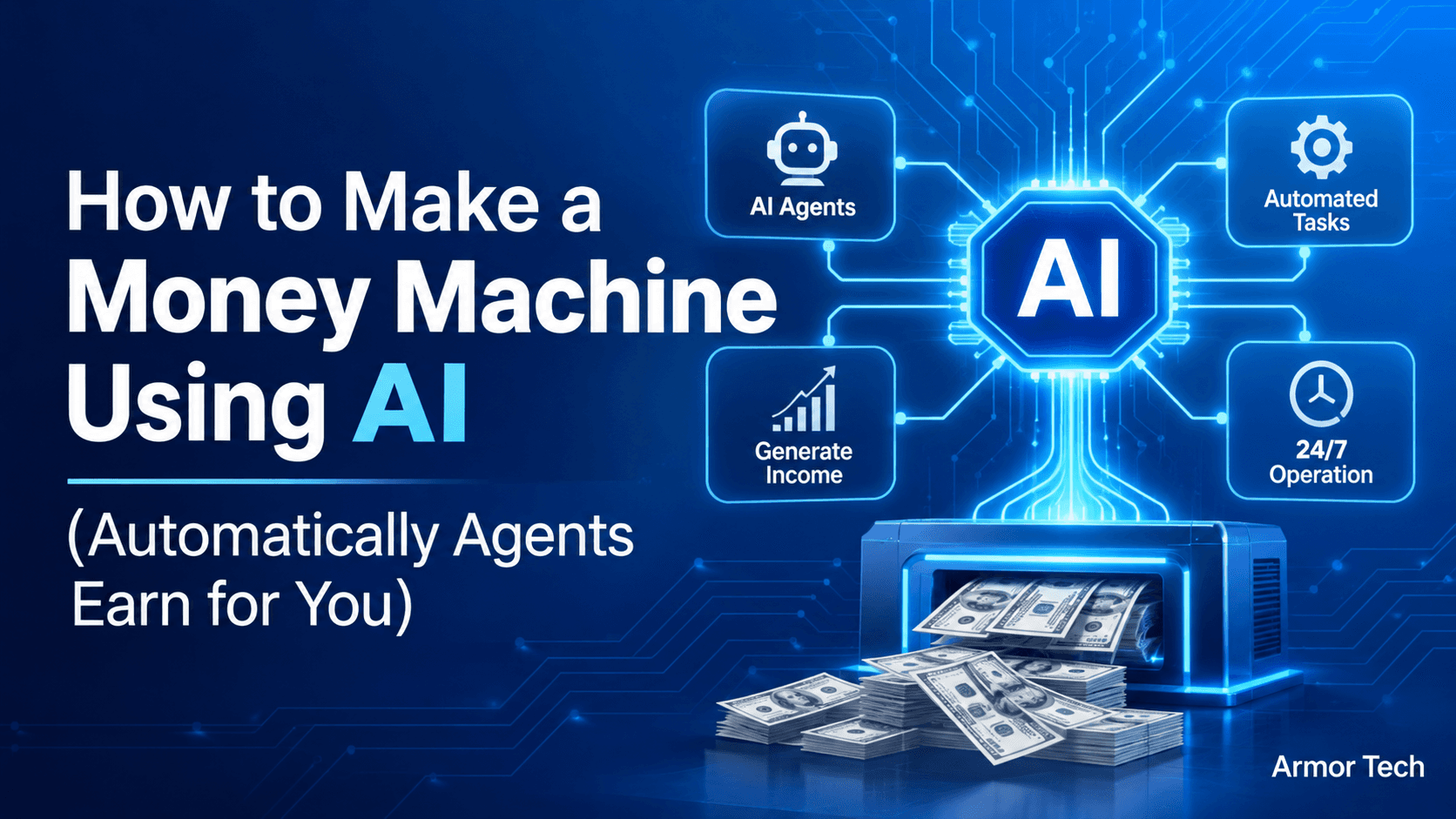
An AI money machine is a connected business system that uses AI agents and automation to perform activities that contribute to revenue.
Think of a traditional business process:
Find potential customers.
Research their requirements.
Contact qualified prospects.
Explain the product or service.
Convert interested prospects into customers.
Deliver the product or service.
Provide support and encourage repeat purchases.
A business may employ different people to manage every stage. An AI-powered system can automate selected activities across this process.
For example, a prospecting agent can identify companies that match a target customer profile. A research agent can examine their public websites and identify relevant business needs. A sales assistant can prepare personalized outreach for human review. When a prospect responds, another agent can classify the inquiry and update the CRM.
After a customer purchases, a delivery workflow can create a project, assign tasks, send onboarding instructions, and monitor progress.
The result is a system that reduces manual work and helps a business handle more opportunities without increasing administrative effort at the same rate.
The important distinction: AI agents support revenue generation; they do not guarantee revenue. A profitable system still depends on product-market fit, pricing, customer demand, operating costs, and execution.
The Five AI Agents Behind an Automated Revenue System
Instead of asking one AI agent to operate an entire business, divide the process into specialist responsibilities. Each agent should have a clearly defined objective, approved tools, and measurable results.
Agent 1: Market Research Agent
The first challenge is finding people who actually need what a business sells.
A market research agent can:
Search approved public sources for companies in a selected industry.
Identify business websites and relevant company information.
Detect potential buying signals, such as hiring activity or new product launches.
Categorize companies by industry, size, and service relevance.
Prepare a structured prospect research report.
For example, an AI automation agency targeting US-based B2B SaaS companies could search for businesses with repetitive customer-support processes or manual lead qualification workflows.
The agent does not need to contact every company it discovers. Its job is to produce a relevant, researched list for the next stage.
Agent 2: Lead Qualification Agent
A large prospect list is not necessarily valuable. The next agent determines which opportunities deserve attention.
It can evaluate prospects against criteria such as:
Does the company match the target industry?
Is there evidence of a relevant operational problem?
Does the business appear to have a suitable budget or need?
Is the proposed service relevant to its operations?
Is there a clear reason to start a conversation?
The agent can assign a qualification score and explain the evidence behind it.
For example:
ProspectPotential opportunityPrioritySaaS company with manual supportAI support automationHighE-commerce business with basic websiteUnclear automation needLowRecruitment company handling many applicationsCandidate screening workflowHigh
A human should be able to inspect the evidence before high-value prospects enter an outreach campaign.
Agent 3: Sales and Outreach Agent
Once a prospect is qualified, the outreach agent prepares relevant communication.
It can:
Draft personalized emails.
Reference a genuine business challenge.
Suggest a relevant product or service.
Generate follow-up drafts.
Classify incoming replies.
Update prospect status in the CRM.
For example, rather than sending a generic message about AI automation, the system could prepare a message explaining how an AI assistant might help a software company categorize incoming support requests.
The agent should not invent company research, pretend to have a personal relationship with the recipient, or send unlimited unsolicited messages. Use appropriate consent, unsubscribe, and communication rules for each market and channel. Keep human approval in place until the workflow has demonstrated reliable behavior.
Agent 4: Sales Conversion Agent
When a prospect responds positively, the next challenge is moving the conversation toward a commercial decision.
A sales assistant can answer routine questions using approved company information, explain service packages, collect requirements, and schedule meetings.
It can also prepare proposals using predefined templates and pricing rules.
For high-value contracts, discounts, legal commitments, and unusual pricing requests, a human salesperson should approve the final offer.
The agent should never invent prices, make unsupported performance promises, or claim that a deal has been closed before payment or contract confirmation.
Agent 5: Customer Delivery and Retention Agent
Revenue does not end when a customer pays. The business must deliver what it promised.
A delivery agent can coordinate onboarding, create project tasks, collect required information, monitor milestones, and notify the team about delays.
A support agent can answer common questions using approved documentation and route complex issues to a human.
A retention agent can identify customers who may need assistance, prepare renewal reminders, and suggest relevant additional services based on actual customer requirements.
This final stage is important because repeat business and customer retention can contribute significantly to long-term profitability.
How the Agents Work Together
A revenue automation system needs an orchestration layer that connects its agents and business applications.
A simplified architecture looks like this:
Market Research → Lead Qualification → Outreach → Sales Conversion → Payment → Delivery → Retention
Each stage passes structured information to the next.
For example, the research agent produces a company record. The qualification agent adds a score and evidence. The outreach agent prepares a message. Once the prospect responds, the CRM is updated and the sales assistant takes over.
After a customer accepts the proposal, the payment system processes the transaction. A verified payment event can trigger onboarding and project creation.
This is more dependable than allowing multiple agents to independently edit business records without shared rules.
OpenAI's official Building Agents guide explains how agents use instructions, tools, guardrails, and orchestration to perform tasks. The Agents SDK documentation covers specialist agents, handoffs, tool integrations, and human review. These are useful foundations for building coordinated systems rather than disconnected AI assistants.
Build a Practical AI Revenue Workflow Using n8n
A useful first project is an automated lead research and qualification workflow. It is smaller and easier to validate than attempting to automate an entire business.
Step 1: Define the target customer
Choose one niche and define what makes a prospect relevant.
For example:
Industry: B2B SaaS.
Geography: United States.
Company profile: Small and medium-sized software businesses.
Potential need: Repetitive customer support or manual lead qualification.
Offer: Custom AI automation and agent development.
A narrow target makes it easier to assess whether the system is finding useful prospects.
Step 2: Create a prospect database
Use a CRM or database with fields such as:
Company name
Website
Industry
Location
Relevant business signal
Potential AI opportunity
Research source
Qualification score
Outreach status
Last activity
The database should retain source information so that people can verify the agent's findings.
Step 3: Build the research workflow
In n8n, create a workflow with the following structure:
Schedule Trigger starts the workflow.
Approved search or data source supplies company information.
HTTP Request retrieves permitted public website information.
AI Agent extracts relevant business details.
Qualification logic evaluates the prospect.
Google Sheets, PostgreSQL, or a CRM stores the result.
A notification sends high-priority opportunities to the sales team.
Do not assume that an AI agent can access every website or platform. Respect site terms, access restrictions, privacy requirements, and applicable data-protection rules.
Step 4: Add the outreach stage
Create a separate workflow that reads approved prospects and generates personalized email drafts.
Initially, send drafts to a human reviewer instead of automatically sending them.
The reviewer checks the facts, relevance, recipient, and compliance requirements. Approved messages can then be sent through the business's email provider.
Step 5: Connect replies to the CRM
When a prospect responds, an email trigger can start another workflow.
The AI classifies the response as interested, not interested, requesting more information, or asking to schedule a meeting. The CRM record is updated and the appropriate next action is suggested.
Step 6: Connect payment and delivery
When a customer accepts an offer, provide a secure checkout or invoice.
Do not start paid delivery merely because an AI model says the customer agreed. Use a verified payment event from the payment provider. Stripe's Checkout fulfillment guide explains why applications should handle server-side payment events rather than relying only on a customer's return to a success page.
After verifying payment, the workflow can create a customer record, project, onboarding task, and confirmation message.
Three Business Models That Can Use AI Agents to Generate Revenue
An AI revenue system is only useful when connected to a business model. Here are three practical options.
Model 1: AI Automation Agency
An agency sells custom automation services to other businesses.
Examples include:
AI customer support agents.
Lead qualification systems.
Appointment booking agents.
Document processing automation.
Internal workflow automation.
AI agents can help the agency research prospects, prepare proposals, manage follow-ups, and coordinate project delivery.
Revenue can come from implementation fees, monthly maintenance, or ongoing service retainers.
Model 2: AI-Powered Micro-SaaS
A micro-SaaS business solves one focused problem through subscription software.
For example, a product might automatically classify incoming customer inquiries for a specific industry or generate structured reports from business documents.
The AI system can assist with onboarding, customer support, usage monitoring, and routine account operations.
The business earns recurring subscription revenue when customers continue receiving enough value to justify the cost.
Model 3: Productized AI Services
Instead of creating a different solution for every customer, package a repeatable service with a clear scope and price.
Examples:
AI chatbot setup for service businesses.
Automated appointment booking.
Monthly lead research and qualification.
AI-powered document processing.
AI agents can support research, onboarding, reporting, and customer communication while the team manages quality and delivery.
This model can be easier to validate than building a full software product because the business can sell a defined service before investing in a large platform.
Important Risks: Why Fully Autonomous Revenue Systems Can Fail
A system that can send messages, update customer records, or process transactions needs clear boundaries.
Incorrect research: An agent may misinterpret a website or generate unsupported company information. Store sources and require verification for important claims.
Poor outreach: Excessive or irrelevant messages can damage brand reputation and violate communication rules. Use targeting, rate limits, suppression lists, and unsubscribe handling.
Unauthorized actions: An agent should not be able to issue refunds, change prices, sign contracts, or make significant purchases without suitable controls.
Payment errors: Never treat a generated message or browser redirect as proof of payment. Verify payment through trusted server-side events and make fulfillment idempotent.
Uncontrolled costs: Monitor model usage, API calls, hosting, data providers, and workflow executions. Set spending limits and alerts.
Customer data exposure: Restrict access to personal information, protect credentials, and define retention policies.
OpenAI's Guardrails and Human Review guide explains how validation and human approval can control sensitive agent actions. n8n also documents human approval for AI tool calls, allowing workflows to pause before selected actions.
There is also a commercial responsibility: do not promise customers that an AI system will generate guaranteed income. The US Federal Trade Commission explains that earnings claims need appropriate substantiation in its business guidance on advertising. Businesses should make realistic, evidence-based claims about expected outcomes.
Conclusion: Build a Revenue System, Not Just an AI Agent
The real opportunity in AI automation is not a single agent that supposedly earns money on its own. It is the ability to connect multiple business activities into a coordinated system.
Research agents can identify opportunities. Qualification agents can prioritize them. Sales assistants can prepare conversations. Workflow automation can coordinate customer onboarding and service delivery. Payment integrations can record successful transactions and trigger the next business process.
When these components are designed around a real customer need, they can reduce repetitive work, improve operational consistency, and help businesses scale more efficiently.
Start with one revenue-generating workflow, measure its commercial results, and expand only when the evidence supports it. Keep people involved in important decisions, protect customer information, and treat profitability—not the number of automated tasks—as the measure of success.
How Armor Tech Can Help
Armor Tech helps businesses design and develop practical AI-powered systems, including AI agents, agentic workflows, lead generation automation, RAG-based assistants, and custom API integrations.
Whether your goal is to automate prospect research, build an AI sales assistant, launch an AI-powered SaaS product, or connect multiple agents to your existing business applications, the right approach begins with identifying the process that can create measurable value.
Explore Armor Tech to discuss how AI automation can support your business growth.