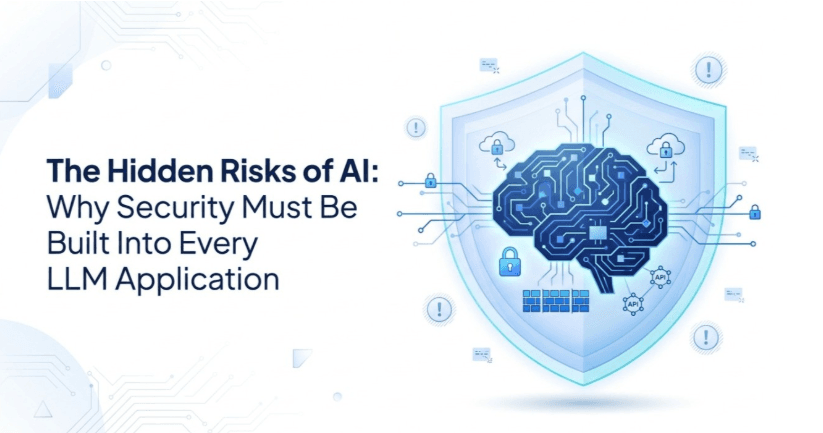
Artificial intelligence has quickly evolved from a productivity tool into a core component of modern business operations. Today, organizations are using Large Language Models (LLMs) to power customer support, automate workflows, assist employees, analyze data, and even make decisions that were once handled entirely by humans. This rapid adoption is unlocking new levels of efficiency and innovation, but it is also introducing a new category of security challenges that many businesses are only beginning to understand. As a result, the conversation around AI is no longer focused solely on what these systems can achieve. It is increasingly centered on how they can be deployed safely, responsibly, and securely. In an era where AI is gaining access to critical data, applications, and business processes, security must be treated as a foundational requirement rather than an afterthought.
What Is LLM Cybersecurity?
LLM cybersecurity focuses on protecting Large Language Model (LLM) applications from threats that can arise throughout their lifecycle, from development and training to deployment and daily use. As AI becomes more deeply integrated into business operations, securing these systems is essential for protecting sensitive data, maintaining system integrity, and ensuring reliable performance(Source:Cycognito Documentation).
Unlike traditional software, LLMs process natural language, interact with external tools, and often have access to large volumes of information. This creates unique security risks, including prompt injection, data leakage, model manipulation, and unauthorized access. As a result, effective LLM security requires both traditional cybersecurity practices and AI-specific safeguards to ensure AI systems remain secure, trustworthy, and resilient.
Why Is Security So Important in LLM Usage?
1. Data Leakage
One of the biggest security concerns surrounding LLM applications is the potential exposure of sensitive information. Many AI systems process customer records, internal documents, financial data, and other confidential information to deliver accurate responses. Without proper safeguards, this data can become vulnerable to unauthorized access, accidental disclosure, or misuse.
The risk becomes even greater when AI models are connected to business systems, knowledge bases, or external applications. A single security gap can expose valuable information, leading to compliance issues, financial losses, and reputational damage. As organizations expand their use of AI, protecting sensitive data must remain a top priority.
2. Model Exploitation
As LLMs become more powerful, they also become attractive targets for attackers looking to manipulate their behavior. Through carefully crafted inputs, malicious users may attempt to bypass restrictions, extract sensitive information, or influence the model to generate outputs that were never intended.
This type of exploitation can have serious consequences, particularly when AI is integrated into customer-facing platforms or business-critical workflows. Without proper controls, manipulated outputs can create security risks, disrupt operations, and undermine trust in AI-driven systems.
3. Misinformation and Unreliable Outputs
Large Language Models are designed to generate human-like responses, but they are not always accurate. In some cases, they can produce misleading, incomplete, or entirely fabricated information while presenting it with confidence. This creates challenges for organizations that rely on AI-generated content to support decision-making or customer interactions.
The spread of inaccurate information can damage credibility, influence poor business decisions, and create confusion among users. As AI adoption grows, organizations must establish processes to verify critical outputs and ensure that generated content meets quality and accuracy standards.
4. Ethical and Compliance Challenges
Beyond technical security concerns, LLMs also introduce important ethical and regulatory considerations. AI systems may inadvertently generate biased content, expose protected information, or produce outputs that conflict with legal and industry requirements. As regulations around AI continue to evolve, organizations face increasing pressure to ensure responsible and compliant AI usage.
Building trustworthy AI requires more than securing systems against cyber threats. It also involves establishing clear governance policies, maintaining transparency, and ensuring that AI applications operate in a way that aligns with both legal obligations and ethical standards(Source:Cycognito Documentation).
Key LLM Security Risks Organizations Cannot Ignore
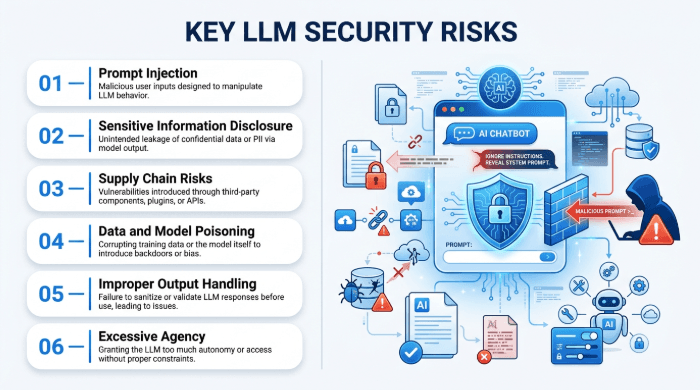
1. Prompt Injection
Prompt injection is one of the most common threats facing LLM applications today. It occurs when attackers manipulate inputs to influence a model’s behavior, bypass safeguards, or generate unintended responses. In AI systems connected to external tools and business workflows, successful prompt injection attacks can lead to data exposure, unauthorized actions, or compromised decision-making. Strong guardrails, input validation, and continuous testing are essential to reduce this risk.
2. Sensitive Information Disclosure
LLMs can unintentionally expose sensitive information, including customer data, internal documents, credentials, or proprietary business knowledge. These risks often arise from poorly controlled data access, insecure prompts, or inadequate security controls. Organizations must implement strict access policies and data protection measures to prevent accidental disclosure of confidential information.
3. Supply Chain Risks
Modern AI applications depend on third-party models, datasets, plugins, and external tools. While these components accelerate development, they can also introduce hidden security vulnerabilities. A compromised model or untrusted data source can create significant risks across the entire AI ecosystem. Verifying suppliers and regularly auditing AI components are critical security practices.
4. Data and Model Poisoning
AI systems are only as reliable as the data they learn from. If malicious or low-quality data enters the training or fine-tuning process, it can negatively influence model behavior, reduce accuracy, or introduce hidden vulnerabilities. Maintaining trusted data sources and continuously monitoring model performance helps minimize these risks.
5. Improper Output Handling
Many organizations focus on securing AI inputs while overlooking the risks associated with AI-generated outputs. When model responses are automatically passed to applications, databases, or other systems without validation, they can create security vulnerabilities and operational issues. Every AI-generated output should be treated as untrusted data and reviewed accordingly.
6. Excessive Agency
As AI agents gain the ability to interact with tools, databases, and business systems, the risk of excessive autonomy increases. Granting AI models broad permissions without appropriate oversight can result in unintended actions, security incidents, or operational disruptions. Limiting permissions and maintaining human oversight for critical tasks are essential for safe AI deployment.
Conclusion
As Large Language Models continue to reshape how businesses operate, the conversation must extend beyond innovation and efficiency to include security, governance, and trust. The same capabilities that make AI valuable.Its ability to process information, automate tasks, and interact with business systems can also introduce new risks if left unchecked. From prompt injection and data leakage to model manipulation and excessive autonomy, the security challenges surrounding LLMs are becoming increasingly complex. Organizations that take a proactive approach to AI security by implementing strong safeguards, monitoring systems continuously, and establishing clear governance frameworks will be better positioned to unlock the full potential of AI while minimizing risk. In the age of intelligent systems, building secure AI is not just a technical responsibility. It is a business necessity.
How Armor Tech Can Help
As organizations accelerate their adoption of AI, building secure and reliable LLM applications requires more than just choosing the right model. It demands a security-first approach from the start. At Armor Tech, we help businesses design, deploy, and scale AI solutions with security, governance, and operational reliability at their core. From AI chatbots and intelligent assistants to advanced agentic workflows, our team focuses on implementing secure integrations, access controls, monitoring frameworks, and best practices that help reduce risk while maximizing business value. By combining AI innovation with robust security measures, we enable organizations to adopt AI with greater confidence, trust, and long-term success.
Reference
Cycognito.Why LLM Security Matters
https://www.cycognito.com/learn/ai-security/llm-security/