The internet transformed the world by connecting billions of people and devices through a common language. Today, AI is going through a similar transition. We've built intelligent agents that can answer questions, write code, and automate tasks—but most of them still operate in isolation.
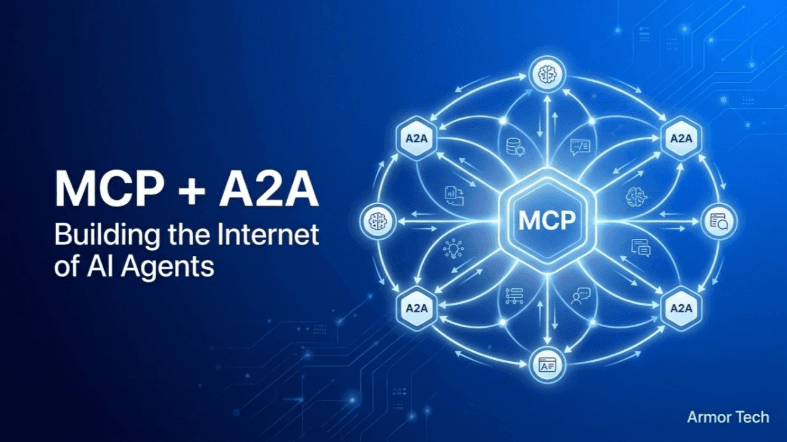
What happens when AI agents can not only interact with the tools around them but also communicate with one another? That question is driving the next phase of artificial intelligence. With Model Context Protocol (MCP) enabling AI-to-tool communication and Agent-to-Agent (A2A) frameworks enabling AI-to-AI collaboration, we're beginning to see the foundations of something much bigger: an interconnected ecosystem of intelligent agents.
In this article, we'll explore how MCP and A2A are shaping the future of AI and why they could become the building blocks of the Internet of AI Agents.
What Is Model Context Protocol (MCP)?
Model Context Protocol (MCP), introduced by Anthropic, provides a standardized way for AI agents to interact with external tools, services, and data sources. Rather than relying on custom integrations for every application, MCP establishes a common framework that allows AI systems to discover available capabilities, use them consistently, and process the results efficiently(Source:auth0).
At a high level, MCP works by connecting AI-powered applications to external resources through MCP clients and servers. This enables AI agents to securely access information, interact with business systems, and perform tasks across a wide range of applications—regardless of the underlying platform or provider.
How MCP Actually Works
At a high level, MCP helps AI agents understand which tools they can access, how to use them, and how to interact with them securely. Instead of relying on custom integrations or ad-hoc API calls, MCP provides a consistent and structured approach to accessing external resources.
A typical MCP workflow is straightforward:
An AI agent identifies that it needs information beyond its existing knowledge.
It sends a request through an MCP client to access an external tool or data source.
The MCP server verifies permissions and processes the request.
The requested information or action is returned to the AI agent.
The agent uses this additional context to generate a more accurate and informed response.
In simple terms, MCP acts as a bridge between AI systems and the digital tools they rely on. It removes much of the complexity associated with traditional integrations, allowing developers to focus on building intelligent applications rather than managing countless custom connections.
What Is Agent-to-Agent (A2A) Communication?
While MCP focuses on connecting AI agents with tools and data, Agent-to-Agent (A2A) communication is centered around collaboration between intelligent systems. Rather than working independently, AI agents can exchange information, coordinate activities, and work together to accomplish shared objectives(Source:auth0).
It enables agents to delegate responsibilities, share context, and combine their capabilities to solve more complex problems efficiently.
In an A2A environment, agents generally take on one of two roles:
Client Agents: These agents initiate requests, assign tasks, and coordinate workflows on behalf of the user.
Service Agents: These agents provide specialized capabilities and respond to requests from other agents when their expertise is needed.
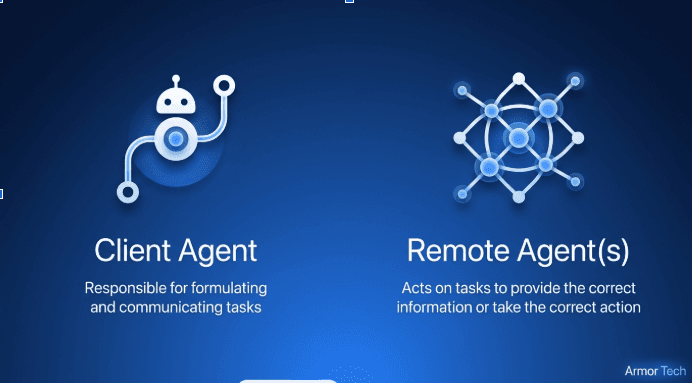
This division of responsibilities creates a more organized and scalable approach to AI collaboration, making it easier for agents to identify the right partners and work together effectively.
How A2A Actually Works
At its core, A2A enables AI agents to communicate using standardized protocols, allowing them to collaborate in a structured and reliable way. Before agents begin working together, they first establish trust and identify each other's capabilities.
This is made possible through Agent Cards descriptive profiles that outline an agent's skills, supported protocols, and the types of tasks it can handle. By sharing this information, agents can discover suitable collaborators without exposing sensitive internal details.
A typical A2A workflow looks like this:
A user submits a complex request to an AI agent.
The agent determines that additional assistance is required and breaks the task into smaller components.
It identifies other agents best suited for each responsibility by reviewing their Agent Cards.
Requests are distributed to specialized agents, allowing multiple tasks to be executed simultaneously.
The participating agents return their results, updates, or additional questions as needed.
The coordinating agent combines the outputs and delivers a unified response to the user.
This collaborative approach allows AI systems to handle complex, multi-step workflows more effectively, making A2A an important foundation for the next generation of intelligent and scalable AI applications(Source:auth0).
Building the Internet of AI Agents
The future of AI will not be built around isolated systems, but around networks of intelligent agents working together. While MCP enables AI agents to interact with tools and data, A2A allows them to communicate and collaborate with one another. Together, they form the foundation of what many are calling the "Internet of AI Agents."
Imagine an organization where specialized AI agents handle research, operations, finance, and customer support simultaneously. By working together, these agents can solve complex problems more efficiently, paving the way for a new era of intelligent and autonomous enterprise systems.
Conclusion
The future of AI lies not in isolated systems, but in interconnected networks of intelligent agents. By combining MCP's ability to connect AI with tools and data and A2A's ability to enable collaboration between agents, we are moving toward a more scalable and intelligent AI ecosystem. The Internet of AI Agents may still be in its early stages, but it has the potential to reshape how businesses build and use AI in the years ahead.
How Armor Tech Can Help
At Armor Tech, we believe the future of AI lies in intelligent, connected systems. We help businesses design and implement AI solutions—from AI agents and intelligent automation to custom integrations that connect seamlessly with existing tools and workflows. Whether you're exploring MCP, Multi-Agent Systems, or the next generation of enterprise AI, our team is committed to turning innovative ideas into practical business solutions.
References
Auth0.MCP vs A2A…
https://auth0.com/blog/mcp-vs-a2a/