What We Know (and Don't) About Mistral Large 4 Today
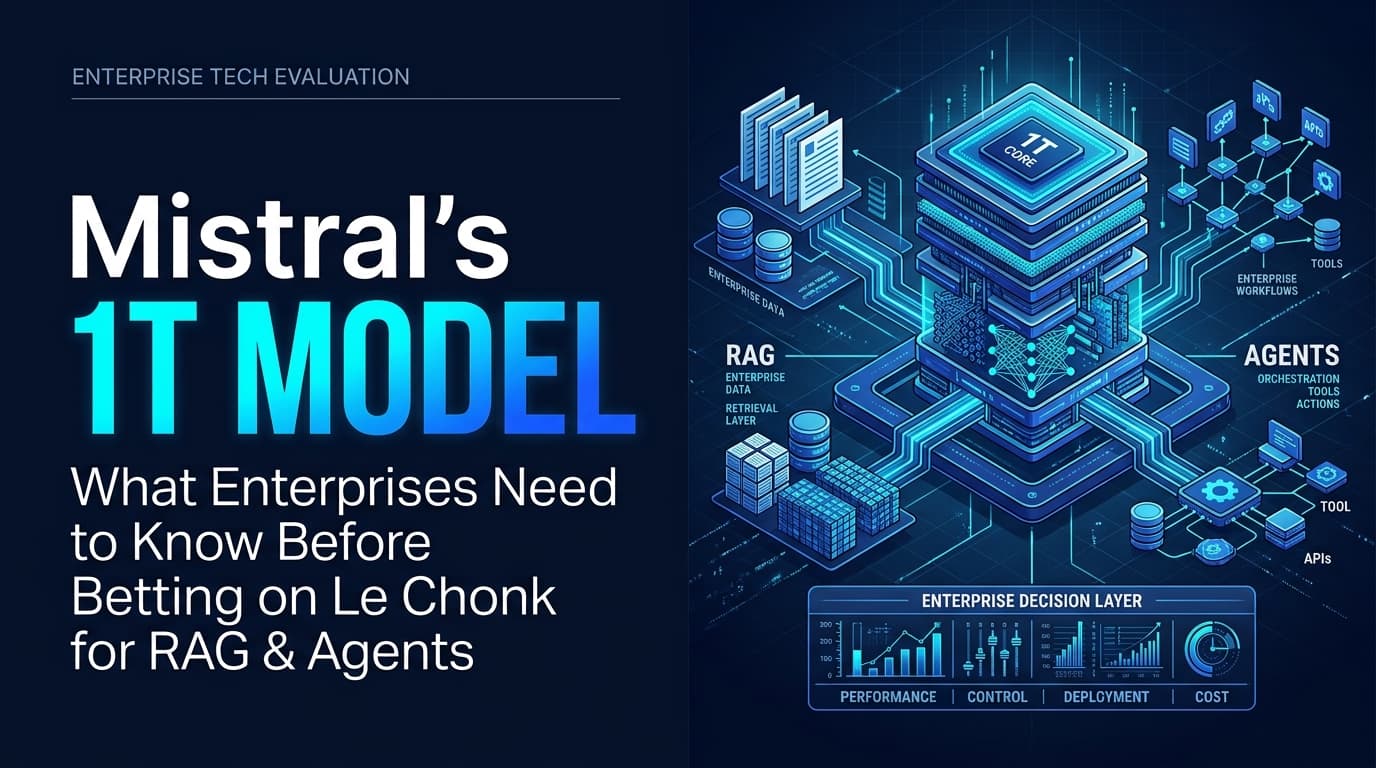
The TechCrunch announcement confirms the following: ML4 is a 1 trillion parameter multimodal model trained on 4,000 Nvidia GPUs. Mistral claims 2–3× compute efficiency versus Chinese peers and significantly less compute than closed-source counterparts. The weights are not yet open; a three-week safety testing period precedes an "open-weight" release under a license that has not been published. Current access is limited to a guarded API endpoint — no self-host option exists today. Stated focus verticals are cybersecurity, finance, and chip design, the latter aligning with backing from ASML (Series C lead) and Samsung (Series D lead at a €21B valuation).
Critical unknowns that block procurement decisions:
- Architecture: dense transformer vs mixture-of-experts (MoE) — parameter count alone doesn't reveal active parameters per forward pass.
- Context window size and RoPE scaling method (if any).
- Licensing terms for commercial use of open weights (Apache-2.0, Mistral Research License, or custom).
- Independent benchmarks on MMLU, GSM8K, HumanEval, or RAG-specific suites (LongBench, LoCoMo).
- Inference VRAM requirements for 4-bit/8-bit quantization at 1T scale.
- Multimodal tokenizer details, image resolution limits, and vision encoder architecture.
Until weights and benchmarks land, any capacity planning or vendor comparison is speculative. Treat the three-week window as your evaluation design sprint.
Why 1T Parameters Changes the Self-Host Calculus
Teams accustomed to 7B–70B models face a different infrastructure tier at 1T. Rough VRAM math for a dense 1T model (assuming 2 bytes/parameter for BF16): ~2 TB for weights alone. At 4-bit quantization (0.5 bytes/parameter), weights sit around 500 GB — still requiring multiple 80 GB H100s or MI300X nodes. Add KV-cache for long-context RAG (if context exceeds 128k tokens) and activation memory, and you're looking at 8–16× H100 80 GB for a single replica with headroom. GB200 NVL72 or MI300X 8×192 GB configurations become the practical entry point.
Deployment pattern hinges on architecture:
- Dense 1T: Tensor-parallel across 8–16 GPUs per replica; pipeline parallelism adds latency but reduces per-GPU memory.
- MoE 1T (e.g., 8×125B experts, top-2 routing): Active parameters ~250B per token. Expert-parallel + tensor-parallel hybrids reduce per-GPU memory but increase all-to-all communication. Router logits and expert affinity become new observability surfaces.
KV-cache sizing scales with context length and batch size. At 128k context, BF16 KV-cache for a 1T dense model exceeds 100 GB per sequence — quantization (FP8/KV-cache compression) and paged attention (vLLM, TGI) are non-optional. Cost-per-token versus closed-model APIs (GPT-4o, Claude 3.5 Sonnet) depends entirely on throughput utilization. At low concurrency, API wins; at sustained high throughput, self-host amortizes capital if you can saturate the cluster.
RAG-Specific Evaluation Checklist for When Weights Drop
Use the three-week window to instrument a repeatable, weekend-sprint protocol. Target: run the full suite within 7 days of weight availability.
- Needle-in-haystack at 32k / 128k / 1M tokens with domain documents — financial regulations, chip datasheets, security logs. Measure recall at each depth and position.
- Faithfulness & citation accuracy using RAGAS or a custom LLM-as-judge on your retrieval pipeline. Compare ML4 against your current 70B baseline on identical chunks and queries.
- Latency/throughput with vLLM or TGI + your chunking/embedding stack (BGE, E5, Voyage). Profile p99 latency at concurrency levels matching production (e.g., 16, 64, 256 simultaneous requests).
- Multimodal RAG: table/figure extraction from PDFs, diagram-to-code for chip design schematics. Test vision encoder + LLM alignment on your document corpus.
- Guardrail compatibility: does Mistral's safety alignment (tuned for "defense not malicious attacks") conflict with your domain prompts? Run red-team prompts for your vertical — financial advice boundaries, cybersecurity exploit generation, IP leakage in chip specs.
Teams wanting hands-on help designing this sprint can engage RAG pipeline engineering services to accelerate the first evaluation cycle.
Agentic Workload Fit: Tool Use, Planning, and Long-Horizon Tasks
Chat performance ≠ agent reliability. Structure your agent eval around:
- Function-calling JSON schema adherence: run BFCL or API-Bank style evals with your actual tool schemas. Measure valid JSON rate, correct argument types, and hallucinated function names.
- Multi-step planning: replay internal production traces or use WebShop/ALFWorld. Track success rate over 5, 10, 20 tool turns. Does 1T scale improve plan coherence or increase attention drift?
- Context retention over long horizons: inject distractor tokens between tool turns; measure retrieval of early instructions.
- Fine-tuning / LoRA feasibility: QLoRA on 1T dense is ~250 GB VRAM for 4-bit base + adapter gradients — likely infeasible without model-parallel LoRA. DoRA or MoE-specific adapter methods (expert-only tuning) may reduce cost. Full-weight update is a dedicated training run.
- Orchestration framework compatibility: test LangGraph, CrewAI, or n8n custom nodes with ML4's function-calling format. Verify streaming tool calls, parallel tool execution, and error-recovery loops. For production deployment support, Armor Tech's agentic AI platform includes model-agnostic orchestration nodes that can swap ML4 in once weights are available.
Licensing, Sovereignty, and Supply-Chain Risk
Non-technical gates often kill adoption before a GPU spins up.
- License class prediction: Apache-2.0 enables unrestricted commercialization. Mistral Research License (used for prior models) restricts commercial use without a separate agreement. A custom license could impose audit requirements, geographic restrictions, or derivative-work limitations. Read the final license before committing infra.
- Export control / EU AI Act classification: a 1T multimodal model likely falls under "general-purpose AI model with systemic risk" thresholds. If you operate in regulated sectors (finance, defense, healthcare), confirm weight provenance audit trail — Mistral claims training on Mistral compute only, which simplifies supply-chain attestation.
- Single-vendor dependency: weights from one lab create concentration risk. Maintain a diversified model portfolio strategy (e.g., Llama-3 405B, Nemotron 340B, ML4) so orchestration layer can route per-task without vendor lock-in.
Decision Framework: Adopt, Watch, or Skip?
| Posture | Conditions | Timeline |
|---|---|---|
| Adopt early | You have ≥8× H100 80 GB (or MI300X/GB200), need sovereign multimodal capability, can absorb a 3-month eval cycle, and your legal team can review an unknown license fast. | Week 1: weights → Week 2: quantization (AWQ/GPTQ) → Week 3: RAG eval → Week 6: agent eval → decision |
| Watch | Running 70B-class today, waiting for vLLM/TGI optimization PRs for 1T scale, need license clarity, or budget cycle doesn't align with hardware lead times. | Monitor community quantization releases, independent benchmarks, and license publication. Re-evaluate at 60 days. |
| Skip | Latency-sensitive <100 ms p99, no GPU cluster, hard requirement for Apache-2.0 only, or regulatory regime forbids non-auditable weight provenance. | Stay on current stack. Revisit when ML4-derivative Apache-2.0 fine-tunes emerge (if license permits). |
The three-week safety window is your signal to prep infra, scripts, and eval data. When weights drop, the teams that move from download to first RAG numbers in 48 hours will make the go/no-go call before the hype cycle peaks.
Frequently Asked Questions
When will Mistral Large 4 weights actually be available for download?
Mistral has stated a three-week safety testing period from the October 6 announcement, after which they plan to release open weights. The exact date and distribution channel (Hugging Face, Mistral-hosted, torrent) have not been specified.
What license will the open weights use, and can I use them commercially?
The license has not been published. Previous Mistral models used the Mistral Research License (non-commercial without separate agreement). Assume commercial use requires legal review until the final license text is public.
Can I run ML4 on a single 8×H100 node, or do I need a larger cluster?
For a dense 1T model at 4-bit quantization, weights alone require ~500 GB VRAM. An 8×H100 80 GB node provides 640 GB — tight with KV-cache and activation overhead. A 16-GPU node (or 8×MI300X 192 GB) gives comfortable headroom for production concurrency. MoE variants would reduce active memory but add communication complexity.