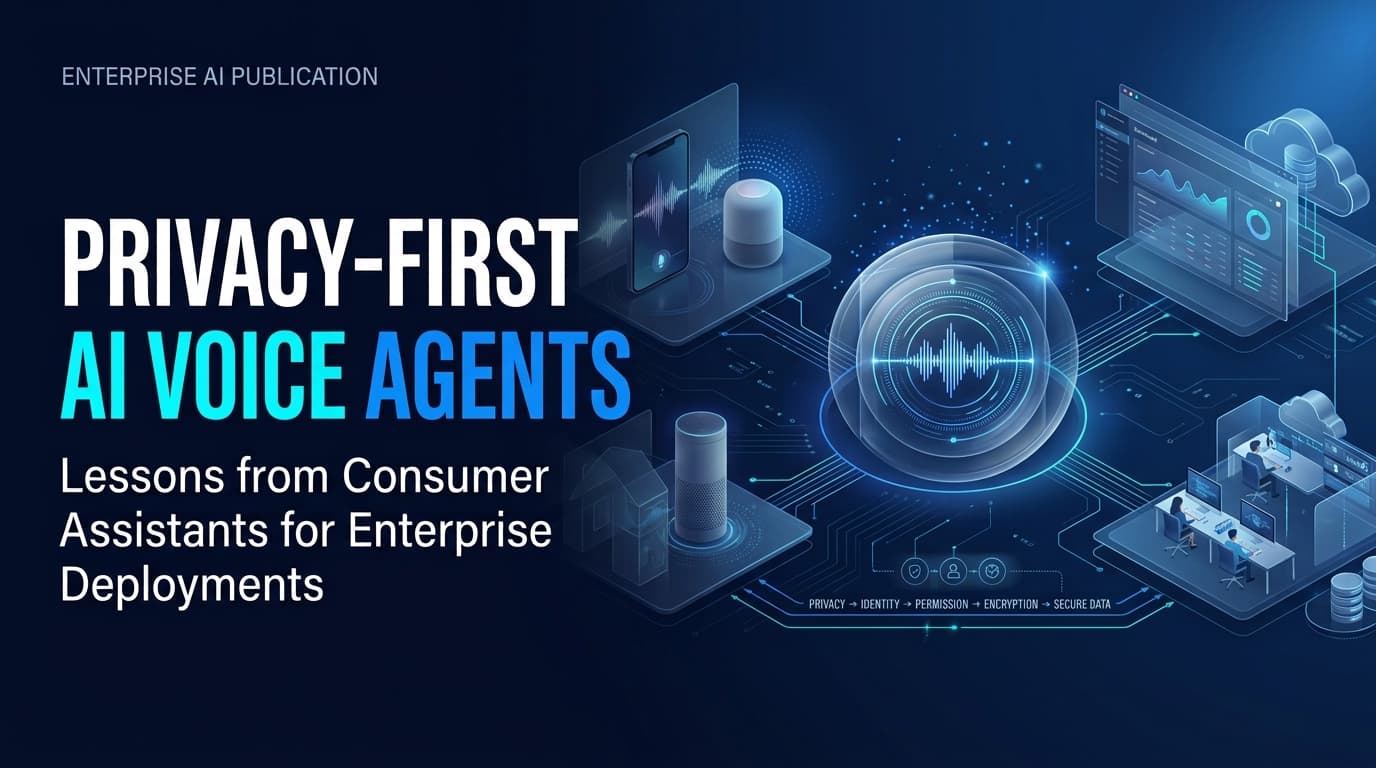
Privacy-first AI voice agents are shifting from marketing claims to architectural requirements as enterprises deploy assistants that handle sensitive operations. The recent release of Hark Pro illustrates how a computer-use model combined with visible agent behavior changes the trust calculus. We examine the technical patterns that make this possible and where the gaps remain.
Architecture of a Privacy-First Voice Agent
The core tension in voice assistants is that utility requires context — email, calendar, filesystem, payment credentials — while privacy demands minimal data exposure. Hark's approach, as described by design lead Abidur Chowdhury, is to train a model explicitly for computer use rather than general reasoning. This specialization reduces the model surface area that needs access to raw user data.
In practice, this means the agent operates as a local orchestrator that drives the browser and OS APIs directly. Instead of uploading screenshots or DOM trees to a cloud LLM for interpretation, the model executes predefined action primitives: click, type, scroll, extract. The heavy reasoning stays in the cloud; the sensitive execution stays on device. This split architecture is the pattern we see emerging across serious privacy-first implementations.
Local-First Execution Model
A true local-first voice agent keeps three categories of data on the user's machine:
- Credential material — OAuth tokens, API keys, stored passwords never leave the keychain
- Behavioral logs — The sequence of actions the agent takes, including which sites it visits and what it clicks
- Intermediate state — Partial form fills, scraped table data, clipboard contents during a task
Only the high-level intent ("book the 8:30 AM flight to SFO") and the final confirmation screenshot traverse the network. This contrasts with cloud-first assistants that stream continuous audio, screen captures, and context windows to centralized inference.
Model Specialization Trade-offs
Hark's computer-use model is "faster and cheaper at those tasks" but trades away "broader knowledge and capability of a frontier LLM." This is the correct engineering decision for a privacy-first agent. A 7B parameter model fine-tuned on browser automation benchmarks outperforms a 70B general model on form completion because the action space is constrained and deterministic.
The specialization also reduces the attack surface. A model that only outputs structured action JSON ({"action": "click", "selector": "#submit-btn"}) cannot be prompt-injected into exfiltrating data the way a free-form chat model can. The output grammar becomes a security boundary.
Transparency as a Trust Mechanism
Hark's notable UX choice — showing the agent's browser navigation in a small window — is more than a demo flourish. It creates an auditable execution trail. When users can see the agent navigate to the California DMV site, locate the registration renewal form, and fill it field by field, they gain empirical evidence of scope limitation.
This visibility addresses the fundamental asymmetry of AI agents: the user delegates authority but cannot easily verify compliance. A visible execution window turns "trust me" into "watch me." For enterprise deployments, this pattern should extend to structured logs — JSONL streams of every DOM interaction, network request, and data access — that feed into SIEM systems.
Contrast with Profiling-Based Assistants
Chowdhury explicitly differentiates Hark from assistants that "create detailed profiles of your friends and family." The technical distinction is whether the system builds a persistent user model beyond the current task. Profiling assistants maintain embeddings of communication patterns, contact relationships, topic interests — a longitudinal dataset that becomes a privacy liability.
A task-scoped agent discards context after completion. The renewal task finishes; the DMV session data is ephemeral. No vector store accumulates "user visits DMV annually." This requires deliberate architectural discipline: no hidden telemetry, no "improvement" pipelines that silently upload interaction traces.
Enterprise Deployment Considerations
Moving from consumer to enterprise voice AI introduces compliance boundaries that architecture must enforce.
Data Residency and Tenancy
Regulated industries require that certain data never leaves specific geographic or logical boundaries. A privacy-first voice agent for healthcare must guarantee that PHI never enters the model inference path — not even in tokenized form. This means:
- Local speech-to-text (Whisper.cpp or equivalent) on approved hardware
- Intent classification via on-device SLU (spoken language understanding)
- Action execution through approved internal APIs with audit logging
- Zero cloud round-trips for sensitive workflows
The hybrid model — local execution, cloud reasoning for non-sensitive tasks — requires a policy engine that classifies each intent against data sensitivity labels before routing.
Identity and Access Control
Enterprise agents operate on behalf of a principal with RBAC permissions. The agent's capabilities must be a strict subset of the user's permissions, enforced at the API gateway layer. If the user cannot access the payroll database, the agent cannot either — even if the model "thinks" it should.
This means the agent runtime integrates with the organization's identity provider (Okta, Entra ID, Ping) and requests scoped tokens per task. The token scope becomes the effective capability boundary, not the model's training.
Hardware Integration and the Device Question
Hark's planned 2027 hardware device highlights an unresolved tension: privacy-first software on general-purpose OSes (macOS, Windows) still depends on platform permissions that users grant broadly. Full disk access for an AI agent is a significant privilege.
Apple's tightening of macOS full disk access controls in response to AI agent risks demonstrates that OS vendors recognize this gap. A dedicated device with a verified boot chain, hardware-enforced memory isolation, and no third-party app ecosystem eliminates the "trust the host OS" assumption.
Form Factor Constraints
Chowdhury's dismissal of "creep factor" wearable cameras is well-founded. Always-on cameras create ambient surveillance that contradicts privacy-first principles regardless of on-device processing. The viable form factors for privacy-first voice agents are:
- Stationary hub — Desk device with physical mute switch, indicator LED hardwired to microphone power
- Phone companion — Leverages Secure Enclave, user-controlled permissions, existing biometric auth
- Laptop integration — Runs in a VM or sandbox with dedicated virtual display for agent visibility
Each avoids persistent environmental sensing. The agent activates on explicit invocation (wake word, button press, hotkey) and deactivates deterministically.
Evaluating Privacy Claims: A Checklist
When assessing a voice agent's privacy posture, verify these technical properties:
| Property | Verification Method |
|---|---|
| Local STT/TTS | Network capture shows no audio egress |
| Ephemeral context | Memory profiler shows context cleared post-task |
| No profiling stores | Disk scan reveals no vector DBs or embedding caches |
| Structured action output | Model outputs JSON schema, not free text |
| Visible execution | UI surfaces agent's browser/OS actions in real time |
| Scoped permissions | Agent requests per-task OAuth scopes, not blanket access |
Hark Pro demonstrates several of these — visible execution, task-scoped understanding, computer-use specialization. The missing pieces for enterprise readiness are the audit log integration, identity provider hooks, and policy-based cloud routing.
Internal Links
For deeper technical context on the patterns discussed here:
- Local-first AI architecture patterns — How to structure inference, storage, and orchestration for data residency
- Threat modeling for enterprise voice agents — Attack surfaces specific to conversational interfaces with system access
- Enterprise AI gateway patterns — Routing, policy enforcement, and observability for hybrid local/cloud agents
Frequently Asked Questions
How does a privacy-first voice agent handle tasks requiring cloud knowledge?
The agent decomposes the task: local execution for sensitive steps (filling a form with PII), cloud reasoning for generic steps (looking up a public flight schedule). A policy engine classifies each sub-intent and routes only non-sensitive portions to cloud models. The user sees a unified flow; the architecture enforces the boundary.
Can on-device models match cloud performance for complex workflows?
For computer-use tasks — navigation, form filling, data extraction — specialized 3-7B models match or exceed general frontier models because the action space is narrow and verifiable. The performance gap appears in open-ended reasoning, creative writing, or novel problem solving. Privacy-first agents constrain scope to where local models excel.
What prevents a malicious update from exfiltrating data?
Reproducible builds, signed releases, and user-controlled update timing. The agent runtime should verify its own binary hash against a transparency log before executing privileged actions. Enterprise deployments add centralized policy: devices only run versions approved by the organization's security team, with rollback capability.