The Trust Gap: What the 2% Figure Really Signals for Product Teams
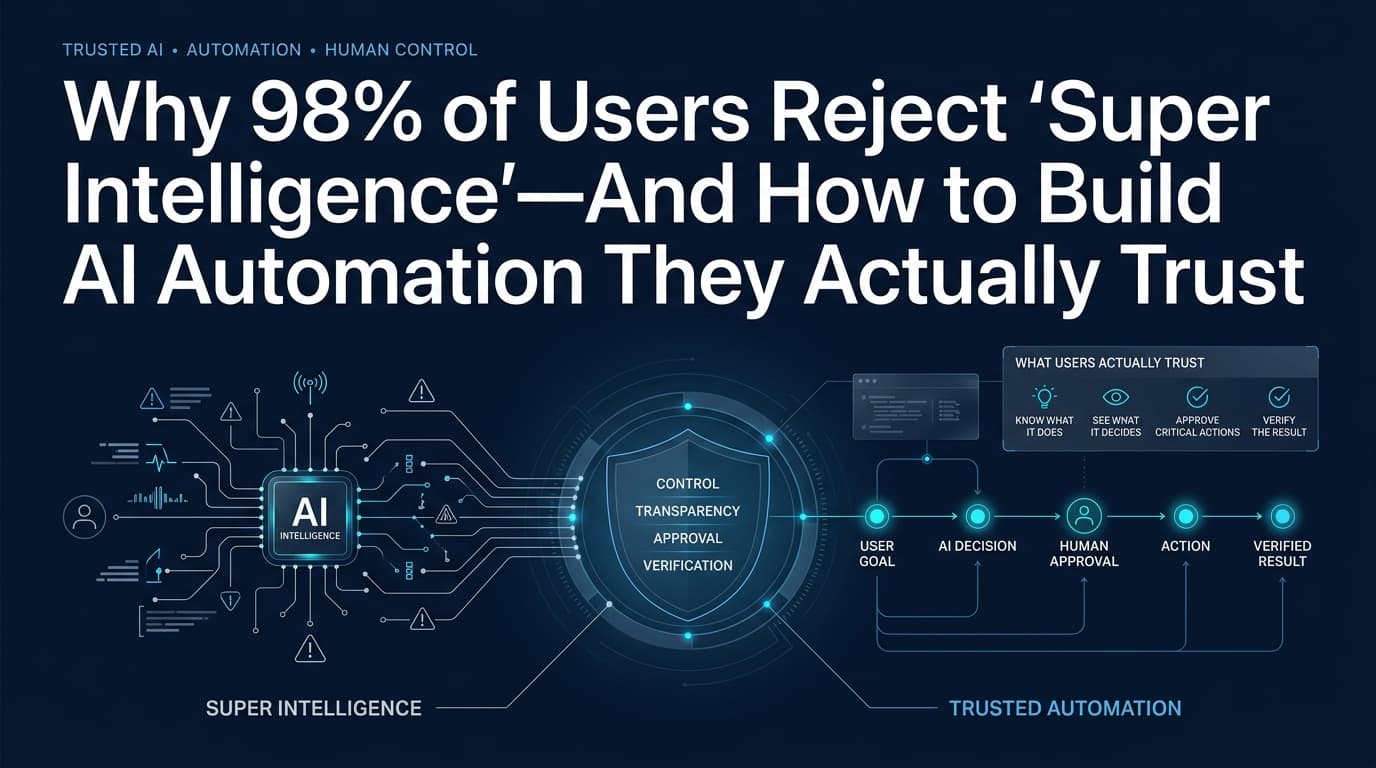
TechCrunch's Equity podcast recently highlighted a striking data point: only 2% of consumers are buying the "super intelligence" branding push. This isn't a rejection of AI capability—it's a rejection of the narrative wrapper. The White House executive order rebranding AI as "super intelligence" and Meta and OpenAI rolling out friendlier agent avatars haven't moved the needle. For product teams, the signal is clear: trust is a feature you engineer, not a marketing message you attach.
Enterprise buyers operate on different incentives than consumers. They evaluate automation against SLA risk, compliance exposure, and operational continuity. But the consumer skepticism bleeds into enterprise procurement—security reviews now ask for the same explainability and override controls that skeptical users demand. If your autonomous workflow can't show its work, it won't ship past a security questionnaire.
Anatomy of a Trustworthy Autonomous Workflow
Trustworthy automation rests on three architectural primitives: explainable step decomposition, explicit human-in-the-loop checkpoints, and rollback tooling that non-technical stakeholders can operate. These aren't optional add-ons—they're the difference between a workflow that gets adopted and one that gets disabled after the first false positive.
Explainable Step Decomposition (Decision Trace)
Every autonomous decision needs a reversible, inspectable trace. Not a black-box confidence score—a structured log showing: input context, rule or model invoked, intermediate conclusions, and the final action taken. This trace must be queryable by operators who aren't ML engineers. A product manager should be able to ask "why did the agent escalate this ticket?" and get a natural-language answer derived from the trace, not a tensor dump.
Implementation pattern: wrap each agent step in a DecisionSpan object that captures {input_hash, policy_version, model_version, reasoning_tokens, output, confidence_calibration}. Store spans in an append-only log indexed by workflow execution ID. Expose a read API that renders spans as a timeline with expandable reasoning blocks.
Explicit Human-in-the-Loop Checkpoints
Full autonomy is a destination, not a starting point. Design checkpoints where the workflow pauses for human confirmation before irreversible actions: financial commitments, data deletion, external API calls with side effects, or policy exceptions. The checkpoint must present the decision trace, the recommended action, and alternatives—all in the operator's domain language.
Critical distinction: checkpoints are not "human approval for everything." Route low-confidence or high-impact decisions to humans; let high-confidence, low-impact actions proceed automatically. The routing logic itself should be configurable without code changes—a policy engine, not hardcoded if-statements.
Rollback and Replay Tooling
When something goes wrong, operators need to revert state and replay with modified inputs—without engineering support. This requires: idempotent action design, compensating transaction definitions for every external call, and a replay sandbox that mirrors production state minus side effects. The replay UI should let a support lead change one input parameter, re-run the workflow, and compare the new trace against the original.
Designing Override Controls That Don't Defeat Automation ROI
Override controls often get built as emergency brakes that, once pulled, dump the entire workflow back to manual process. That destroys the ROI case. Instead, design overrides as calibrated interventions that preserve automation value.
Confidence-Threshold Routing to Human Review
Define confidence thresholds per action type, not globally. A 95% threshold for "refund customer" might be appropriate; 99.9% for "terminate vendor contract." Route below-threshold decisions to a review queue with the full decision trace pre-loaded. The reviewer sees: recommended action, confidence score, top contributing features, and similar historical decisions with outcomes. One-click approve/modify/reject.
The threshold itself should be a tunable parameter with audit history. When you lower a threshold, log who changed it, when, and why. This prevents silent degradation of safety margins.
One-Click Pause/Resume with State Preservation
Operators need to pause a running workflow—say, during a payment gateway outage—without losing context. Implement workflow state as a serializable snapshot: current step, completed steps with outputs, pending steps, and all variable bindings. Pause writes the snapshot to durable storage. Resume rehydrates and continues from the exact point. No re-execution of completed steps, no duplicate side effects.
Escalation Paths That Preserve Context
When a reviewer escalates to a specialist (legal, security, finance), the escalation must carry the full decision trace, the reviewer's annotations, and the current workflow snapshot. The specialist shouldn't need to reconstruct context from Slack threads. Build escalation as a first-class workflow transition, not an email forward.
Audit Logs as a User-Facing Feature, Not Compliance Checkbox
Most audit logs are write-only—written for auditors, never read by operators. Flip the model: make the audit log the primary trust interface. Operators should open it daily, not quarterly.
Natural-Language Summaries of Agent Decisions
Don't render raw JSON. Generate a one-paragraph summary per decision: "Agent classified incoming request as 'billing dispute' (confidence 0.91) based on keywords 'chargeback' and 'unauthorized.' Recommended action: initiate evidence collection workflow. Human reviewer approved at 14:23 UTC." Use a small summarization model fine-tuned on your domain, or structured templates with variable interpolation. The summary must be accurate enough that operators trust it without checking the raw trace.
Time-Travel Debugging for Business Users
Enable "what would have happened if..." queries against historical executions. A product manager asks: "If this request had come in last month before the policy update, what would the agent have done?" The system re-runs the historical workflow against the old policy version and returns the counterfactual trace. This requires versioned policies, versioned model artifacts, and immutable input snapshots—all stored at execution time.
Exportable Trails for Regulatory or Customer Inquiries
When a regulator or enterprise customer asks for the decision trail on a specific case, export should be one click. Format: PDF with signed timestamp, or machine-readable JSON with cryptographic proof of log integrity (Merkle tree root anchored to a transparency log). Include: all decision spans, human interventions with reviewer identity, policy versions in effect, and model versions. No manual compilation.
Progressive Autonomy: Shipping Trust in Increments
Don't ship full autonomy on day one. Ship a progression where each increment earns the right to the next. This matches how teams actually adopt automation—and how security reviews actually approve it.
Shadow-Mode Validation Before Live Traffic
Run the autonomous workflow in parallel with the existing manual process for a minimum of 1,000 executions (or whatever volume gives statistical significance for your error rates). Compare agent decisions against human decisions. Measure: agreement rate, false positive rate, false negative rate, and—critically—cases where the agent was right and the human was wrong. Only promote to live traffic when shadow metrics meet predefined thresholds.
Shadow mode also catches integration bugs: the agent calls an API that changed its contract, or writes to a database schema that drifted. These surface safely in shadow.
Graduated Scope Expansion Tied to SLA Metrics
Define autonomy levels: Level 1 = recommend only (human executes), Level 2 = execute low-impact actions autonomously, Level 3 = execute high-impact actions with checkpoint, Level 4 = full autonomy with audit. Promote levels only when SLA metrics hold: override rate below X%, time-to-override below Y minutes, zero unrecoverable errors in Z executions. Codify promotion criteria in a runbook, not tribal knowledge.
Feedback Loops That Surface False Positives/Negatives Fast
Every override is a training signal. Build a feedback pipeline: override → label (false positive/false negative/edge case) → retraining queue → model/policy update → shadow validation → promotion. Close this loop in days, not quarters. The faster you turn overrides into improvements, the faster trust compounds.
Measuring Trust Adoption: Metrics Beyond Accuracy
Accuracy metrics (precision, recall, F1) measure model performance. Trust metrics measure whether humans actually use the system. Track both.
Override Rate and Time-to-Override as Leading Indicators
High override rate means the agent is making decisions operators disagree with. Low time-to-override means operators spot the disagreement fast—good. High time-to-override means operators are confused or distrustful—they're checking the trace, second-guessing, hesitating. Segment override rate by action type, confidence bucket, and operator tenure. New operators overriding at 3x the rate of veterans signals onboarding gaps, not model gaps.
User-Initiated Audit-Log Views Per Session
Instrument the audit log UI: how often do operators open a trace voluntarily (not via alert)? How many spans do they expand? How long do they spend reading? This is a direct trust signal. If operators stop checking traces, either trust is high (good) or they've given up (bad). Correlate with override rate to disambiguate.
Churn Correlation with Autonomy-Level Changes
When you promote a workflow from Level 2 to Level 3, track retention of the accounts using that workflow. A dip in retention within 30 days of promotion suggests the autonomy increase broke trust. A flat or improving retention suggests the promotion was earned. This metric requires cohort analysis—compare accounts that got the promotion against similar accounts that didn't (e.g., different regions on staggered rollout).
Building What Gets Adopted
The 2% figure isn't a verdict on AI—it's a verdict on AI that demands trust without earning it. The patterns above—explainable traces, calibrated checkpoints, reversible state, readable audit logs, progressive rollout, trust metrics—are how you earn it. They're engineering work, not messaging work. Teams that treat trust as architecture ship automation that stays enabled. Teams that treat it as branding ship demos that get turned off.
If you're designing agentic AI system design for production use, start with the override controls and audit logs. The autonomy logic is the easy part. The human-in-the-loop automation case studies we've seen succeed all share one trait: they made the human operator feel more capable, not less necessary.
Frequently Asked Questions
How do we decide which decisions need human checkpoints versus full autonomy?
Classify each action by two dimensions: reversibility (can we undo it automatically?) and impact radius (financial, regulatory, reputational, user-facing). High impact + low reversibility = mandatory checkpoint. Low impact + high reversibility = autonomous with audit. Everything else = confidence-threshold routing. Review this classification quarterly with legal, security, and product.
What's the minimum viable shadow-mode duration before promoting to live?
There's no universal number—it depends on your execution volume and error tolerance. Calculate the sample size needed to detect your target error rate with 95% confidence. For a 1% target error rate, you need roughly 300 executions with zero errors to be 95% confident the true rate is below 1%. For 0.1%, you need ~3,000. Run shadow until you hit your statistical threshold, not a calendar date.
How do we prevent audit-log fatigue where operators stop checking traces?
Make the audit log proactive, not passive. Push anomaly alerts when the agent's confidence distribution shifts, when override rates spike, or when a new decision path appears. Operators should only need to open traces when something unusual happens—or during scheduled spot checks. If they're opening traces routinely to verify normal behavior, your summaries aren't trustworthy enough.