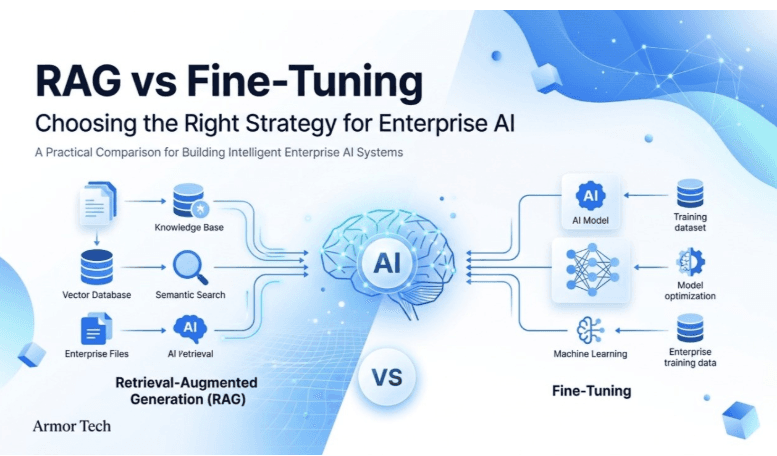
As more organizations integrate AI into their daily operations, choosing the right approach has become just as important as choosing the right model. While both Retrieval-Augmented Generation (RAG) and Fine-Tuning are designed to improve AI performance, they solve different problems and serve different business needs. Understanding when to use each approach can help organizations reduce costs, improve accuracy, and build AI solutions that are easier to maintain and scale. In this article, we'll explore how RAG and Fine-Tuning work, and discuss when each approach is the better choice for enterprise AI.
Quick Definition :RAG, Fine Tuning.
Retrieval-Augmented Generation
Retrieval-Augmented Generation (RAG) is a technique that enhances the capabilities of large language models by connecting them to external knowledge sources. By retrieving relevant information in real time before generating a response, RAG helps AI systems produce answers that are more accurate, context-aware, and aligned with the latest available information(Source:Retrieval-Augmented Generation).
Fine-Tuning
Fine-Tuning is the process of taking a pre-trained AI model and further training it on a specific dataset to improve its performance for a particular task or domain. This allows the model to better understand specialized knowledge, follow specific instructions, or generate responses that align with a business's unique requirements(Source:FIne -Tuning).
Core Terms to Know
Key terms: training data (curated examples used to fine tune a model)
knowledge bases (document stores retrieval pipelines query at inference time)
parameter efficient fine tuning methods such as LoRA
fine tuned models (LLMs adapted via additional supervised training).
Introducing New Model Capabilities:
The Role of Fine-Tuning
Fine-Tuning allows a general-purpose language model to become more effective in a specific domain by training it on carefully selected, domain-specific data. This process refines the model's behavior, enabling it to better understand industry terminology, follow specialized instructions, and generate responses that align with a particular business or use case(Source:IBM Documentation).

Role of Fine Tuning
Fine-Tuning is most effective when the knowledge or requirements remain relatively stable over time. It is commonly used in areas such as healthcare, finance, legal services, and regulatory compliance, where accuracy, consistency, and domain expertise are essential. Although it requires additional time, data, and computational resources, Fine-Tuning provides long-term value by creating AI models that are highly specialized and tailored to enterprise needs.
Integrating External Knowledge:(Source:IBM Documentation)
The Role of RAG
Unlike Fine-Tuning, which requires retraining a model to introduce new knowledge, Retrieval-Augmented Generation (RAG) enhances AI by connecting it to external data sources. This allows organizations to use existing language models while giving them access to the latest business information without modifying the model itself. As a result, RAG has become a popular approach for building AI systems that rely on accurate and continuously updated knowledge.

Role of RAG
A typical RAG workflow includes the following steps:
Data Transformation
Enterprise data is converted into a searchable format, allowing AI systems to efficiently locate relevant information when responding to user queries.
Knowledge Base Storage
The processed data is stored in a centralized knowledge base or vector database, making it available for real-time retrieval whenever it is needed.
Response Generation
When a user submits a query, the AI retrieves the most relevant information from the knowledge base and uses it to generate accurate, context-aware, and evidence-based responses.
The Best of Both Worlds: Combining Fine-Tuning and RAG
Rather than choosing between Fine-Tuning and RAG, many organizations achieve better results by combining both approaches. Fine-Tuning equips an AI model with deep domain knowledge and consistent behavior, while RAG provides access to the latest information from external knowledge sources. Together, they create AI systems that are both specialized and continuously informed.
Ultimately, the right AI strategy should align with an organization's goals rather than relying on a single technology. Evaluating business requirements and combining the right techniques enables enterprises to develop AI solutions that deliver long-term value while adapting to evolving business needs.
How Armor Tech Can Help
Choosing between RAG, Fine-Tuning, or a combination of both isn't just a technical decision it's a business decision. At Armor Tech, we help organizations identify the right AI strategy based on their goals, data, and operational needs. From building RAG-powered knowledge assistants and fine-tuned AI models to developing intelligent AI agents and end-to-end automation solutions, we create scalable AI systems that deliver measurable business value. Our focus is simple: helping businesses transform AI from an emerging technology into a practical tool for growth, efficiency, and innovation.
References
Retrieval-Augmented Generation.What is RAG?
https://www.ibm.com/think/topics/retrieval-augmented-generation
IBM Documentation.RAG vs.Fine Tuning