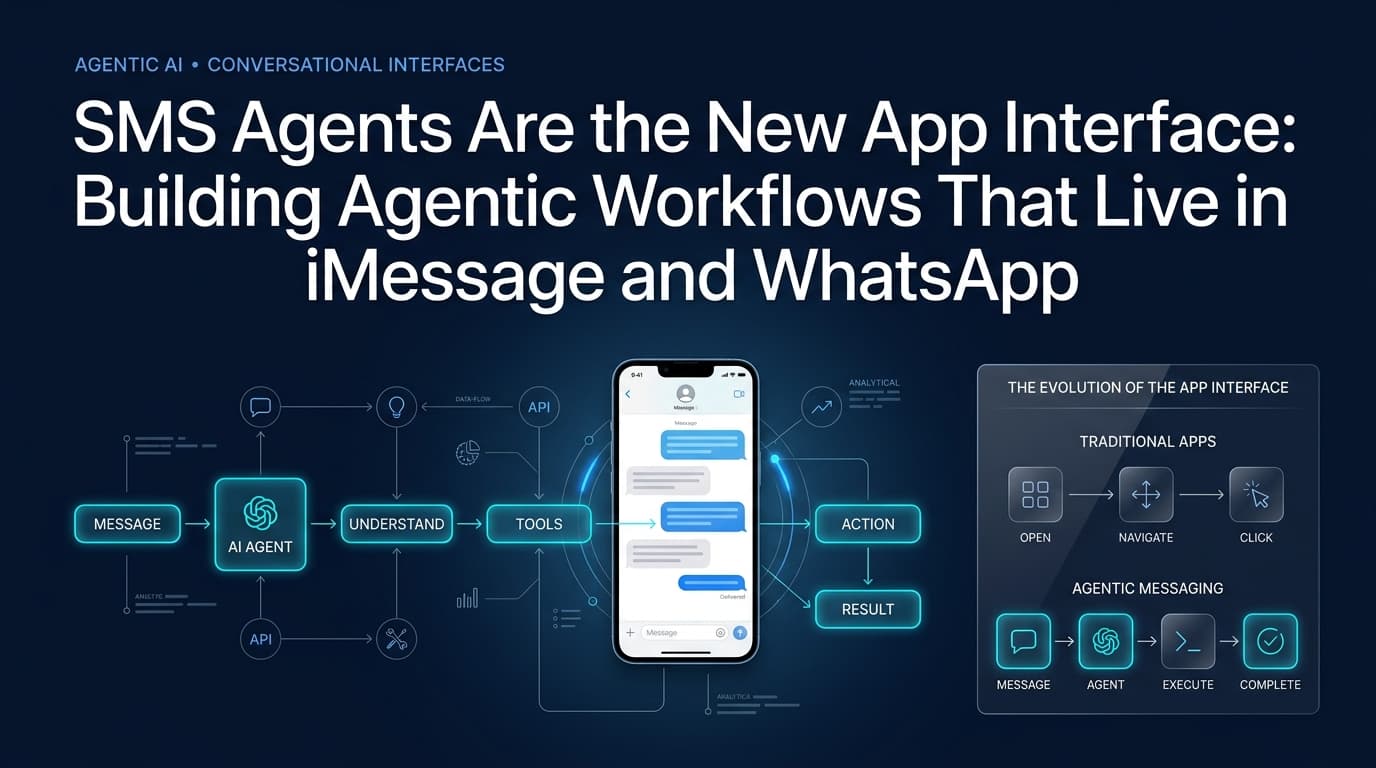
Messaging apps have become the default runtime for AI agents because they eliminate installation friction, provide persistent context through conversation history, and already handle identity. The 17 agents that launched across iMessage, WhatsApp, and SMS in 2026 — from family coordinators like Fambot and Ollie to travel specialists like Miso and content tools like Stanley — prove users will pay $8–100 monthly for agents that live where they already communicate. This guide covers the architectural decisions, platform constraints, and integration patterns needed to ship a production-grade messaging-native agent.
Why Messaging Is Becoming the Default Runtime for AI Agents
Three forces converge here. First, user acquisition cost drops to near zero when the interface is pre-installed on every phone. Second, message threads function as natural long-term memory — no separate vector database required for conversation context. Third, the revenue signal is real: subscription models across the current landscape range from Folk's $8.33/month Pro tier to Ollie's $100/month plan, with family-focused agents like Ohai ($9.99/month) and Fambot (targeting Netflix-equivalent pricing) validating willingness to pay.
Platform validation arrived in two forms. Apple approved Poke for Messages for Business in June 2026, establishing a review pathway for AI agents on iMessage. Meta simultaneously expanded WhatsApp Flows and the Business API, enabling structured interactions beyond template messages. Agents like Folk, Martin, and Rene now operate across iMessage, WhatsApp, and Telegram simultaneously, proving multi-platform deployment is viable with channel-specific adapters.
Platform Constraints & Opportunities: iMessage vs WhatsApp vs SMS/RCS
Each messaging rail imposes different technical boundaries. Understanding them upfront prevents costly rewrites.
iMessage: Messages for Business Framework
Apple's Messages for Business provides rich cards, Apple Pay integration, and authenticated sessions — but only on iOS devices. The review process is gated; Poke was the first AI agent approved after launching in March 2026. Agents receive a dedicated business ID and communicate through Apple's servers, which means message payloads transit Apple infrastructure. Rich interactions (pick lists, time pickers, OAuth flows) work natively, but Android users fall back to SMS or require a separate channel.
WhatsApp: Business API with Session Windows
The WhatsApp Business API operates on a 24-hour customer care window: user-initiated conversations allow free-form messages for 24 hours; outside that window, only pre-approved template messages (HSMs) can be sent. This fundamentally shapes agent architecture — proactive outreach requires template approval, and session state must survive window resets. WhatsApp Flows now support multi-step forms natively, useful for structured data collection. Global reach is the advantage: Town, Rene, and Folk all leverage WhatsApp for professional and international users.
SMS/RCS: Universal Fallback with Carrier Dependencies
SMS works everywhere but supports no rich interactions. RCS adds typing indicators, read receipts, and carousel cards — but carrier support is fragmented. Caddy uses RCS for Android users while serving iMessage on iOS. Martin uses plain SMS as one of six channels. For agents requiring guaranteed delivery (appointment reminders, security codes), SMS remains the reliability baseline. RCS Business Messaging exists but carrier onboarding timelines are unpredictable.
Encryption Impact on Agent Architecture
End-to-end encryption on iMessage and WhatsApp means the platform provider cannot inspect message content. Agents running server-side only see inbound messages after decryption on the user's device (iMessage) or through the Business API webhook (WhatsApp). This limits server-side context inspection for compliance or analytics. Agents like Folk that run on "private cloud computers" effectively operate as user-delegated clients, maintaining context locally. Any architecture requiring server-side message analysis needs explicit user consent and key management.
Architecture Patterns for Agentic Workflows Inside Chat Threads
The conversation thread is your primary key. Every architectural decision flows from this constraint.
Event-Driven Message Processing
Inbound message → intent classification → tool orchestration → state update → response. This loop must complete within platform latency budgets (WhatsApp: ~5 seconds for webhook acknowledgment; iMessage: similar). Folk's architecture runs on a private cloud computer per user, enabling multi-step code execution between messages — essentially a persistent compute environment keyed to conversation ID.
Persistent Session Store Design
Conversation ID maps to: user preferences, OAuth tokens, task queues, long-running workflow state, and conversation summary. PostgreSQL or similar relational store handles structured state (calendar events, contact records); vector storage handles semantic history for context retrieval. The session store survives platform session windows — critical for WhatsApp's 24-hour boundary.
Human-in-the-Loop Checkpoints
High-stakes actions (payments, bookings, credentialed API calls) require explicit approval. Wajo's Fo brings in a human assistant when autonomous execution fails; this hybrid model reduces trust barriers. Implementation pattern: agent emits "approval_required" event with structured payload → user replies with confirmation → agent executes → audit log entry created. Keep approval flows inside the chat thread — don't redirect to web views.
Background Task Runners
Agents like Folk execute multi-step workflows (research → compare → book) asynchronously. Architecture: task queue (Redis/Celery or similar) keyed by conversation ID, workers poll queue, progress updates pushed back to chat via proactive messages. Proactive outreach patterns — Fambot's nightly summaries, Skye's daily briefings — require scheduler integration (cron or event-driven) with template message handling for WhatsApp.
Authentication, Identity & Permissions in Encrypted Channels
Agents act on users' behalf without owning their credentials. The security model must reflect this delegation.
Delegated Authorization with Scoped Tokens
OAuth tokens stored per-user, scoped per-service (Google Calendar: read/write events; Gmail: send/modify; Stripe: create payments). Token vault encrypts at rest; rotation handled per-provider. Instinct's dedicated email addresses for agents (launched September 2026) demonstrate identity separation — the agent gets its own credentials for account creation and business communication, keeping user's personal inbox clean.
Agent Identity Separation
Two models exist. Wajo gives Fo its own email, phone number, and payment card — the agent is a distinct legal entity interacting with businesses. Instinct uses dedicated email addresses per user's agent. Martin and Rene operate through the user's existing channels. Choose based on use case: distinct identity for B2B interactions (vendor calls, bookings); user's identity for personal productivity (calendar, email).
Consent Granularity and Revocation
Per-task consent ("book this restaurant") vs. standing permission ("manage my calendar"). Revocation UX must live in chat: "stop accessing my calendar" → immediate token revocation → confirmation message. Audit trails — immutable logs of every agent action with timestamp, tool invoked, parameters, and result — serve compliance (SOC 2, GDPR) and user trust. Ollie achieved SOC 2 compliance in 2026, a benchmark for family agents handling children's schedules and health data.
Integration Strategies: Build Custom, Use n8n/Make, or Adopt Agent Platforms
The integration layer determines velocity and maintenance burden. Three tiers exist.
Custom Integrations
Full control, highest maintenance. Required when: proprietary business logic, strict data residency (healthcare, finance), or latency-critical paths. You own the API clients, retry logic, rate limiting, and schema migrations. Town's professional integrations (Slack, documents, email) likely use custom connectors for depth.
n8n / Make: Visual Workflow Builders
400+ pre-built connectors, self-hostable, good for rapid MVP and ops-heavy flows. n8n workflow automation and RAG pipeline expertise lets teams ship integrations in hours instead of days. Trade-off: workflow logic lives in JSON, version control is weaker, complex branching gets messy. Self-hosted n8n on your infrastructure controls data and costs at scale; SaaS pricing scales per execution.
Agent Platforms (LangGraph, AutoGen, Custom Orchestration)
When you need multi-agent collaboration, code execution sandboxes, or reasoning loops. Folk's private cloud computer model suggests custom orchestration. LangGraph provides stateful graph execution; AutoGen enables agent-to-agent dialogue. These frameworks replace the intent router with LLM-driven planning — higher capability, higher latency, harder debugging.
Hybrid Approach (Recommended for Most Teams)
n8n for external system integrations (CRM, email, calendar, payments); custom orchestrator for agent reasoning, state management, and tool selection. The orchestrator calls n8n webhooks for integration tasks, receives structured results, continues reasoning. This separates "how to talk to Salesforce" from "whether to talk to Salesforce now."
Lessons from the Current Landscape: What Works and What Doesn't
The 17-agent survey reveals clear patterns without needing to relist every product.
Niche Focus Beats Generalists
Family agents (Fambot, Ohai, Ollie, Orbits), travel (Miso), content (Stanley), and professional (Town) outperform general-purpose assistants. Specialization reduces intent classification surface area, enables domain-specific tooling, and creates clearer value propositions. Stanley connects to Instagram for context-aware content suggestions — a generalist wouldn't justify that integration depth.
Pricing Clarity Correlates with Retention
Per-month subscriptions (Folk $8.33, Martin $21, Tomo $19.99, Ollie $25/100) beat per-message or per-call models. Pally's call-minute tiers ($25 for 30 minutes, $100 for 60) add friction. Users understand "Netflix for family logistics" (Fambot's positioning) better than metered usage.
Proactive Beats Reactive
Agents that push daily briefings (Fambot nightly summaries, Skye contextual cards) create habit loops. Reactive-only agents wait for user intent, which requires behavior change. Proactive messages on WhatsApp require template approval — plan this early.
Group Chat Support Unlocks B2B2C Expansion
Tomo's group chat capability enables household and team adoption from a single user. One parent adds the agent; the whole family interacts. This viral loop doesn't exist in 1:1 channels. Architecture must handle multi-user context, permission scoping per participant, and conversation threading.
Human Fallback Reduces Trust Barrier
Wajo's human-assisted completion for high-stakes tasks (bookings, purchases) addresses the "will it actually work?" hesitation. Implementation: escalation queue routes to human operators with full context; agent resumes after human completes sub-task. Costly but justifiable for high-LTV segments.
MVP Checklist: Launching Your First Messaging-Native Agent in 6 Weeks
This timeline assumes a two-person team (backend + ML/agent logic) with n8n self-hosted.
Week 1: Channel Selection and Use Case Definition
Pick one channel. WhatsApp Business API sandbox is fastest to provision (Meta Business Manager → WhatsApp Business Account → phone number verification → webhook configuration). iMessage requires Messages for Business application and Apple review (weeks). Define 3 core use cases with clear success criteria: e.g., "schedule meeting from email thread," "research and book restaurant," "daily calendar summary at 7 AM."
Week 2: Infrastructure and Auth Foundation
Deploy n8n self-hosted (Docker Compose on VM or Kubernetes) with PostgreSQL for session state. Build encrypted token vault (AES-256 at rest, per-user encryption keys). Implement OAuth flows for Google Calendar, Gmail, and one payments provider (Stripe). Create conversation ID mapping: platform user ID → internal user ID → token set.
Week 3: Intent Router and Core Tool Integrations
Build intent classifier (fine-tuned small model or structured prompt with function calling). Implement 5 tool integrations via n8n: calendar (create/read/update events), email (send/search), web search (SerpAPI or similar), payments (Stripe PaymentIntent), CRM (HubSpot or Airtable). Each tool returns structured result or "approval_required" flag.
Week 4: Proactive Scheduler, Approval Flows, Audit Logging
Add cron scheduler for proactive messages (daily briefings, deadline reminders). Implement approval flow: agent emits approval event → stores pending action in session → user replies "yes"/"no" → webhook processes confirmation → executes tool → logs audit entry. Audit log table: conversation_id, timestamp, action_type, tool_name, parameters_hash, result_status, human_approved boolean.
Week 5: Beta with Instrumentation
Recruit 20 power users (friends, network, waitlist). Instrument: end-to-end latency (message in → response out), task completion rate (approved actions / initiated actions), escalation frequency (human-in-the-loop triggers), error rates by tool. Target: <3s median latency, >80% task completion, <10% escalation.
Week 6: Harden and Multi-Channel Prep
Add retry logic with exponential backoff for all external APIs. Implement dead letter queue for failed webhook deliveries. Build channel adapter interface: normalize inbound payload (WhatsApp, iMessage, SMS) → internal message object → process → normalize outbound. Prepare Messages for Business submission (Apple review takes 2-4 weeks). Submit WhatsApp template messages for proactive notifications.
Frequently Asked Questions
How do I handle WhatsApp's 24-hour session window for proactive agent messages?
Use pre-approved template messages (HSMs) for any outbound message outside the 24-hour window. Templates require Meta approval (typically 24-48 hours). Design your proactive flows — daily briefings, deadline alerts, opportunity notifications — as parameterized templates. Store the last user message timestamp per conversation; if >24 hours, route through template endpoint instead of free-form message endpoint.
Can I run the agent logic client-side to avoid E2EE limitations?
Folk's architecture runs a "private cloud computer" per user — effectively a dedicated VM that acts as the user's delegate. This keeps message content off your central servers while enabling multi-step execution. For lighter agents, on-device ML (Core ML on iOS, ML Kit on Android) can handle intent classification and simple tool calls, but complex reasoning still needs cloud compute. The trade-off is infrastructure cost per user versus data privacy.
What's the fastest path to iMessage deployment?
Apply for Messages for Business immediately — Apple's review takes weeks and requires a registered business, privacy policy, and demo video. While waiting, build on WhatsApp Business API (sandbox available same day) and SMS (Twilio/Telnyx). Use a channel adapter layer so the same agent logic serves all three. Poke's approval in June 2026 established precedent; Apple now has a review pathway for AI agents specifically.
Armor Tech builds production-grade agentic AI systems we build for messaging interfaces — from architecture through App Store and WhatsApp Business review. If you're ready to deploy an agent where your users already live, book a technical discovery call.