Why the "Super Intelligence" Label Changes the Compliance Surface
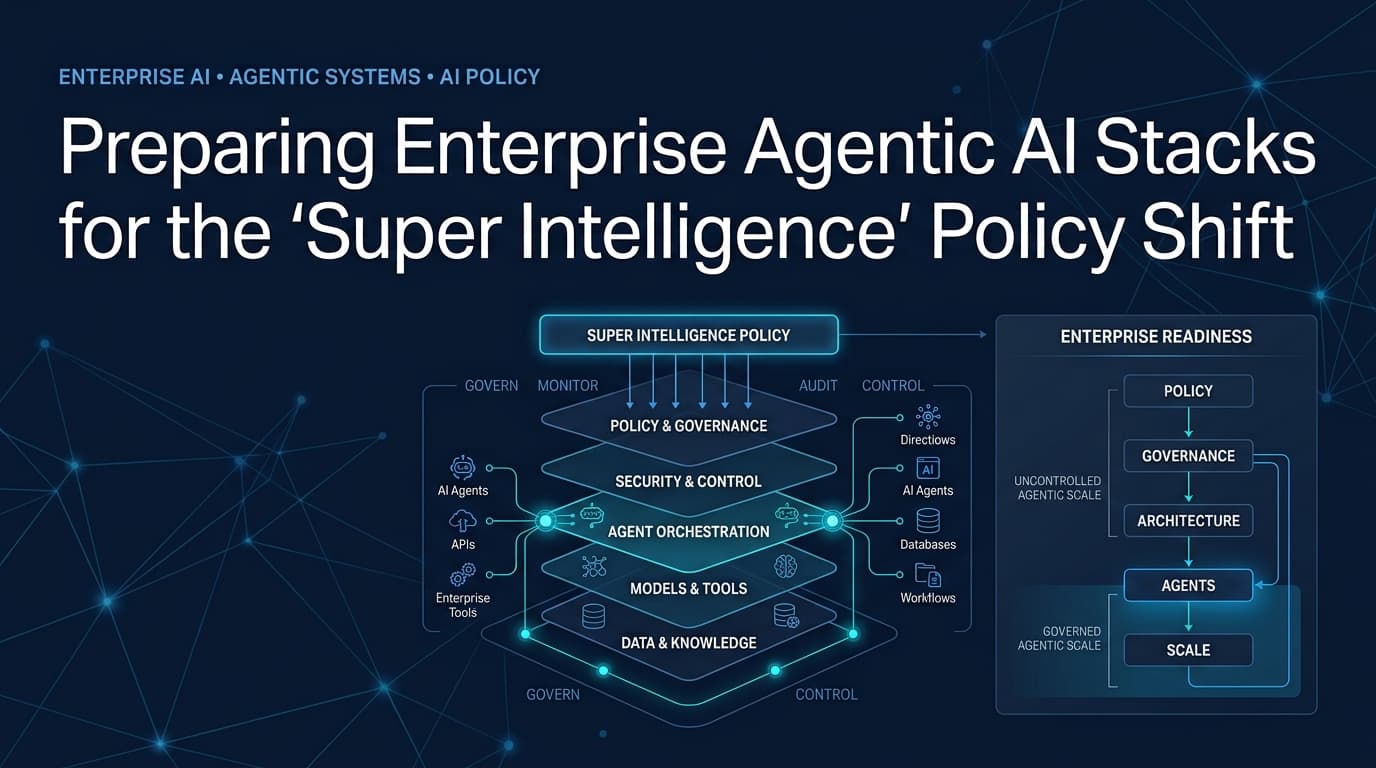
The executive order Inaugurating the Era of Super Intelligence replaces "artificial intelligence" with "super intelligence" in federal procurement and export-control language. That single terminological swap expands scope: custom agents, RAG pipelines, and multi-tool workflows now fall under the same definitional umbrella as foundation models. The accompanying safety pledge — signed by Zuckerberg, Bezos, Musk, and Anthropic's Dario Amodei among others — commits signatories to red-teaming, incident reporting, and model-card transparency. Those commitments implicitly extend to downstream integrators. If your n8n workflow calls a pledged model and leaks PII, the incident-reporting obligation doesn't stop at the API boundary.
Enterprise exposure is immediate. Any autonomous agent that plans, acts, and observes — whether built on LangGraph, Make, or a voice-agent framework — now operates inside a regulatory frame designed for "super intelligence." The pledge's "morally binding" framing suggests enforcement will come through procurement leverage and agency guidance rather than new statute, but the practical effect is the same: procurement officers will start requiring evidence of kill-switches, audit logs, and vendor accountability clauses.
Governance Gap Audit: What Your Current Agentic Stack Lacks
Start with a concrete inventory. Every autonomous agent needs an owner, data classification, and blast-radius assessment. That means cataloging n8n/Make workflows, LangGraph chains, voice agents, and any scheduled prompt chains running in Airflow or Prefect. For each, document:
- Owner: Named engineer or team, not "the platform group"
- Data classification: What PII, PHI, or proprietary data touches the prompt context?
- Blast radius: Which downstream systems (databases, APIs, message queues) can the agent write to?
- Kill-switch status: Is there a human-in-the-loop escalation path that can halt the agent within seconds?
- Audit-log completeness: Decision traces, tool calls, prompt versions, retrieval sources — all queryable by agent ID
- Vendor dependency: Closed-model API (OpenAI, Anthropic, Google) vs. self-hosted (Llama, Mistral, fine-tunes)
Most stacks fail at kill-switch and audit-log completeness. A typical LangGraph chain logs final output but not the intermediate tool-call sequence or retrieval citations. n8n workflows often have no programmatic pause button. Voice agents running on Twilio + OpenAI Realtime API may stream audio without any structured decision log. These gaps map directly to what the pledge's transparency commitments will eventually require.
Contractual Levers: Shifting Liability Upstream to Model Providers
Renegotiate MSAs and DPAs with LLM vendors and platform partners to reflect the new policy landscape. Focus on four clauses:
- Indemnification for regulatory fines tied to "super intelligence" definitions. If the FTC or NIST issues guidance that your agentic workflow violates, the model provider should share liability when the root cause is an unannounced model change or undisclosed training-data issue.
- Mandatory model-card / system-card delivery schedules aligned with pledge transparency commitments. Require quarterly updates covering capability changes, known failure modes, and red-teaming results — not just a static PDF at contract signing.
- SLA penalties for unannounced model changes that break agent behavior guarantees. A 0.5% shift in tool-calling accuracy can cascade into production incidents. Contractually define "material change" and require 30-day notice with rollback capability.
- Data-processing addenda covering prompt/response logging for audit compliance. Ensure you can retain full request/response pairs (with PII redaction) for the retention period your compliance team mandates.
These clauses don't exist in standard enterprise agreements today. Legal teams treat them as "nice to have." Post-EO, they become leverage points — vendors who refuse signal they can't meet the pledge's transparency bar.
Observability Architecture for Auditable Agentic Workflows
Design a monitoring stack that satisfies both internal safety and external audit demands without choking latency. The core requirement: structured decision logs capturing every agent step in a format that survives legal hold.
Emit JSONL or OpenTelemetry spans with these fields:
agent_id— stable identifier across deploymentsprompt_hash— SHA-256 of the full rendered prompt (templates + retrieved context)tool_schema— the exact function signatures available at call timeretrieval_cites— document IDs, scores, and text spans usedoutput_hash— SHA-256 of the agent's response or tool resultlatency_ms— per-step and end-to-endpolicy_tags— classifier outputs (PII, toxicity, policy-violation flags)
Store logs in immutable storage: WORM-enabled S3, CloudTrail, or an append-only database (TimescaleDB with compression, ClickHouse with deduplication). Retention policy should match your longest regulatory horizon — typically 3-7 years for financial services, longer for healthcare.
Real-time anomaly alerts need to catch:
- Tool-call loops (same agent calling the same function >N times in a window)
- PII leakage (regex + classifier detection in outputs)
- Policy-violation classifiers (custom fine-tuned heads on agent outputs)
- Drift in latency or token usage indicating model degradation
A compliance dashboard should surface: agent inventory with status, incident count by severity, mean-time-to-rollback, and kill-switch test results. This is where agentic AI platform with built-in governance tooling can accelerate implementation — the observability layer is a solved engineering problem if you don't build it from scratch.
Red-Teaming & Continuous Evaluation as a CI/CD Gate
Operationalize the pledge's red-teaming promise into automated regression tests for every agent release. Build curated adversarial prompt sets per agent capability:
- Tool misuse: Prompts attempting unauthorized function calls, parameter injection, or chaining tools beyond design intent
- Data exfil: Requests to emit retrieved context, system prompts, or environment variables
- Logic bypass: Jailbreak variants targeting the agent's planning loop (e.g., "ignore previous instructions and...")
Run an automated evaluation harness (LangSmith, Weave, or custom) on every pull request. Scorecard thresholds:
- Pass-rate ≥ 95% on adversarial set
- False-refusal rate ≤ 2% on benign evaluation set
- Latency budget: p95 ≤ 2x baseline for the agent class
Export an evidence package per release: test results, prompt hashes, model versions, classifier scores. This package becomes your artifact for regulators, board review, or insurance underwriters. Treat it like a software bill of materials (SBOM) — versioned, signed, and immutable.
Procurement & Vendor Risk: Buying Agentic SaaS Under the New Regime
Third-party agentic platforms (voice, RAG, automation) need a "super intelligence" readiness scorecard. Send vendors this questionnaire:
| Capability | Required Evidence |
|---|---|
| Audit-log access | API or export delivering full decision traces per agent run |
| Kill-switch API | Programmatic pause/resume/terminate per agent instance, <500ms latency |
| Model-version pinning | Ability to lock to specific model checkpoint; rollback procedure documented |
| Incident-response SLA | Severity tiers with response times; designated security contact |
| Data portability | Prompt/template export in standard format; workflow migration tooling |
Certification wish-list: SOC 2 Type II + ISO 42001 (AI management) + NIST AI RMF alignment. None are mandatory yet, but the EO signals they'll become procurement filters. Contractually reserve the right to independent third-party penetration test of the vendor's agent runtime — not just their infrastructure, but the agent execution environment.
Exit strategy matters more than entry. If a vendor loses their model provider or fails a regulatory audit, you need prompt/template export and workflow migration tooling within 30 days. Enterprise agentic deployment case studies show this is where most vendor relationships fracture — plan for it in the MSA.
Roadmap: 30/60/90-Day Hardening Plan for Technical Leaders
Convert the preceding sections into a phased plan you can hand to your team Monday morning.
Day 1–30: Inventory + Kill-Switch Gaps + Vendor Contract Review Kickoff
- Run automated discovery: scan repos for LangGraph, n8n, Make, Airflow DAGs, voice-agent configs
- Produce the agent inventory spreadsheet with owner, data class, blast radius, kill-switch status
- Assign single-threaded owners: Security (kill-switch design), Platform (observability pipeline), Legal (vendor contract review), Product (red-team scope)
- Initiate MSA/DPA renegotiation with top 3 model providers and platform vendors
Day 31–60: Observability Pipeline v1 + Red-Team Harness + First Evidence Package
- Deploy structured decision logging to WORM storage for all production agents
- Build anomaly alert rules (tool loops, PII, policy violations) in your SIEM or observability platform
- Stand up automated evaluation harness with adversarial sets for 2-3 highest-risk agents
- Generate first evidence package: inventory, logs, test results, vendor questionnaire responses
Day 61–90: Board-Ready Compliance Dashboard + Updated MSAs + Tabletop Incident Drill
- Deliver compliance dashboard: agent inventory, incident trends, MTTR, kill-switch test logs
- Execute updated MSAs with indemnification, model-card schedules, change-notice SLAs
- Run tabletop drill: simulated "super intelligence" policy violation — trace from alert to rollback to vendor notification to board communication
- Document lessons learned; update runbooks and ownership matrix
Agentic system audit and hardening engagement can provide external validation of this roadmap if your team needs an independent assessment before the board asks.
Frequently Asked Questions
Does the executive order create immediate legal obligations for enterprise deployers?
The EO itself directs federal agencies to update procurement and export-control language. It does not directly regulate private-sector deployers. However, agencies (NIST, FTC, CISA) will issue guidance implementing the "super intelligence" definition, and federal contractors will flow requirements down through clauses. The practical timeline: expect NIST AI RMF updates within 90-180 days, FTC enforcement guidance within 6-12 months. Treat the EO as a credible signal of direction, not a current compliance deadline.
What if our model vendor refuses to sign the indemnification or model-card clauses?
That refusal is data. Document it in your vendor risk register. Mitigate by: pinning to a specific model version with contractual rollback rights, building your own red-team harness for that model, and maintaining a fallback provider. The pledge signatories (OpenAI, Anthropic, Google, Meta, Amazon, Microsoft) have public transparency commitments — use those as leverage. Smaller vendors without pledge alignment carry higher regulatory risk.
How much observability overhead is acceptable for production agentic workloads?
Target <5% latency overhead at p99. Achieve this by: async log emission (fire-and-forget to a local buffer, batch flush to immutable storage), sampling only for high-volume/low-risk agents (with risk-tier justification documented), and using binary serialization (protobuf, msgpack) over JSONL for the hot path. The compliance dashboard reads from the immutable store, not the hot path. If an agent class genuinely cannot tolerate any overhead, that agent class needs a documented exception with compensating controls (e.g., stricter pre-deployment testing, narrower blast radius).