Why Voice-First Agents Just Became an Automation Requirement
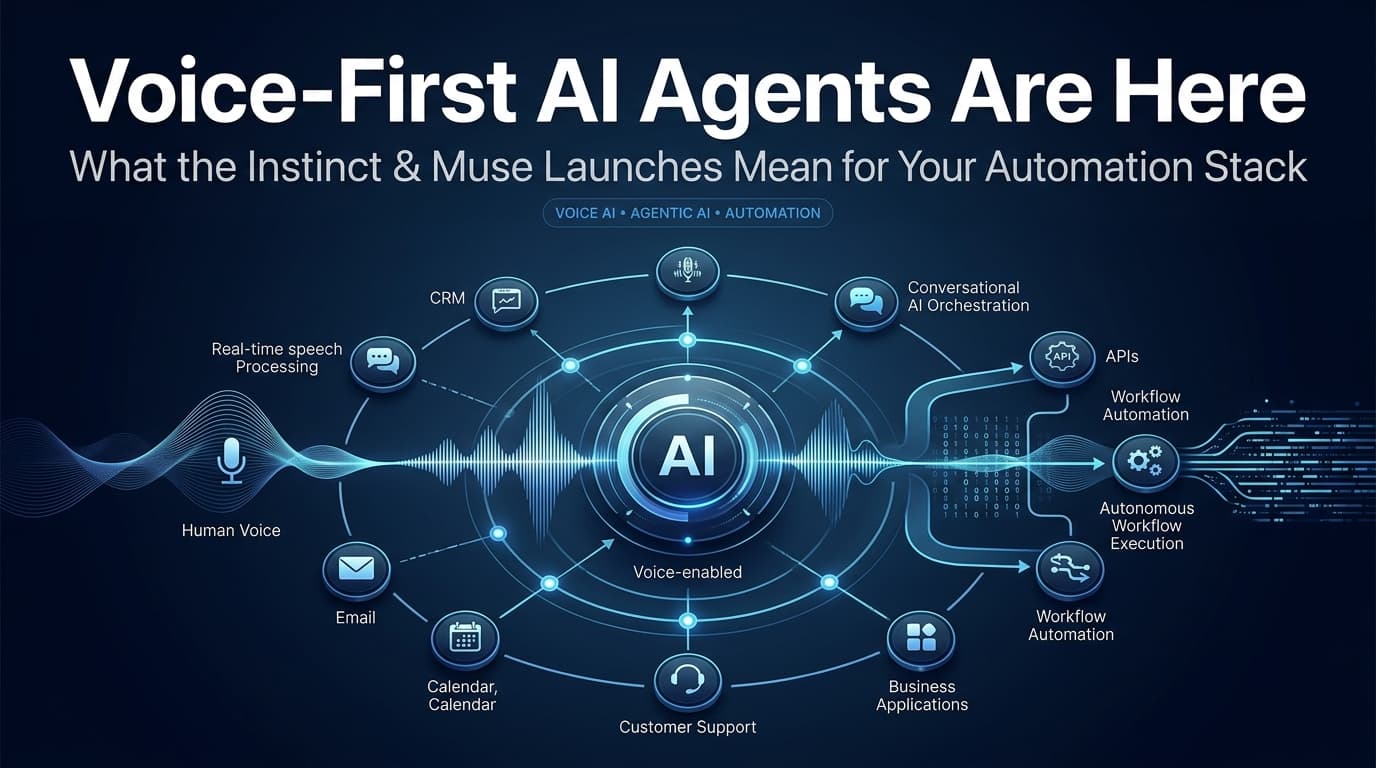
Instinct Concierge and Meta's Muse both shipped real-time calling within days of each other. The press covers feature parity; engineers see a market signal that B2B buyers will expect voice-native automation inside the same workflows that already handle email, webhooks, and database writes. The announcements skip the integration layer entirely—no API docs, no WebRTC specs, no latency budgets. That layer is what n8n and Make builders now have to construct.
The Missing Middleware: What the Press Releases Don't Tell You
Getting an LLM to speak on a phone call requires solving four distinct engineering problems that sit between the model and the PSTN.
WebRTC Signaling + ICE Negotiation in Serverless Functions
Browser-based WebRTC works because both peers run long-lived ICE agents. In a serverless automation platform, the function cold-starts, negotiates ICE candidates, and must maintain a DTLS-SRTP session for the call duration. You need a media relay (TURN) that survives function recycling, plus a signaling channel—typically WebSocket or SIP over WebSocket—that stays open while the workflow executes. Most n8n/Make deployments lack persistent WebSocket workers, so the media path must terminate on an external media server (Janus, MediaSoup, or a CPaaS media endpoint) while the workflow orchestrates via HTTP callbacks.
Turn-Taking, VAD, and Barge-In State Machine
Human conversation relies on overlapping speech, back-channeling, and interruption. A voice agent needs a voice-activity detector (VAD) running on the media server, a turn-taking policy (half-duplex vs. full-duplex), and a barge-in handler that cancels in-flight TTS when the user speaks. This is a state machine with states like LISTENING, THINKING, SPEAKING, INTERRUPTED. The LLM only sees transcript deltas; the state machine lives in the media layer or a dedicated orchestration service. Without it, the agent talks over the user or leaves awkward silences.
PSTN Gateway Fallback When WebRTC Fails
WebRTC fails on corporate networks that block UDP, on mobile carriers with aggressive NAT, and on devices without codec support (Opus/G.722). The fallback chain is WebRTC → SIP trunk (via Kamailio/OpenSIPS) → PSTN via a carrier gateway. Each hop adds 30-80 ms latency and requires re-inviting the media path. Your automation must track which leg is active so that call-transfer, recording, and DTMF collection continue working after fallback.
Latency Budgets: STT → LLM → TTS Round-Trip Under 800 ms
Perceptual studies show conversation feels natural below ~800 ms end-to-end. That budget splits roughly: 150 ms network to STT, 200 ms STT inference, 250 ms LLM generation (streaming), 150 ms TTS synthesis, 50 ms network to media server. Streaming tokens from the LLM to a streaming TTS (e.g., ElevenLabs, Cartesia, or self-hosted Piper) is mandatory—batch TTS blows the budget. If your n8n workflow makes sequential HTTP calls for each step, you've already lost.
Architecture Patterns for n8n: From HTTP Request to Live Call
Three patterns map cleanly to n8n's execution model. Choose based on call volume, inbound vs. outbound, and whether you can run a persistent worker.
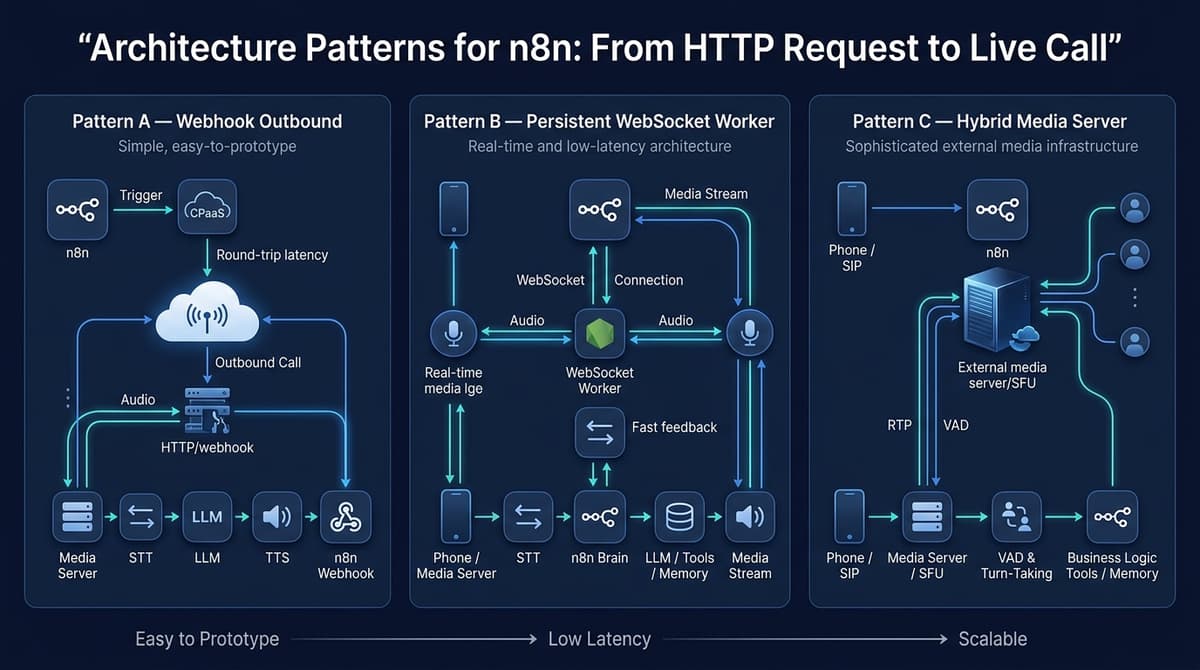
Pattern A: Webhook-Triggered Outbound via Twilio/Vonage/SignalWire
Easiest to prototype. n8n receives a webhook (form submit, cron, chat message), calls the CPaaS REST API to create an outbound call with a Twiml or NCCO that points back to an n8n webhook for onAnswer. The media server streams audio to your STT endpoint; n8n receives transcript chunks via webhook, streams LLM tokens to TTS, and returns audio URLs. Pros: zero custom infrastructure. Cons: each turn is a new HTTP round-trip; latency adds up; hard to do barge-in because the CPaaS controls the media loop.
Pattern B: Persistent WebSocket Worker (Custom Node) for Inbound
Deploy a small Node.js/Go process that holds a WebSocket to the media server (Janus/MediaSoup) and a long-polling connection to n8n's internal API. The worker forwards audio frames to STT, pushes partial transcripts to n8n via a dedicated webhook, receives TTS audio chunks, and writes them to the RTP stream. n8n becomes the "brain" only—state machine, tool calls, memory—while the worker handles real-time I/O. Pros: sub-100 ms loop, full barge-in control. Cons: you now operate a stateful service; n8n Cloud can't run it—self-hosted only.
Pattern C: Hybrid—n8n Orchestrates, External Media Server Handles RTP
Spin up a MediaSoup or LiveKit SFU on a VM. n8n workflows call the SFU's REST API to create rooms, add SIP participants, start/stop recording, and inject TTS audio via a bot participant. The SFU runs the VAD and turn-taking logic; n8n receives structured events (user_speech_start, transcript_final, dtmf_received) via webhook. This separates concerns cleanly: n8n for business logic, SFU for media. Pros: scales horizontally, supports conferencing and assistant-to-assistant calls (like Instinct's trusted-network feature). Cons: most moving parts; requires SFU ops knowledge.
Make.com Scenarios: Handling Async Voice Callbacks
Make's scenario scheduler and built-in data stores can manage call state without a custom server—if you design for eventual consistency.
Webhook Endpoints for Call-Status Events
Create a dedicated webhook scenario per event type: call.ringing, call.answered, call.ended, speech.result, dtmf.received. Each webhook validates a shared secret, writes a record to a Make data store keyed by call_sid, and triggers the next scenario via Run a scenario module. Keep webhooks stateless—they only persist events.
Data Store as Lightweight Call-State Machine
Use a data store record per call with fields: status (enum), turn (integer), context (JSON: reservation details, user preferences), idempotency_key (hash of action + params). Scenarios read the record, decide the next action (ask question, call function, transfer), update status and turn, and return TTS text or function result. This avoids passing massive payloads between scenarios.
Retry / Exponential Backoff for Failed TTS/STT Webhooks
STT and TTS providers occasionally 5xx or time out. Wrap each external call in a Make Error handler route that increments a retry_count field, waits 2^retry_count seconds (capped at 30 s), and re-triggers the same scenario. Set a hard limit (e.g., 3 retries) then fall back to a static "Sorry, I'm having trouble" TTS prompt and log the failure for alerting.
Fallback Logic That Keeps the Workflow Alive
Real-time audio degrades. The workflow must survive without dropping the user's request.
WebRTC → SIP Trunk → PSTN Cascade
When ICE connection state moves to failed or disconnected for >5 s, the media server signals the orchestration layer. The workflow issues a transfer to a SIP URI backed by a carrier gateway (Twilio Elastic SIP Trunk, Telnyx, SignalWire). The transfer is a SIP REFER or 302; the media server re-invites the new leg. Preserve the call_sid across legs so downstream logic (recording, CRM link) stays correlated.
Graceful Degradation: Voice → SMS → Email Summary
If the call drops after the user's intent is captured (e.g., "book table for 7 PM"), the workflow should not restart. Branch on call.status == 'failed' && intent_captured == true: send an SMS confirmation with a deep link to modify, and email a summary with a calendar .ics. If intent isn't captured, SMS the user: "Call dropped. Reply with time/party size and I'll retry."
Idempotency Keys So Retries Don't Double-Book Reservations
Every external action (restaurant API, calendar write, payment) gets an idempotency key: sha256(call_sid + action_name + params_json). Store the key in the call data store before the first attempt. On retry, the external service (or your wrapper) sees the key and returns the original result. This is non-negotiable for any workflow that mutates state.
Security & Compliance Checklist for Production Voice Flows
Before shipping customer-facing calling, audit these items. They're not optional.
STIR/SHAKEN attestation for outbound caller ID. Your CPaaS must sign calls with an A-attestation; otherwise carriers mark them spam. Verify the
Identityheader on a test call.PCI/DSS scope if payment data is spoken. DTMF collection is safer than ASR for card numbers—DTMF never hits STT logs. If you must use ASR, ensure the STT provider offers PCI-compliant transcription (no logging, encrypted pipeline).
Recording consent prompts per jurisdiction. One-party vs. two-party consent varies by US state and country. Play a pre-recorded "This call may be recorded" prompt before recording starts; log the timestamp and user acknowledgment (DTMF 1 or verbal "yes").
Encryption at rest for call transcripts in vector store. If you embed transcripts for RAG, encrypt the vector DB (pgvector with TDE, Pinecone with SSE, Weaviate with encryption module). Transcripts contain PII—names, addresses, medical info.
Next Steps: Prototype a Voice-Enabled Concierge in One Sprint
Five days to a working slice that proves the stack before budget asks.
Day 1: Spin up a SignalWire or Twilio trial account + n8n Cloud (or self-hosted on Railway/Render). Provision a phone number, enable voice, configure the
onAnswerwebhook to your n8n endpoint.Day 2: Build the outbound call webhook. n8n calls the CPaaS REST API, passes a minimal TwiML/NCCO that says "Connecting you to the assistant" and
<Stream>s to your media server (or CPaaS media stream). Verify audio reaches the media server.Day 3: Add STT webhook → LLM → TTS loop. Use a streaming STT (Deepgram Nova-2, Gladia, or self-hosted Whisper.cpp via WebSocket). Stream LLM tokens (OpenAI, Anthropic, or local Llama.cpp) to a streaming TTS. Return audio chunks to the media server. Measure first-token-to-audio latency.
Day 4: Implement fallback branch + logging. Add a
catchnode on the STT/LLM/TTS chain. On failure, log error to Postgres/Supabase, send SMS fallback via CPaaS SMS API, end call gracefully. Add idempotency keys to any mutation nodes.Day 5: Load test 50 concurrent calls using a simple k6 or Artillery script that hits your outbound webhook. Measure P95 end-to-end latency (user speech → TTS audio start). Target <800 ms. Document where the budget breaks.
At the end of the sprint you'll have a measurable baseline, not a slide deck. That's what moves the conversation from "can we?" to "what's the next bottleneck?"
Frequently Asked Questions
Can I run this entirely on n8n Cloud without a VPS?
Pattern A works on n8n Cloud because it uses only HTTP webhooks and CPaaS media. Patterns B and C require a persistent WebSocket worker or media server, which need a VPS, Railway, Render, or Kubernetes pod. n8n Cloud does not expose long-lived TCP listeners.
Which CPaaS gives the lowest latency for streaming STT/TTS?
Latency is dominated by the STT and TTS provider locations, not the CPaaS. Choose a CPaaS with media regions near your STT/TTS endpoints (e.g., Twilio US1 + Deepgram US-East, or SignalWire + Gladia EU). Test round-trip with a 100-byte audio payload before committing.
How do I handle assistant-to-assistant calls like Instinct's trusted network?
Model each assistant as a SIP endpoint registered to your SFU. When Assistant A needs Assistant B, the workflow creates a conference room, invites both SIP endpoints, and bridges the RTP. The SFU handles mixing; n8n tracks which assistant owns which task via the call data store. This is Pattern C territory.