AI agents are becoming more capable, moving beyond simple conversations to using tools, handling multi-step tasks, and working across longer workflows. But an LLM does not automatically remember everything once its current context is gone. That is where agent memory becomes important. While the context window provides information for the current task, memory allows an agent to store, retrieve, and reuse useful information over time. As AI agents become more autonomous in 2026, understanding different forms of memory from working and semantic memory to episodic, procedural, retrieval, parametric, and prospective memory is becoming an important part of building reliable, context-aware AI systems.
What is AI agent memory?
AI agent memory is the ability of an AI system to retain, organize, and retrieve information from previous interactions or experiences so it can make better decisions and perform tasks more effectively(Source: IBM Docs).
Unlike conventional AI models that often treat each request as a separate task, memory-enabled AI agents can maintain context, identify patterns across interactions, and adjust their behavior based on previous experiences. This capability is particularly valuable for goal-driven AI applications that depend on continuous feedback, accessible knowledge, and the ability to adapt over time.
Frameworks for Agentic AI Memory
Building memory into an AI agent usually involves a mix of external data stores, memory architectures, and feedback mechanisms. The right approach depends on how the agent is designed and what it needs to accomplish. A simple agent may only need short-term context, while more advanced agents can require persistent memory, retrieval systems, and feedback loops to learn from previous interactions. In practice, memory architecture should be chosen based on the agent’s complexity, use case, and how much adaptation it needs over time(Source:IBM Docs).
LangChain
LangChain is a widely used framework for developing AI applications that need to work with memory, APIs, tools, and multi-step reasoning workflows. It provides building blocks that developers can use to connect agents with external memory systems. When paired with vector databases, LangChain can help applications store and retrieve relevant information from previous interactions, allowing agents to maintain more consistent context across conversations and tasks.
LangGraph
LangGraph provides a graph-based approach for building more structured and stateful AI agent workflows. It allows developers to manage an agent's state across multiple steps and coordinate more complex interactions between different components. When combined with vector databases, agents can store representations of previous interactions and retrieve relevant information when needed. This can be particularly useful for applications such as AI-powered document generation, where an agent may need to remember user preferences, previous edits, and decisions made during earlier tasks.
The Seven Types of Agent Memory
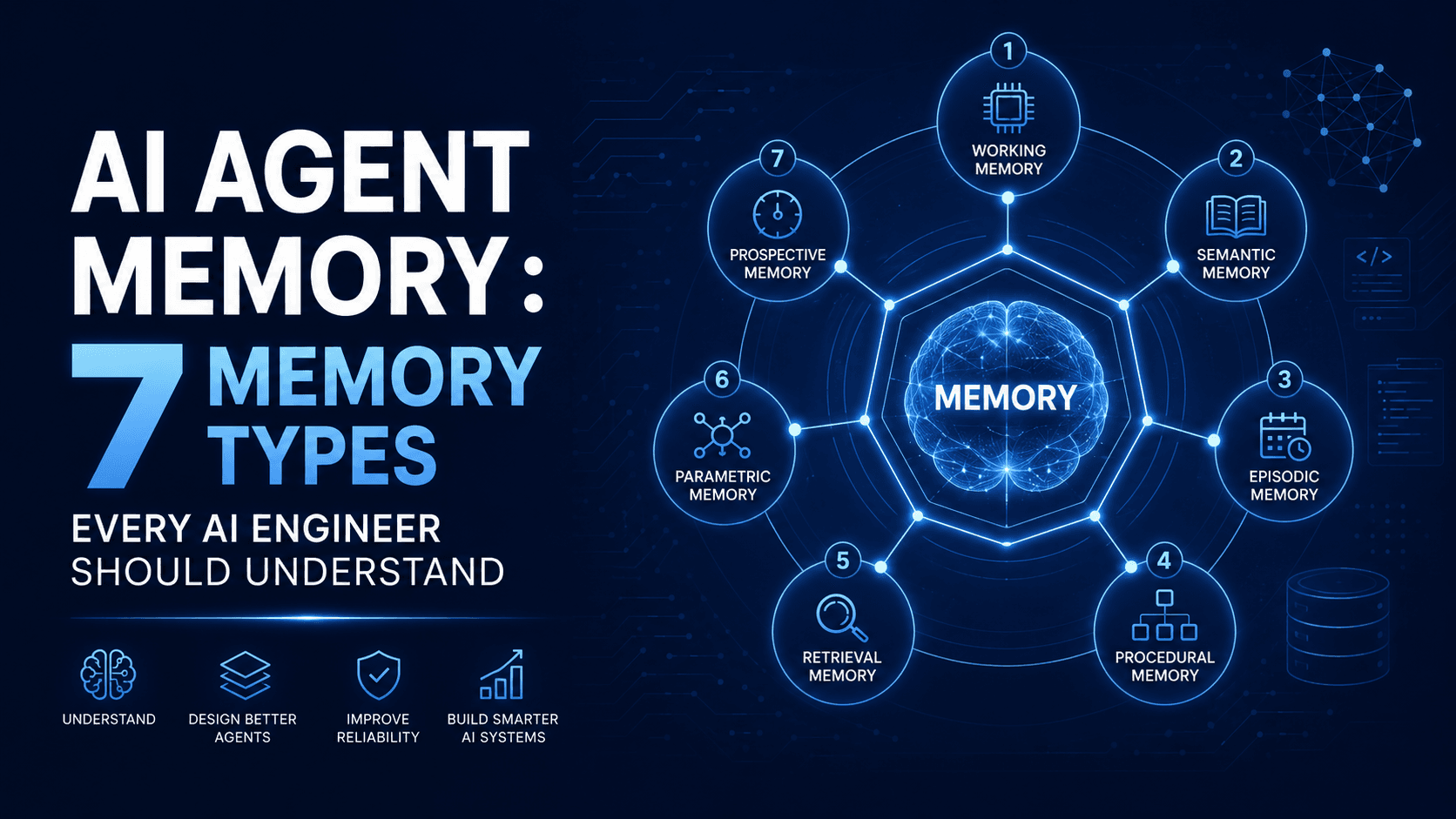
The following seven types of agent memory provide a practical framework for understanding how modern AI agents maintain context, learn from past interactions, and support more reliable decision-making(Source:Marktechpost Docs).
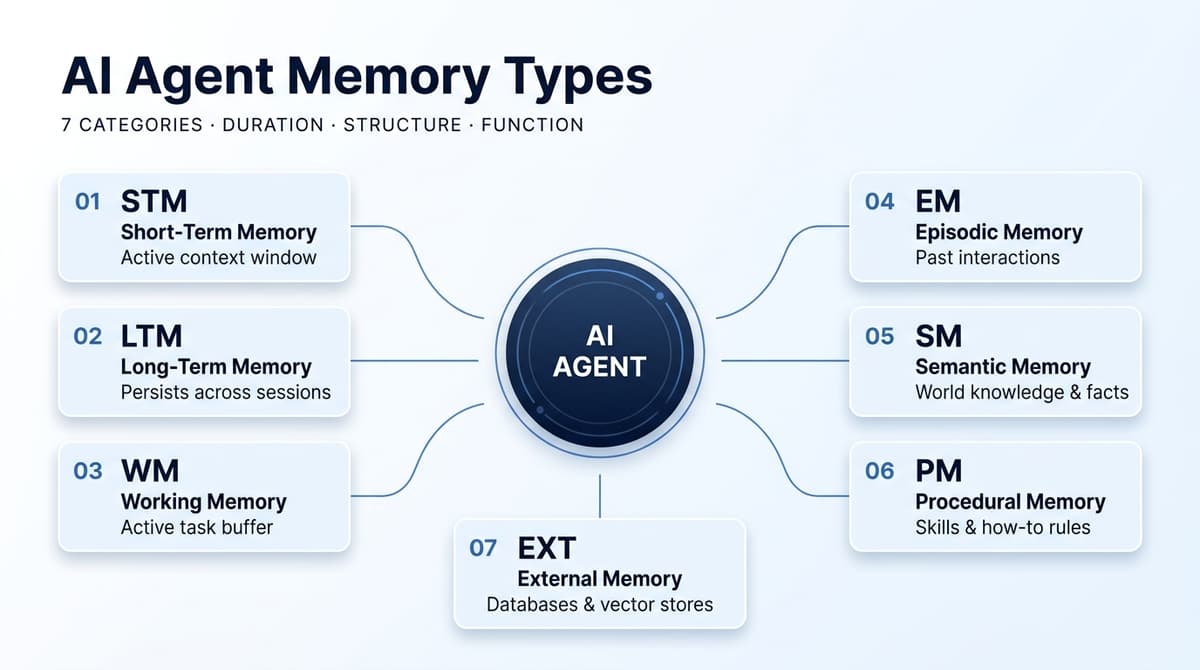
1. In-Context / Working Memory (Short-Term)
Working memory contains the information an AI agent can access during its current task through the context window. This can include system instructions, recent conversation messages, tool responses, and intermediate task information. It works much like RAM in a computer: it is quickly accessible and necessary for immediate processing, but it is temporary and limited by the model's context capacity. All information an agent uses during a task ultimately has to fit within this available context.
2. Semantic Memory (Long-Term)
Semantic memory stores persistent facts, user preferences, and domain-specific knowledge that can remain useful across multiple interactions. For example, an agent might remember that a user prefers Python over JavaScript. Unlike episodic memory, semantic memory focuses on what is known rather than the specific interaction in which the information was learned. It effectively acts as an organized knowledge base about users, topics, or environments.
3. Episodic Memory (Long-Term)
Episodic memory preserves details about specific past experiences, including conversations, completed tasks, decisions, successes, and failures. This allows an agent to look back at previous experiences and use them to improve future performance. Approaches such as Reflexion and ExpeL demonstrate how agents can record lessons or reflections from previous tasks and reuse those insights in later runs.
4. Procedural Memory (Long-Term)
Procedural memory represents an agent's knowledge of how to perform a task. It can include learned skills, tool-use patterns, workflows, and behavioral rules. Instead of figuring out the same process from scratch every time, an agent can rely on an established procedure for recurring tasks. For example, a customer-support agent can follow a predefined or learned workflow when handling repeated password-reset requests.
5. External / Retrieval Memory (Short-Term + Long-Term)
External or retrieval memory refers to information maintained outside the model and accessed when needed. A common implementation uses vector databases, where relevant information can be retrieved through similarity search and added to the agent's current context. This approach is closely connected to Retrieval-Augmented Generation (RAG), allowing agents to access documents, previous interactions, or other external knowledge. However, the usefulness of this memory depends heavily on the quality and relevance of the retrieval process.
6. Parametric Memory (Long-Term)
Parametric memory is the knowledge and learned patterns encoded directly into a model's parameters during training or fine-tuning. It includes capabilities such as language understanding, learned associations, reasoning patterns, and broad world knowledge. When using this type of memory, the model does not need to query an external database for every piece of information; it generates responses based on what has been encoded in its weights. The main limitation is that updating this knowledge generally requires additional training or fine-tuning rather than simply changing a stored record.
7. Prospective Memory (Short-Term + Long-Term)
Prospective memory enables an agent to retain information about future intentions, planned actions, and pending goals. Instead of only remembering what has already happened, the agent can keep track of what it needs to do next or what it has committed to doing later. This is particularly important for long-running and multi-step agents. Without some form of prospective memory, an agent may lose track of unfinished tasks, scheduled actions, or commitments made earlier in a workflow.
How the Seven Compare
The table below provides a quick comparison of the seven memory types, highlighting how long they persist, where the information is stored, and how they are typically implemented in AI agent systems(Source:Marktechpost Docs).
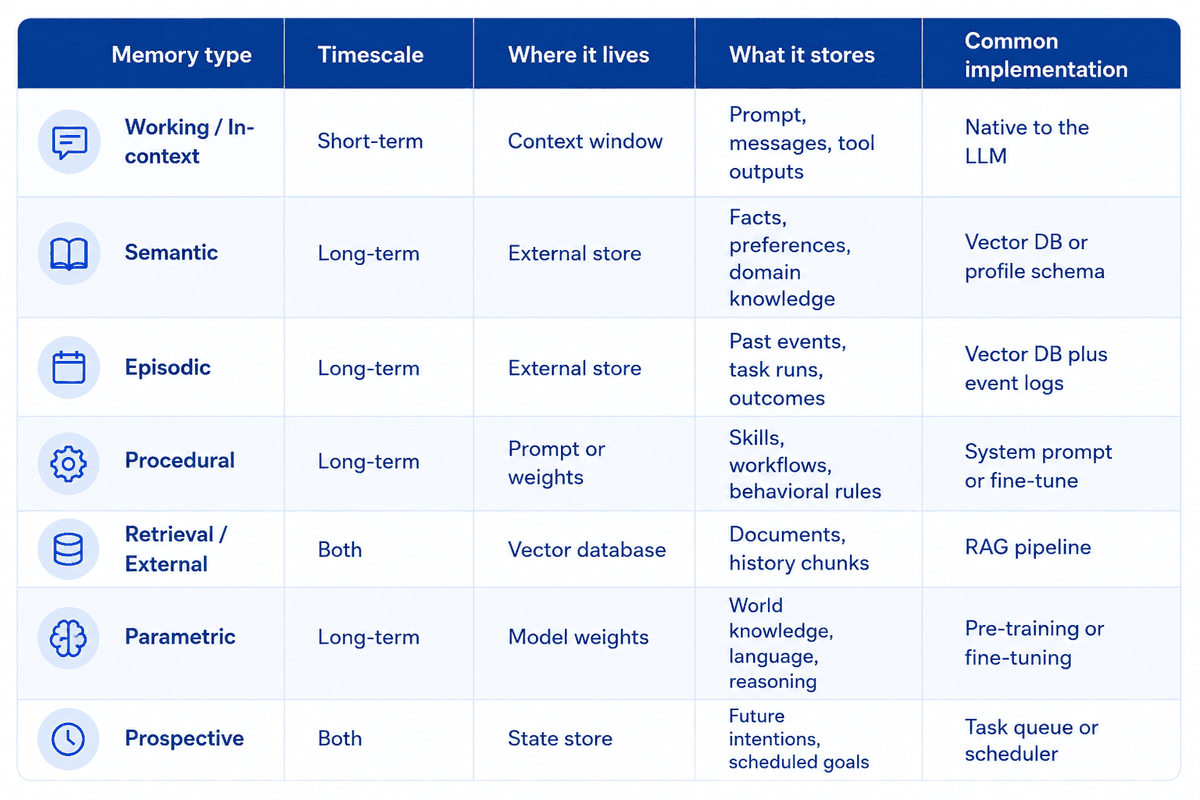
Image Source: Marktechpost Docs
Conclusion
As AI agents move toward more complex and long-running tasks, memory is becoming a core part of agent architecture. The seven memory types each serve a different purpose from maintaining current context and storing past experiences to retrieving external knowledge and tracking future actions. For engineers, the goal is not to store everything, but to build a memory system that knows what to remember, where to store it, when to retrieve it, and when to update or forget it. A well-designed memory architecture can turn an agent from a simple responder into a system that maintains continuity, learns from experience, and performs more reliably over time.
How Armor Tech Can Help
At Armor Tech, we help businesses turn AI agents into practical, production-ready systems by designing the right architecture around their specific needs. From RAG and vector databases to persistent agent memory, AI workflows, and intelligent automation, our solutions can help agents retain relevant information, retrieve the right context, and handle complex tasks more consistently. Whether you need a customer-support agent, internal knowledge assistant, or a more autonomous AI workflow, Armor Tech can help build a memory-enabled system that is reliable, scalable, and aligned with your business goals.
References
What is AI Agent ,IBM Docs
https://www.ibm.com/think/topics/ai-agent-memory
The 7 Types of Agent Memory, Marktechpost Docs