Introduction
Modern software needs more than well-written AI responses. A business application may need to classify a support ticket, decide which workflow should handle an order, flag a suspicious request, or determine whether a case needs a person. These are small but important decisions that shape what software does next.
Large language models (LLMs) can perform these tasks, often by generating structured JSON when prompted. But an application still needs to validate that output and decide what to do if the response is incomplete, ambiguous, or outside the expected format. Jev, from TypeSafe AI, takes a more focused approach: it is presented as a System One model that accepts application state and clearly defined questions, then returns typed decision values that software can consume. The aim is not to replace generative AI, but to give software a specialized decision layer.
That distinction matters for businesses building AI workflow automation and agentic AI systems. A model that writes a customer response and a model that chooses which internal process should run are solving related, but different, problems.
What Is the Jev System One Model?
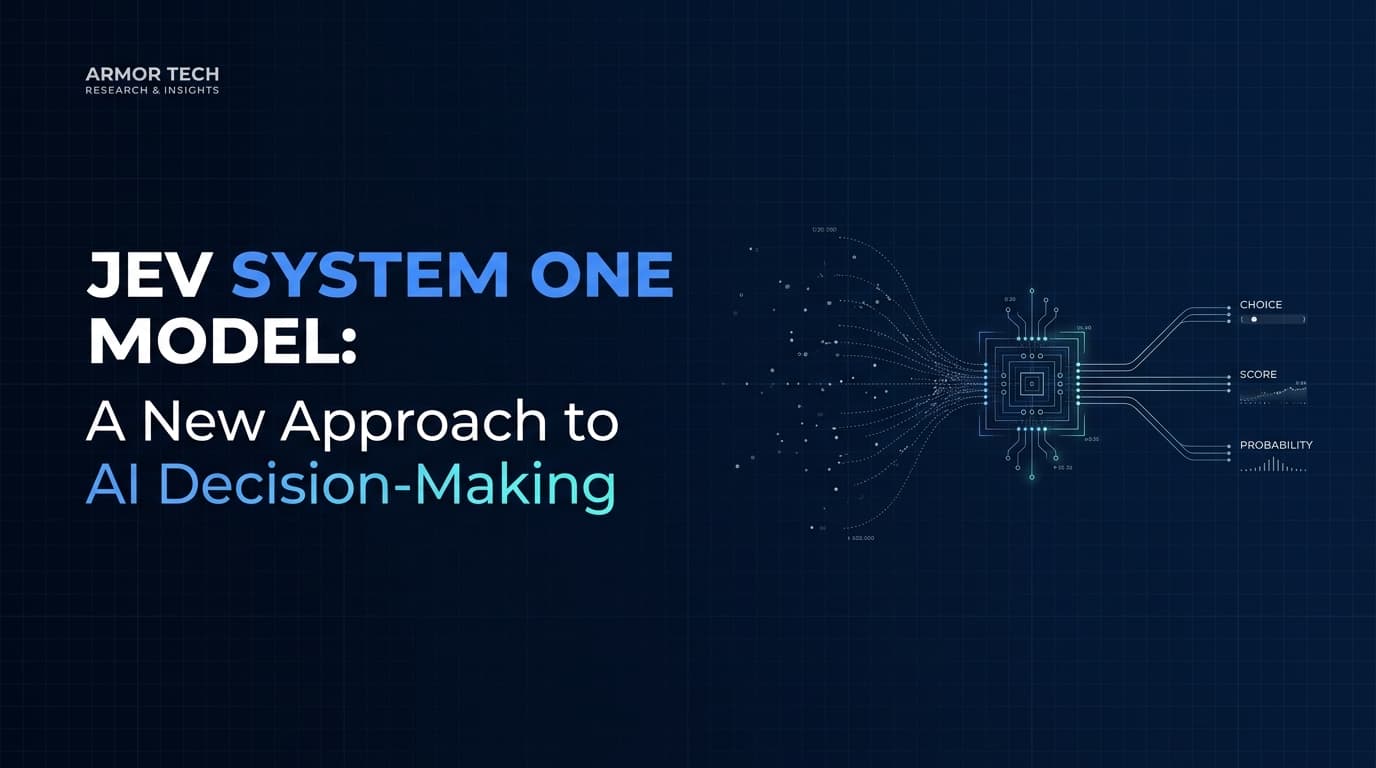
Jev is a decision-oriented AI model designed for machine-to-machine use. Instead of asking it to produce a paragraph, a developer supplies a state such as a ticket, message, log entry, or JSON object and one or more questions with predefined answer types. Jev returns structured results, such as a selected category, a score on an ordered scale, or the probability that a yes/no statement is true.
The term “System One” is the terminology used by TypeSafe for this model category. It should not be treated as a universal industry standard or as a label for every decision-making AI. In practical terms, the idea is simple: define the kind of answer your software needs before asking the model to make the judgment.
For example, a support platform might provide a customer message and ask three separate questions: Which team should handle it? How urgent is it? Does it require human review? The application can then use those results in its own rules and workflow.
How Does Jev Work?
1. Receive the state. The state contains the relevant context, such as a support ticket, an incident log, or structured order details.
2. Define the decisions. The developer describes focused questions and specifies the permitted answer shape Choice, Score, or Noul.
3. Evaluate the questions. The documentation says multiple questions can be evaluated in parallel against the same state, returning structured answers.
4. Apply application logic. The software not Jev decides whether to route a ticket, open a task, call an API, or stop a workflow.
5. Escalate when needed. If the signal is uncertain, the case is unusual, or the action is high impact, the application can request more information or send it to a human reviewer.
This separation is important. A decision model can supply a useful signal, but permissions, business policies, retries, audit logs, and consequential actions should remain under the control of the surrounding application.
The Three Main Decision Types
Choice: Select from predefined options
Choice selects an option from a set defined by the developer. Jev’s documentation describes the result as including the selected option, probabilities for the available options, and a confidence value. Example: classify a ticket as “billing,” “technical,” or “account access,” then route it to the matching queue.
Score: Rate against an ordered scale
Score evaluates the state against a rubric with ordered levels. It is suitable for concepts such as urgency, severity, or completeness, where the levels have a meaningful order. Example: rate an incident as “low,” “medium,” or “high” severity so the application can prioritize review. The rubric must define what each level means; a score is not automatically an objective measurement.
Noul: Estimate the probability of a yes/no statement
Noul evaluates a binary proposition and returns the probability that the statement is true. The official documentation distinguishes this from Choice and Score: Noul returns a yes-probability rather than a separate confidence field. Example: “Does this request appear to need immediate human review?” The application can use the probability as one signal in a conservative escalation policy.
These outputs are useful only when the questions are specific. Broad prompts such as “decide what to do with this customer” hide several separate judgments. Breaking them into smaller questions makes it easier to test each decision and adjust application rules.
Jev vs. Traditional LLMs
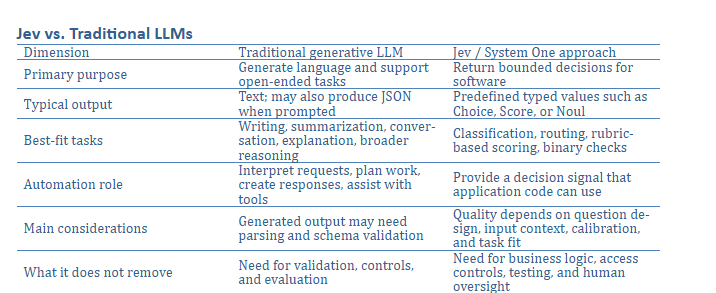
This is a difference in design focus, not proof that one approach is always more accurate, faster, or cheaper. Generative LLMs can return structured JSON, and a specialized decision model can still make mistakes. The appropriate comparison is based on a representative evaluation of the actual business task.
The strongest architecture may use both: an LLM for open-ended understanding or response generation, a decision model for a clearly bounded judgment, and deterministic code for rules that must be exact.
Real-World Business Applications
Customer support classification: Classify incoming tickets by topic, then send each ticket to the correct team. Include an “other” or fallback path for cases that do not fit the available categories.
Urgency and priority scoring: Evaluate incident descriptions against a documented severity rubric. Combine the result with deterministic rules such as customer tier, service-level agreement, or known outage status.
AI agent tool-use checks: Before an agent calls a tool, assess whether the proposed action matches an allowed purpose. The result should supplement—not replace—authorization checks and tool-level permissions.
Human-review decisions: Flag ambiguous, sensitive, or high-impact cases for review. Use conservative thresholds and test false negatives, because a missed escalation can be more costly than an extra review.
Model routing: Classify a request as suitable for a lightweight model, a more capable reasoning model, or a human operator. Evaluate routing quality against task success and total system cost.
Workflow triage: Use structured signals to select a known workflow, such as billing, onboarding, technical support, or document review. Application code should still validate prerequisites before running the workflow.
These are potential implementation patterns, not guaranteed outcomes. The business value depends on data quality, the cost of errors, integration design, and how the workflow is monitored.
Benefits and Limitations
Potential benefits
Structured output: predefined answer types can reduce the need to interpret free-form text in downstream code.
Focused decisions: small, well-defined questions can be easier to test than a single prompt that asks for several decisions at once.
Parallel evaluation: the official documentation says multiple questions can be evaluated in one request, which may simplify the application flow. Actual latency must be measured in the target environment.
Explicit uncertainty signals: probabilities and confidence fields can help applications decide when to proceed, gather more context, or escalate.
Limitations and safeguards
Task fit matters: Jev is not designed to replace a model needed for long-form writing, summarization, or open-ended generation.
Probabilities are not guarantees: validate calibration and decision quality on representative, labelled examples from your own environment.
Poor questions produce poor decisions: ambiguous categories, overlapping options, and vague scoring rubrics make results harder to trust.
High-impact actions need stronger controls: payments, account changes, access decisions, data deletion, and safety-related actions should use authorization checks, audit trails, fallback behavior, and appropriate human review.
Production conditions change: monitor drift, error rates, escalation rates, latency, and business outcomes, then re-evaluate when inputs or policies change.
How Businesses Can Apply Decision-Oriented AI
Start with one narrow use case. Choose a repetitive decision with a clear outcome, such as ticket routing or document triage. Avoid beginning with a broad goal like “make the business autonomous.”
Define the decision contract. Write down the input, possible outputs, category definitions, scoring rubric, and what the application should do with each result.
Build an evaluation set. Use representative historical or synthetic examples reviewed by knowledgeable people. Measure per-category accuracy, false escalations, missed escalations, and calibration where relevant.
Set thresholds and fallbacks. Choose thresholds based on the cost of mistakes. Provide a route for uncertain or out-of-scope cases rather than forcing every input into an automatic action.
Integrate securely. Call the model from a backend, protect API keys, limit permissions, validate returned values, and keep business rules in application code.
Monitor real outcomes. Track operational metrics and review errors after deployment. Compare the decision model with a baseline and with an LLM-based approach on the same test cases.
A controlled pilot can establish whether a decision-oriented model is useful in a specific workflow. The results should determine whether to expand, adjust, or stop the implementation.
Conclusion
The Jev System One model represents a decision-first approach to AI: instead of generating another paragraph, it returns structured judgments that application code can use. Its Choice, Score, and Noul outputs are designed for bounded tasks such as classification, prioritization, and yes/no checks. That makes the approach worth evaluating for software workflows where predictable output shape matters.
It is not a universal replacement for LLMs, business rules, or human judgment. In many systems, the most practical architecture combines generative AI for language and broader reasoning, specialized decision models for bounded judgments, and deterministic code for policies and actions. As with any model, performance should be measured on the task and data that matter to the business.
How Armor Tech Can Help
Armor Tech helps businesses design and build AI agent systems, workflow automation, custom software, SaaS platforms, and integrations that connect AI with real business processes. A decision-oriented model can be one component of that architecture when a use case benefits from structured classifications, scores, or escalation signals.
Our team can help identify an appropriate pilot, define decision criteria, integrate model APIs with existing applications, establish evaluation and monitoring, and add safeguards for actions that require human approval. The goal is to build an AI system around measurable business needs—not to add a model where it is not needed.
If you are exploring AI workflow automation, agentic AI, or a custom software integration, visit Armor Tech(https://www.armortechtrading.com/) to discuss your requirements.