For years, businesses have relied on automation to streamline repetitive tasks and improve efficiency. But traditional automation was built for predictable processes workflows where every step, decision, and outcome could be defined in advance. Today's business environment is different. Organizations are dealing with unstructured data, changing priorities, and increasingly complex workflows that require context and decision-making.
This shift is driving the rise of Agent Orchestration, a new approach that combines AI agents, tools, and business systems to dynamically coordinate work and achieve goals. Rather than following a fixed set of rules, orchestrated agents can adapt, collaborate, and respond to changing conditions in real time.
What Is Agent Orchestration?
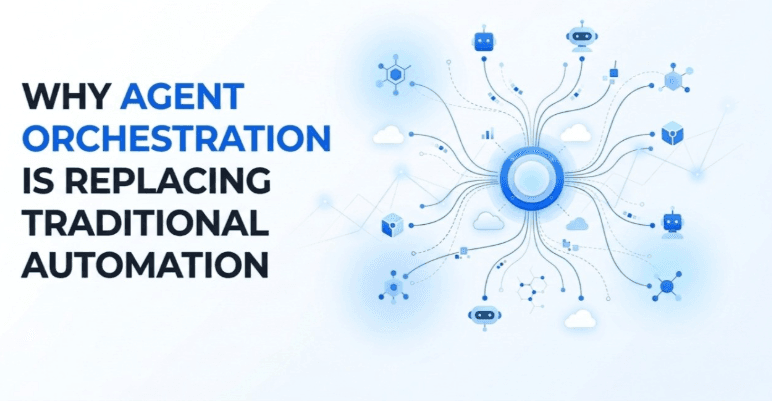
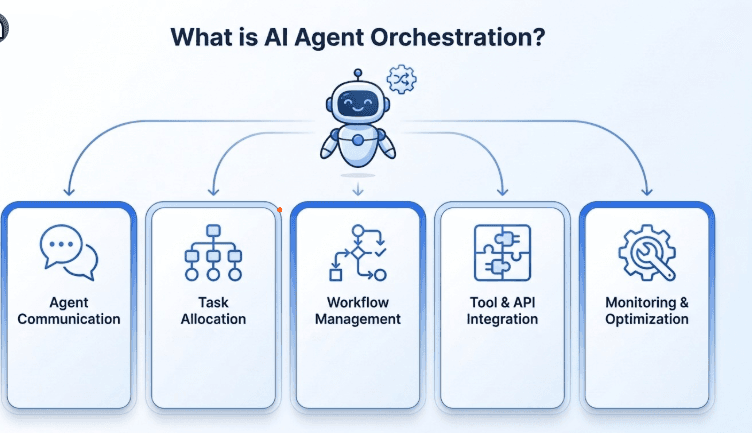
Agent orchestration is the process of managing and coordinating multiple AI agents so they can work together efficiently toward a common goal. Instead of operating independently, each agent performs a specific role while collaborating with others to complete complex tasks(Source:IBM Documentation).
Instead of depending on a single AI system to handle every task, agent orchestration brings together multiple specialized AI agents. Each agent is responsible for a specific function, allowing them to collaborate and automate complex workflows more efficiently.
Why Agent Orchestration Is Different
As AI adoption continues to grow, relying on a single AI agent is no longer enough for many enterprise use cases. Complex business processes often require multiple AI agents with different capabilities, yet these agents frequently operate across separate platforms and systems. Without proper coordination, they can become isolated, resulting in fragmented workflows and reduced efficiency. Agent orchestration addresses this challenge by enabling AI agents to communicate, collaborate, and work toward a shared objective.
This approach is particularly valuable in industries such as healthcare, finance, and customer service, where tasks involve multiple systems and stakeholders. For example, in healthcare, different AI agents can work together to analyze medical data, manage patient records, and automate administrative processes. By coordinating these activities, agent orchestration helps reduce manual effort, eliminate workflow bottlenecks, and improve overall operational efficiency.
How Agent Orchestration Works
1. Planning and Strategy
The process begins with defining business objectives and identifying workflows that can benefit from AI agent orchestration. Teams evaluate existing systems, determine integration requirements, and choose the most suitable technologies before implementation begins.
2. Selecting Specialized AI Agents
Once the strategy is in place, developers select AI agents based on their individual capabilities. Each agent is designed to perform a specific function, such as data analysis, decision-making, content generation, or workflow automation.
3. Building the Orchestration Framework
The selected agents are then integrated into a centralized orchestration framework. At this stage, developers establish communication between agents, define workflow sequences, connect external systems through APIs, and configure the platform that will manage the overall process.
4. Intelligent Task Assignment
When a request is received, the orchestrator analyzes the task and assigns it to the most appropriate AI agents. This ensures that every part of the workflow is handled by the agent best equipped for the job.
5. Workflow Execution
The orchestrator coordinates the entire process by dividing complex requests into smaller tasks, managing collaboration between agents, and connecting with external applications or business systems whenever additional information is required.
6. Context Sharing
Throughout the workflow, AI agents continuously exchange relevant information to maintain a shared understanding of the task. This helps eliminate duplicate work and enables more accurate, context-aware decision-making.
7. Continuous Improvement
Agent orchestration is not a static process. The orchestrator continuously monitors workflow performance and identifies opportunities for optimization, while human teams refine strategies, update AI models, and improve orchestration rules over time((Source:IBM Documentation).
Limitations of Traditional Automation
Although traditional automation helps streamline repetitive tasks, it also has several limitations that make it less effective for today's dynamic business environments(Source:NetMaxims).
1. Limited Decision-Making
Traditional automation follows predefined rules and cannot understand context or make informed decisions. When unexpected situations arise, it often requires human intervention to continue the workflow.
2. No Ability to Learn
Rule-based automation performs the same sequence of actions every time. It cannot learn from previous experiences or adapt its behavior as business needs evolve.
3. Rigid Workflows
Traditional automation lacks flexibility. Any changes to business processes or workflow logic typically require manual updates, making it difficult to adapt quickly to new requirements.
Benefits of Agent Orchestration
Agent orchestration enables organizations to move beyond traditional automation by creating more intelligent, adaptable, and collaborative workflows(Source:IBM Documentation).
1. Greater Operational Efficiency
By coordinating multiple specialized AI agents, businesses can automate complex processes, reduce repetitive work, and improve overall productivity.
2. Increased Flexibility
Unlike rule-based automation, agent orchestration can adapt to changing business requirements and dynamic workflows, allowing organizations to respond more quickly to new challenges.
3. Better User Experiences
Working together, AI agents can deliver faster, more accurate, and personalized interactions, helping businesses improve both customer satisfaction and employee productivity.
Conclusion
Traditional automation has helped businesses improve efficiency for years, but the growing complexity of modern workflows demands a more intelligent approach. Agent orchestration represents the next evolution by enabling multiple AI agents to collaborate, adapt, and make context-aware decisions in real time. Rather than simply automating repetitive tasks, it allows organizations to build flexible, scalable systems that can handle increasingly complex business operations. As AI continues to evolve, businesses that embrace agent orchestration will be better positioned to improve productivity, accelerate innovation, and unlock greater value from their AI investments.
How Armor Tech Can Help
As businesses move beyond traditional automation, building intelligent AI systems requires more than just deploying individual model. It requires the right strategy, seamless integration, and scalable orchestration. At Armor Tech, we help organizations design and implement AI-powered solutions, from intelligent automation and AI agents to enterprise workflow orchestration and custom AI integrations. Our goal is to help businesses transform complex processes into smarter, more efficient operations that deliver measurable business value.
References
What is AI Agent Orchestration .IBM Documentation
https://www.ibm.com/think/topics/ai-agent-orchestration#228874317
Traditional Automation Vs AI Agent Orchestration.NetMaxims