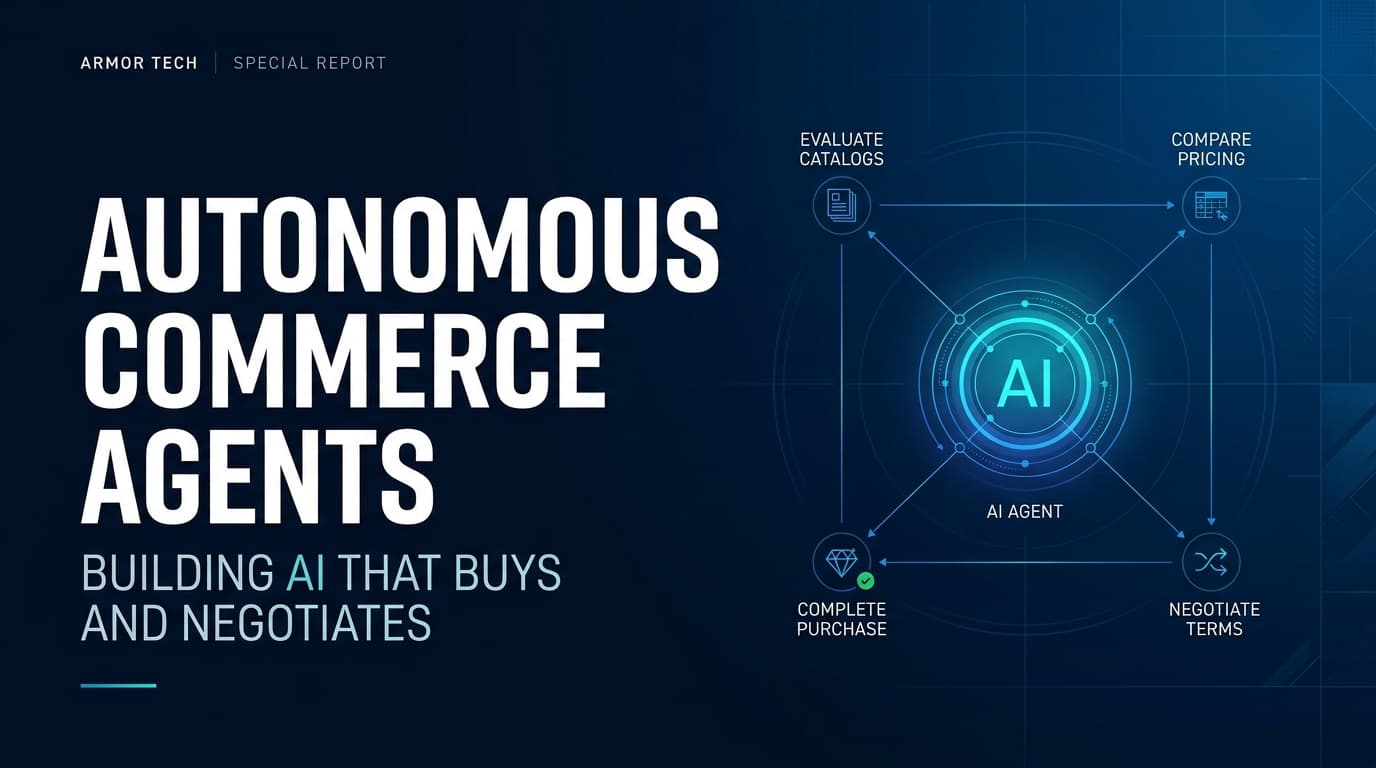
AI agents can browse products, compare prices, and draft purchase requests — but they stall at checkout. The missing piece isn't intelligence; it's a secure, auditable way to hand an agent spending authority without exposing raw payment credentials. Recent startup activity shows the market betting on convenience, while platforms like United, Apple, and Amazon are erecting barriers that make outside agents increasingly unwelcome.
Why Autonomous Commerce Agents Are Stuck at the Checkout
The current wave of personal AI startups — Ghost, Tab, Underdog, Hark — is built on a premise: users will hand over inbox access, file systems, and credit cards if the privacy story holds. Ghost's $3,499 dedicated computer raised $11M on this bet. Tab launched at a $300M valuation pitching privacy as the product. But the podcast discussion revealed a deeper friction: even if users trust the agent, the merchants don't.
United Airlines, Apple, and Amazon have all moved to restrict outside agent access. Apple tightened macOS full-disk-access controls explicitly citing new risks from AI agents. Amazon and United deploy bot detection and CAPTCHA escalation that effectively block autonomous checkout. The result: agents can research but cannot transact without either user intervention at the payment step or unsafe credential sharing.
The core tension is architectural. Browsing is read-only; purchasing requires write authority on financial rails. Current workarounds — screen scraping with shared credentials, browser automation with stored cards — create credential exposure surfaces that scale poorly and violate card-network rules.
Threat Model: What Goes Wrong When Agents Hold Payment Credentials
Before designing vault patterns, we need a threat model specific to agentic commerce. Four failure modes dominate:
- Credential theft via prompt injection or memory exfiltration. An agent with access to a PAN (primary account number) or full card details becomes a target. Prompt injection attacks can trick the agent into revealing stored secrets or making unauthorized API calls to payment services.
- Unauthorized purchases and negotiated terms outside user intent. An agent authorized for "office supplies under $200" might agree to a subscription auto-renewal, accept unfavorable shipping terms, or bundle unwanted services — all technically within a vague mandate.
- Auditability and dispute resolution gaps. When a human clicks "buy," there's a clear intent signal. When an agent negotiates a multi-round deal, the audit trail must capture every counter-offer, acceptance, and human checkpoint. Current card-network dispute flows (Reg E, chargeback reason codes) assume human cardholders.
- Regulatory scope creep. PSD2 in Europe already treats payment initiation services as regulated activities. Emerging agent-liability frameworks may classify autonomous purchasing agents as payment initiators, requiring licensing, strong customer authentication (SCA), and transaction monitoring.
Any architecture must treat the agent as an untrusted component that needs scoped, revocable, auditable delegation — not a trusted principal with full credential access.
Credential Vault Patterns: Tokenized Cards, Virtual Cards, and Delegated Auth
The solution space centers on never giving the agent raw PANs. Three patterns emerge from payment-network primitives and emerging standards:
Network-Tokenized Credentials
Visa Token Service (VTS) and Mastercard Digital Enablement Service (MDES) replace PANs with merchant-specific, device-specific, or channel-specific tokens. A token scoped to a single merchant category code (MCC), dollar limit, and time window renders exfiltration low-value — the token won't work at a different merchant or above the ceiling. The vault holds the mapping; the agent only sees the token reference.
Issuer Virtual Cards with Programmable Controls
Modern card-issuing platforms (Marqeta, Stripe Issuing, Adyen, Lithic) let you create virtual cards per transaction, per merchant, or per agent session. Controls include: single-use, merchant-lock, MCC-lock, amount ceiling, velocity limits, and real-time authorization webhooks. The agent requests a virtual card from the vault; the vault returns a tokenized PAN that expires after the authorized purchase.
Delegated Authorization (GNAP, TXN)
Grant Negotiation and Authorization Protocol (GNAP) and Transaction Authorization (TXN) extend OAuth-style delegation to payments. The user (resource owner) grants the agent (client) a time-boxed, scope-limited access token representing "spend up to $X at merchant Y for category Z." The token is presented at checkout instead of a card. Revocation is immediate; audit logs capture the grant, the spend, and the merchant settlement.
Key Management: HSM-Backed Vaults vs. On-Device Secure Enclaves
Where the vault lives determines the trust boundary. Cloud HSM-backed vaults (AWS CloudHSM, Azure Dedicated HSM, Google Cloud HSM) offer FIPS 140-2 Level 3, centralized policy, and rotation — but require the agent to call out over the network. On-device secure enclaves (Apple Secure Enclave, Android StrongBox, TPM 2.0) keep key material local, aligning with Ghost's local-execution model, but complicate sync across devices and revocation propagation. For teams building this today, AI automation workflows can orchestrate either pattern behind a consistent interface.
Negotiation Protocols: From Fixed-Price Checkout to Multi-Round Bargaining
Purchasing is deterministic: price, cart, checkout. Negotiation introduces state machines with multiple rounds, conditional acceptance, and human gates.
- Structured negotiation schemas. Define offer objects with fields: price, delivery date, payment terms, SLAs, return windows, penalty clauses. Both agent and merchant counterparty (or their agents) serialize offers in a shared schema — JSON-LD or Protocol Buffers — enabling programmatic counter-offers.
- Verifiable credentials for agent identity and authorization scope. W3C Verifiable Credentials or JWT-based attestations let the merchant verify: "This agent represents user U, authorized for spend category C up to $X, with human-approval required above $Y." The credential chain traces back to the user's identity provider.
- Human-in-the-loop checkpoints. High-value or novel terms (first purchase from a new vendor, subscription commitments, custom SLAs) trigger a webhook to the user's approved channel (push, email, in-app). The agent pauses; the user approves, modifies, or rejects. The checkpoint decision is logged immutably.
- Logging and replay for audit trails. Every message — offer, counter, acceptance, checkpoint — is written to an append-only log (event store, Kafka, CloudTrail). Replay reconstructs the negotiation for dispute resolution or regulatory examination.
Platform Gatekeeping: Working With (or Around) Anti-Agent Defenses
Major platforms are not passive. Apple's macOS full-disk-access restrictions limit what local agents can read. Amazon and United deploy behavioral bot detection (mouse dynamics, request cadence, TLS fingerprinting) that escalates to CAPTCHAs or hard blocks. These defenses will intensify as agent traffic grows.
Three legitimate access paths exist:
- Official APIs. Merchant-exposed REST/GraphQL endpoints with OAuth scopes for cart, checkout, and order management. This is the only sustainable path — but coverage is sparse.
- Partner programs. Affiliate, marketplace, or enterprise partner programs that issue API keys with rate limits and contractual SLAs.
- Authenticated scraping policies. Some retailers allow authenticated, rate-limited scraping under terms of service — effectively a semi-official API.
For gated sites without APIs, a fallback is user-supervised co-pilot mode: the agent drives the browser to the payment page, then hands control to the user for the final authentication step (3DS challenge, biometric confirm, device attestation). The agent never sees the credential; it only orchestrates the pre-payment flow. This respects platform defenses while keeping the agent useful.
Privacy-First Agent Architectures: Local Execution vs. Cloud Delegation
The privacy-focused startups in the podcast — Tab, Underdog, Hark — signal a market split: cloud-hosted agents that see everything vs. local agents that see only what the user permits. For commerce, this maps directly to trust.
- On-device agent runtimes. Ghost's dedicated computer exemplifies this: the agent, the vault, and the secure enclave live on hardware the user controls. Credentials never leave the device; the agent signs payment requests locally. The tradeoff: no cross-device sync, no cloud-scale compute for complex negotiation, and the user bears operational security.
- Trusted execution environments (TEEs) for cloud agents. Intel SGX, AMD SEV, AWS Nitro Enclaves, or Azure Confidential Computing let you run agent code in attested enclaves. The vault releases tokens only to attested code measurements. Remote attestation proves to the user (and auditor) that the running code matches the audited build.
- Data minimization by design. The agent should receive only tokenized payment artifacts — never PII, never full card data, never login credentials. The vault mediates every payment request, injecting the token at the last moment.
- Business model risk. Agents monetizing purchase data (affiliate fees, preference profiling, targeted offers) misalign incentives. A pure-utility agent charges a subscription or per-transaction fee; its only optimization is user intent fulfillment. Builders should choose the model before writing code — it dictates data flows.
Starter Stack: n8n/Make Workflows for Safe Agent Commerce Today
You don't need a custom agent runtime to start. No-code automation platforms let you prototype the vault → token → purchase → audit loop in hours. Two patterns work well:
n8n Workflow: Approval-Gated Tokenized Purchase
- User approval webhook. User clicks "Approve $150 for vendor X" in Slack/Teams/email → triggers n8n webhook with purchase request payload.
- Vault token request. n8n calls your vault API (or Lambdalith) requesting a single-use virtual card scoped to vendor X, MCC 5045, $150 ceiling, 30-minute TTL.
- Virtual card issuance. Vault talks to issuer API (Marqeta/Stripe/Lithic) → returns tokenized PAN + CVV2 + expiry.
- Purchase execution. n8n HTTP node posts card token to vendor checkout API (or drives headless browser for non-API vendors).
- Receipt logging. Response parsed → structured log to Postgres/ClickHouse/S3 with correlation ID, user ID, agent ID, token ID, amount, vendor, timestamp.
Make Scenario: Price Monitoring → Negotiation → Human Gate → Checkout
- Scheduled price monitor. HTTP GET vendor product page → parse price → compare to threshold.
- Negotiation webhook. If price > threshold, trigger negotiation sub-scenario: agent sends counter-offer via vendor API/email/form.
- Human review gate. Counter-offer response routed to user approval step (Make's built-in approval flow).
- Tokenized checkout. On approval, same vault → virtual card → purchase flow as above.
Observability and Graduation
Instrument every node: structured JSON logs (merchant, amount, token ID, latency, success/failure), alerting on anomalous spend patterns (velocity, new merchants, amount deviations). As volume grows, replace individual n8n/Make nodes with custom TypeScript/Go/Python services — the workflow becomes your integration test suite. When you're ready to graduate from workflows to agentic AI systems and RAG pipelines, the contract boundaries are already defined. For implementation help on the vault and automation layer, our AI automation workflows practice has built this pattern for fintech and marketplace clients.
Frequently Asked Questions
Can I use this with any payment processor?
The tokenized vault pattern works with any issuer that supports virtual card APIs or network tokenization — Marqeta, Stripe Issuing, Adyen, Lithic, and most processor-agnostic BaaS platforms. The vault abstraction layer translates your internal token format to the processor's API. If your processor doesn't offer virtual cards, you can still use network tokens (VTS/MDES) directly, though control granularity is coarser.
How do I handle 3D Secure challenges with an autonomous agent?
3DS requires human interaction (biometric, OTP, app approve). The co-pilot mode handles this: the agent drives checkout to the 3DS challenge page, then pauses and notifies the user. The user completes the challenge in their banking app or browser; the agent resumes once the ACS returns a successful authentication result. For fully autonomous flows, you need merchant-side 3DS exemption eligibility (low-value, trusted beneficiary, secure corporate payment) — which requires issuer and scheme cooperation.
What happens when a virtual card transaction is declined or partially authorized?
Your vault should treat declines as first-class events: log the decline reason code (AVS mismatch, velocity, insufficient funds, issuer decline), notify the agent, and trigger a retry policy (different virtual card, different funding source, human escalation). Partial authorizations (split tender) require the agent to understand the remaining balance and either request a second token or abort. Build the state machine explicitly — don't assume success.
Autonomous commerce agents need more than intelligence — they need a payment architecture that treats credentials as toxic waste. Tokenized vaults, delegated auth, and human gates get you to a first transaction. Platform gatekeeping and regulatory evolution will shape what comes next. If you're building this stack and want a second pair of eyes on the threat model or a pilot workflow, book a 30-min architecture review and we'll map a tokenized vault + n8n pilot for your first merchant category.