Why Decision Models Are Replacing Classifiers in Agentic Moderation
Traditional content moderation stacks rely on fixed taxonomies: a predefined set of labels (hate speech, harassment, violence) mapped to classifier heads trained on labeled datasets. When policy evolves — new slang, regulatory requirements, platform-specific norms — you relabel and retrain. Decision models invert this. They accept a policy written in plain English ("flag content that encourages self-harm, including indirect references") and emit a structured verdict in a single forward pass. The model weights stay frozen; only the policy text changes.
This matters for agentic systems because moderation must run inline. An agent generating user-facing content, tool calls, or memory writes cannot tolerate a round-trip to an external SaaS with 200ms+ latency. Sub-50ms inference means the moderation call becomes a deterministic function inside the agent graph — idempotent, retry-safe, and observable. The trade-off is flexibility: a decision model handles multi-label, context-dependent policies that would require an explosion of classifier heads, but it demands careful policy authoring and version control.
The industry convergence is notable. TypeSafe AI's Jev (September 2026), OpenAI's response, and Amazon's clone all share the same architectural primitive: a transformer that outputs outcome probabilities over a constrained action space rather than free-form tokens. GLiNER (2024) pioneered the bidirectional transformer approach for named-entity recognition with natural-language prompts; PolicyLM-1.7B adapts this for moderation. Same primitive, different domain specialization.
Anatomy of a Real-Time Moderation Pipeline
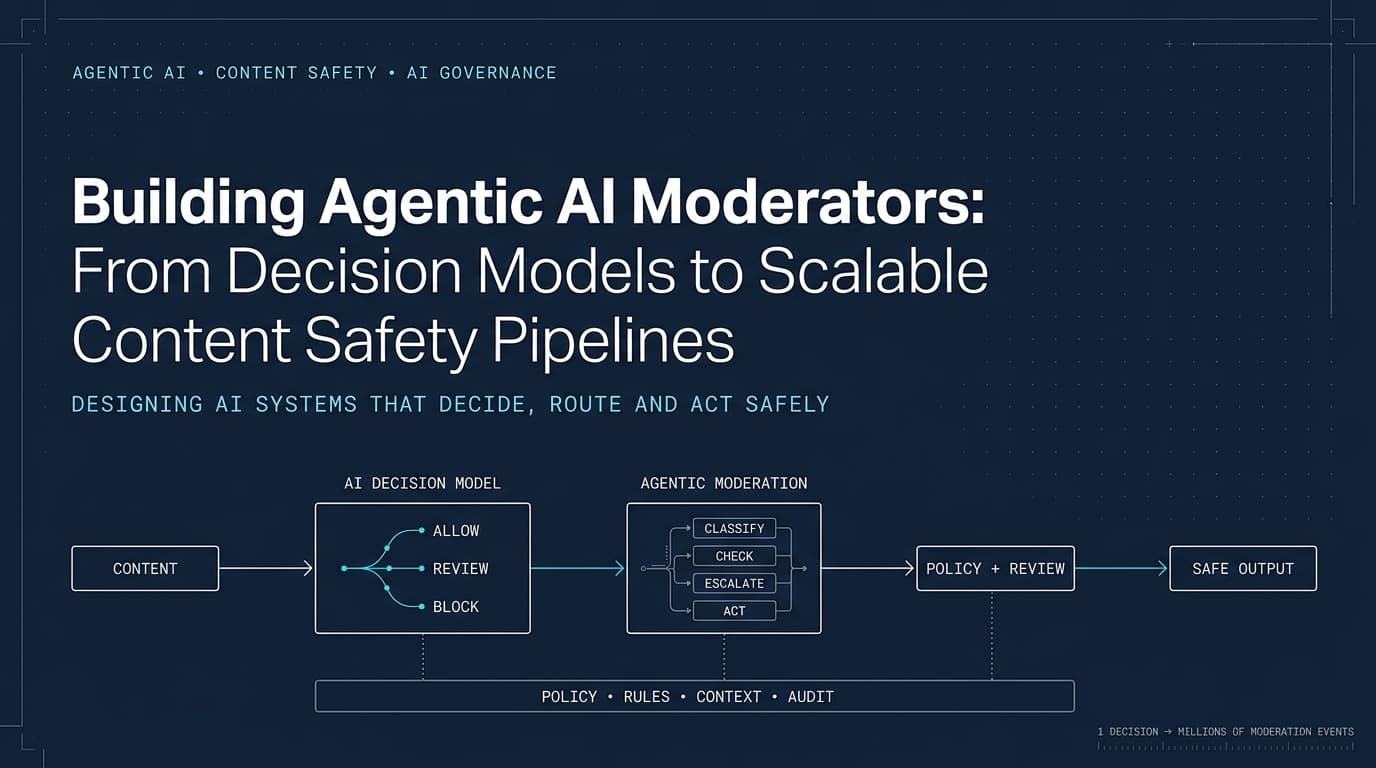
Production moderation is more than a model call. The end-to-end flow looks like this:
- Ingress normalization — Language detection, Unicode normalization, PII stripping (email, phone, SSN patterns), and chunking for long inputs. This runs on CPU before any GPU call.
- Decision head — PolicyLM or equivalent receives the normalized text plus the active policy text. Single forward pass returns structured JSON:
{"verdict": "flag", "categories": ["self-harm"], "confidence": 0.94, "policy_hash": "sha256:..."}. - Policy registry — Versioned, git-managed rule sets. Each policy version is immutable, tagged, and linked to a changelog. Rollback is
git revert. - Action router — Maps verdicts to downstream effects: auto-reject, shadow-log for review, human-in-the-loop queue, or agent self-correction prompt. This routing logic lives outside the model, in workflow code.
- Observability — Verdict drift dashboards (distribution shift over time), policy coverage gaps (inputs receiving low-confidence verdicts), and false-positive budgets per category.
The policy registry is the operational backbone. When a trust-and-safety team updates "harassment" to include coordinated brigading language, they commit a policy diff. The pipeline picks up the new hash on the next inference — no model redeploy, no canary model rollout. This separation of policy velocity from model velocity is the core architectural win.
Handling Policy Drift Without Retraining
The zero-retraining claim holds for policy edits that stay within the model's semantic capacity. PolicyLM-1.7B was trained on a diverse corpus of moderation judgments; its "knowledge" of harm categories, linguistic nuance, and context is baked into weights. Policy text acts as a steering vector at inference time. But there are boundaries:
- Semantic stretch — A policy like "flag content that vibes wrong" fails. The model needs observable linguistic correlates.
- Category explosion — Hundreds of fine-grained labels exceed the effective context window for policy conditioning. Hierarchical policies (parent category → sub-rules) work better.
- Adversarial adaptation — Users discovering policy blind spots (Unicode obfuscation, dog-whistle coding) requires either policy patches or, eventually, model fine-tuning.
Testing harnesses catch regressions before they hit production. Synthetic adversarial suites — generated per policy version — run in CI/CD. Each suite covers: known violation patterns, edge-case negatives (benign content that resembles violations), and language-specific probes. Canary rollout proceeds: shadow mode (log only, no action) → 5% traffic with conservative fallback → full cutover. Every verdict logs the policy hash, input snapshot, and model version, creating an immutable audit trail for DSA/UK OSA compliance.
Scaling to Multi-Modal, Multi-Lingual, Multi-Tenant
Text-only, English-only, single-policy moderation doesn't exist in production. The architecture extends:
- Image/video — CLIP embeddings feed a lightweight decision head trained on policy-conditioned visual judgments. OCR extracts text for joint text+image verdicts. Video samples key frames; temporal policies (e.g., "flashing lights") need frame-sequence heads.
- Low-resource languages — Few-shot policy prompts in the target language plus a distilled decision head (knowledge-distilled from the main model) cover languages without massive labeled datasets. The backbone stays shared; only the head adapts.
- Tenant isolation — Policy namespaces route each tenant's content to their policy version while sharing the GPU backbone. Separate decision heads per tenant prevent policy bleed-through. Cost model: GPU batch inference for throughput, CPU-optimized ONNX export for latency-critical paths.
Multi-modal adds latency. A practical split: text path targets <50ms p99; image path <200ms. Video async with webhook callback. The policy registry manages all modalities — versioned JSON schemas define the input contract for each decision head.
Integrating Moderation Into Agentic Workflows
Moderation becomes a callable tool inside n8n, Make, LangGraph, or custom orchestration — not a separate SaaS with webhook latency. The interface is deterministic:
moderate(content: string, policy_id: string, context?: object) ->
  { verdict: "allow" | "flag" | "escalate",
    categories: string[],
    confidence: float,
    policy_hash: string,
    request_id: string }
Circuit breakers wrap the call. On latency spikes (>p99 threshold), fallback to a conservative policy (e.g., "flag everything for review") or a cached classifier. The agent loop receives the verdict and can self-correct: rewrite the response, skip the tool call, or escalate to human. Feedback loops close when human reviewers label false positives/negatives — those labels feed the synthetic suite for the next policy version.
Compliance export is built-in: immutable logs (append-only store, cryptographic linking) with policy hash, input, verdict, and reviewer actions. Auditors get a reproducible evidence chain without reconstructing state.
Build vs. Buy vs. Fine-Tune Decision Checklist
| Approach | When It Fits | Operational Cost |
|---|---|---|
| Self-host PolicyLM-1.7B | Data residency requirements, policy velocity > model velocity, existing GPU infra | GPU ops, model serving, policy registry build-out |
| Managed decision-model API | Speed to market, no ML team, acceptable vendor lock-in | Per-request cost, policy customization limits, data egress |
| Fine-tune on domain violations | Policy complexity exceeds prompt capacity (e.g., specialized financial fraud patterns) | Training pipeline, eval harness, model versioning |
| Hybrid: open-weight backbone + proprietary heads | Shared semantic understanding + tenant-specific decision boundaries | Head training per tenant, backbone update coordination |
The deciding factor is usually policy velocity versus semantic distance. If your policies change weekly and map to general harm categories, self-host the open-weight model and invest in the policy registry. If you're moderating niche domain violations (medical misinformation, code injection attempts) that the base model hasn't seen, fine-tune. Production agentic systems we've shipped tend toward hybrid: shared backbone for general safety, proprietary heads for product-specific policies.
Operationalizing Safety: From Launch to Continuous Assurance
Launch is not done. Continuous assurance requires:
- Automated red-teaming — Policy fuzzing in CI/CD. Generate adversarial inputs per policy version using the model itself (prompt it to create edge cases), then verify verdicts match intent.
- Drift metrics — Track verdict distribution shift per category per week. Edge-case accumulation: inputs with confidence 0.4–0.6 signal policy ambiguity.
- Human review sampling — Stratified by policy, language, risk tier. Not random — oversample high-impact categories and low-confidence regions.
- Incident playbook — Policy rollback <5 minutes (git revert + config reload). Model rollback <30 minutes (blue/green model serving). Documented runbooks, not tribal knowledge.
The policy registry, observability stack, and red-teaming pipeline are where engineering effort compounds. RAG pipelines and AI automation workflows integrate naturally here — the same retrieval infrastructure that powers agent knowledge can serve policy context, synthetic test cases, and reviewer guidelines.
Frequently Asked Questions
Can decision models handle subjective policies like "borderline harassment"?
They handle it as well as the policy text defines observable correlates. "Borderline harassment" needs concrete linguistic markers (repeated @-mentions after block, coded language patterns) or the model will default to low-confidence escalation. The solution is policy specificity, not model magic.
What happens when the model encounters a language it wasn't trained on?
Performance degrades gracefully — confidence drops, verdicts shift to "escalate." The fix is a distilled head for that language family, trained via few-shot policy prompts on the base model. No full retraining required.
How do you version policies that reference each other (e.g., "harassment includes doxxing")?
Policy registry stores modular rule fragments with explicit dependencies. A "harassment" policy imports the "doxxing" fragment by hash. Changing doxxing creates a new harassment hash automatically. CI validates the dependency graph on every commit.
Ready to embed policy-driven moderation into your agentic stack? Book a 30-min architecture review — we'll map your policy taxonomy to a decision-model pipeline you can ship this sprint. Explore agentic AI platform components to see where moderation fits in your deployment.