Instinct's group-chat rollout exposes a class of architectural problems that single-user agent frameworks don't solve: how to partition state across concurrent participants, enforce consent before bridging private and shared contexts, and keep latency predictable when agents hand off to each other. The patterns below distill what Instinct's public design implies for any team building collaborative agentic workflows.
Why Multi-User Agent Architectures Differ from Single-User Flows
A single-user agent maintains one coherent session—its memory, tool permissions, and conversation history belong to one identity. Group chats fracture that model. Every participant brings a distinct permission boundary, a personal agent with its own context, and an expectation that their private data won't leak into the shared space without explicit action.
Instinct's approach, described by founder Noah Shinn, spawns a siloed group agent per chat that cannot access any user's personal account. The personal agent acts as a gatekeeper: it requests consent before bridging information to the group agent, and users maintain per-group trust toggles they can revoke instantly. This creates three new failure modes absent in single-user flows: permission races (two users granting conflicting access simultaneously), stale context for late joiners, and trust revocation mid-task that must unwind in-flight operations cleanly.
Core Architectural Patterns for Shared-Context Agents
Siloed Group Agent Pattern
Each group chat gets an ephemeral agent instance scoped to that conversation. It holds no references to personal agents, personal memory stores, or cross-chat artifacts. The group agent's toolset is limited to shared actions—calendar polling, ticket APIs, list management—while sensitive operations (payment, private document access) remain exclusive to personal agents. This isolation boundary is enforced at the runtime layer, not just by prompt instructions.
Permission-Gate Pattern
Before any personal-agent output reaches the group agent, the personal agent surfaces a consent prompt to its user. The prompt specifies exactly what data would cross the boundary (e.g., "Share your availability for Dec 15–17 with the group agent?"). Only on affirmative response does the personal agent emit a signed token that the group agent validates before ingesting the payload. This makes consent auditable and revocable.
Trust-List Pattern
Users maintain an allow-list of trusted group chats. Adding a group to the list enables the permission gate; removing it immediately invalidates any outstanding tokens and severs the personal-to-group agent link. The trust list lives in a low-latency store (Redis or in-memory with persistence) so revocation checks add sub-millisecond overhead to each hop.
Pending-Reply Buffer
When a personal agent generates output destined for the group but new members have joined since the request originated, that output is staged in a per-user buffer. The buffer holds payloads until the new member's trust status is confirmed and they've acknowledged the group's privacy policy. Only then does the buffer flush. This prevents context leakage to participants who weren't part of the original consent scope.
Permissioning & Trust Models in Group Chats
The consent flow follows a strict sequence: user → personal agent → group agent. The personal agent never pushes data proactively; it only responds to explicit user directives ("Share my flight options with the group"). Granular trust settings mean a user can trust the "Trip Planning" group but not the "Fantasy League" group, and toggling either takes effect before the next message routes.
Data minimization is structural: the group agent sees only messages explicitly addressed to it (via @mention or explicit share action). Personal context—email threads, private notes, purchase history—never leaves the personal agent's sandbox without a signed consent token. Every grant and revocation writes an immutable audit entry (timestamp, user ID, group ID, scope, decision) to an append-only log for compliance review.
State Management & Consistency Across Participants
The group chat's event-sourced message log serves as the single source of truth. Every agent action, user message, and system event appends with a monotonically increasing sequence number. Group-agent workers replay from the log to reconstruct state, enabling horizontal scaling and crash recovery without distributed consensus.
For late-joining members, versioned context snapshots capture the group agent's working state at defined checkpoints (e.g., after each planning phase). The pending-reply buffer described earlier is a primitive snapshot mechanism; a production system would generalize this to arbitrary state versions so a user joining on day three of a trip-planning thread receives a summarized itinerary rather than raw message history.
Collaborative artifacts—shared task lists, potluck assignments, venue shortlists—benefit from conflict-free replicated data types (CRDTs) or operational transforms. A Thanksgiving potluck list where multiple users add items concurrently resolves merges deterministically without a central lock. Isolation levels remain distinct: personal agent state (private), group agent state (shared conversation + derived artifacts), and shared artifacts (CRDT-backed objects with their own access control).
Real-Time Orchestration & Scaling Considerations
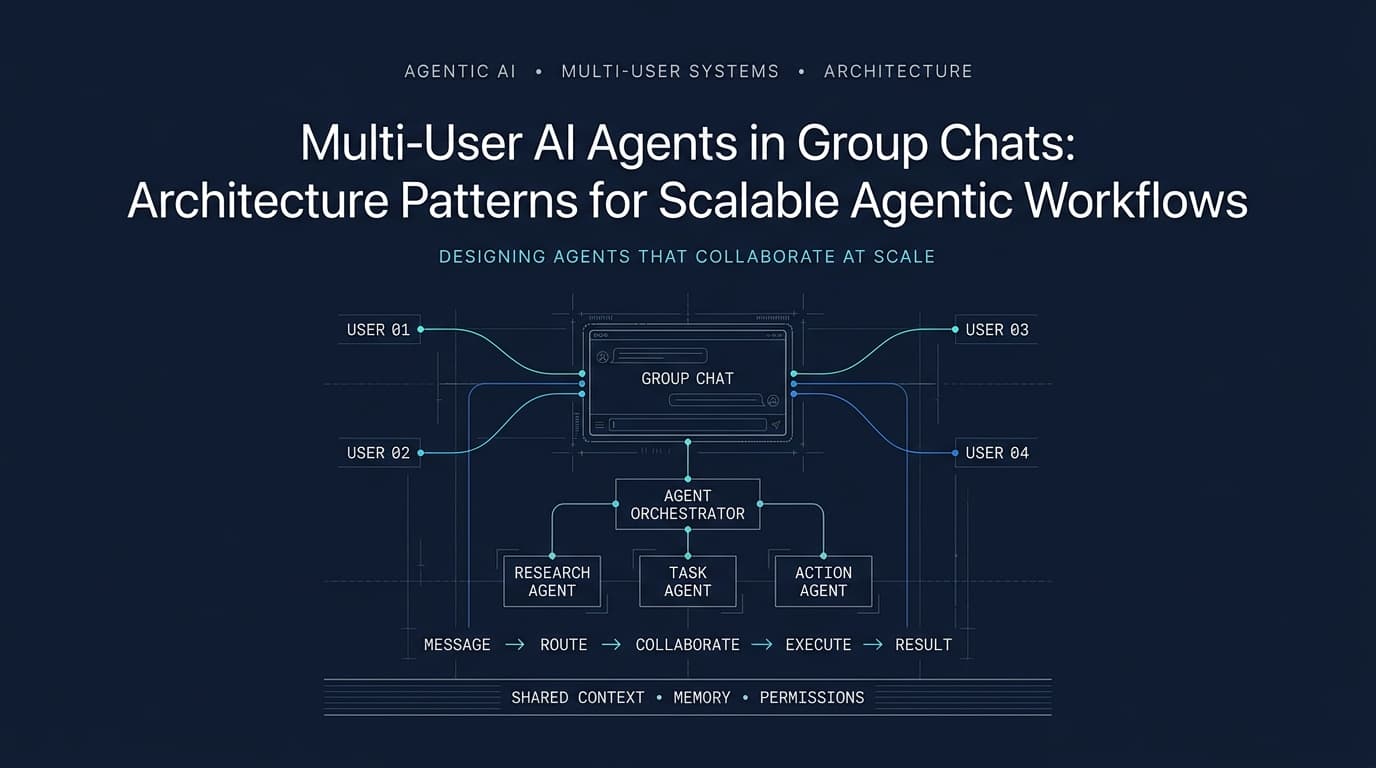
Message routing runs over a WebSocket backbone (or long-polling fallback) that maintains persistent connections from each client to a stateless gateway. The gateway authenticates, enforces rate limits per user and per group, then publishes to a message broker (Kafka or Pulsar) keyed by group ID. Stateless group-agent workers consume from the broker, process, and emit response events back through the gateway to participants.
Horizontal scaling works because workers hold no session affinity—any worker can handle any event for a given group by replaying the log to the required offset. Rate limiting operates at two tiers: per-user quotas prevent spam, per-group quotas prevent a single conversation from monopolizing agent compute. Distributed tracing (OpenTelemetry or equivalent) propagates a trace ID from the user's initial message through the personal agent, consent gate, group agent, and any downstream tool calls, making latency budgets observable end-to-end.
Comparative Look: Instinct, Meta Muse, OpenAI Dots
| Platform | Group-Chat Model | Consent & Isolation | Non-User Participation |
|---|---|---|---|
| Instinct | Siloed group agent per chat; personal agent gates all bridges | Explicit opt-in per share; per-group trust list with instant revocation | Works with friends without Instinct accounts |
| Meta Muse | No group-chat support yet (per public launch) | N/A | N/A |
| Meta AI (legacy) | Single agent added to WhatsApp/Messenger/IG/FB groups | Platform-level permissions only | Native to each platform's user base |
| OpenAI Dots | Operate inside ChatGPT Spaces collaborative workspaces | Workspace-level membership controls | Requires ChatGPT account |
Instinct's distinction is the personal-agent gatekeeper and the ability to involve non-users. Meta AI's legacy group presence lacks per-user consent granularity. Dots treat the workspace as the trust boundary, which suits document collaboration but not ad-hoc social planning.
Building Blocks for Your Own Multi-User Agent System
A starter-kit architecture maps cleanly to managed services:
- API Gateway: Auth, rate limiting, WebSocket termination
- Permission Service: Trust-list CRUD, consent token issuance/validation, audit log append
- Agent Runtime: LangGraph, custom state machines, or actor framework for personal and group agents
- Event Log: Managed Kafka or Pulsar for the group-chat source of truth
- Pending-Reply Buffer: Redis streams or sorted sets with TTL
- Shared Artifact Store: Postgres with CRDT extensions (e.g., yjs + PostgreSQL) or dedicated CRDT service
- Vector Store: Shared knowledge base for group-agent RAG (travel docs, event specs, league rules)
Armor Tech delivers agentic AI system design & RAG pipelines for this stack, including n8n/Make automation for group-task workflows and voice-agent integration for hands-free coordination.
Frequently Asked Questions
How does the pending-reply buffer prevent context leakage when someone joins mid-conversation?
The buffer stages any personal-agent output generated before the new member's trust status is confirmed. The payload only flushes after the new member accepts the group's privacy policy and the inviter's trust list includes them. Until then, the group agent never sees the staged content.
Can a group agent invoke tools that require personal credentials (e.g., booking a flight with a saved payment method)?
No. The group agent's toolset excludes any operation needing personal credentials. The personal agent performs the booking after the user consents to share the selected itinerary, then emits a confirmation event the group agent can display.
What happens if a user revokes trust while the group agent is mid-task?
Revocation invalidates the user's consent tokens immediately. The group agent's next validation check fails, so it halts any action requiring that user's data and emits a "permission revoked" event. In-flight tool calls that don't depend on the revoked data may complete; dependent calls are rolled back or compensated based on the tool's idempotency guarantees.
Multi-user agent architectures are still early. The patterns above are observable in Instinct's public launch and map to well-understood distributed-systems primitives. Teams building in this space should start with the event log and permission gate—those two primitives constrain the rest of the design. Multi-agent collaboration case studies in our portfolio show how these patterns behave under production load.