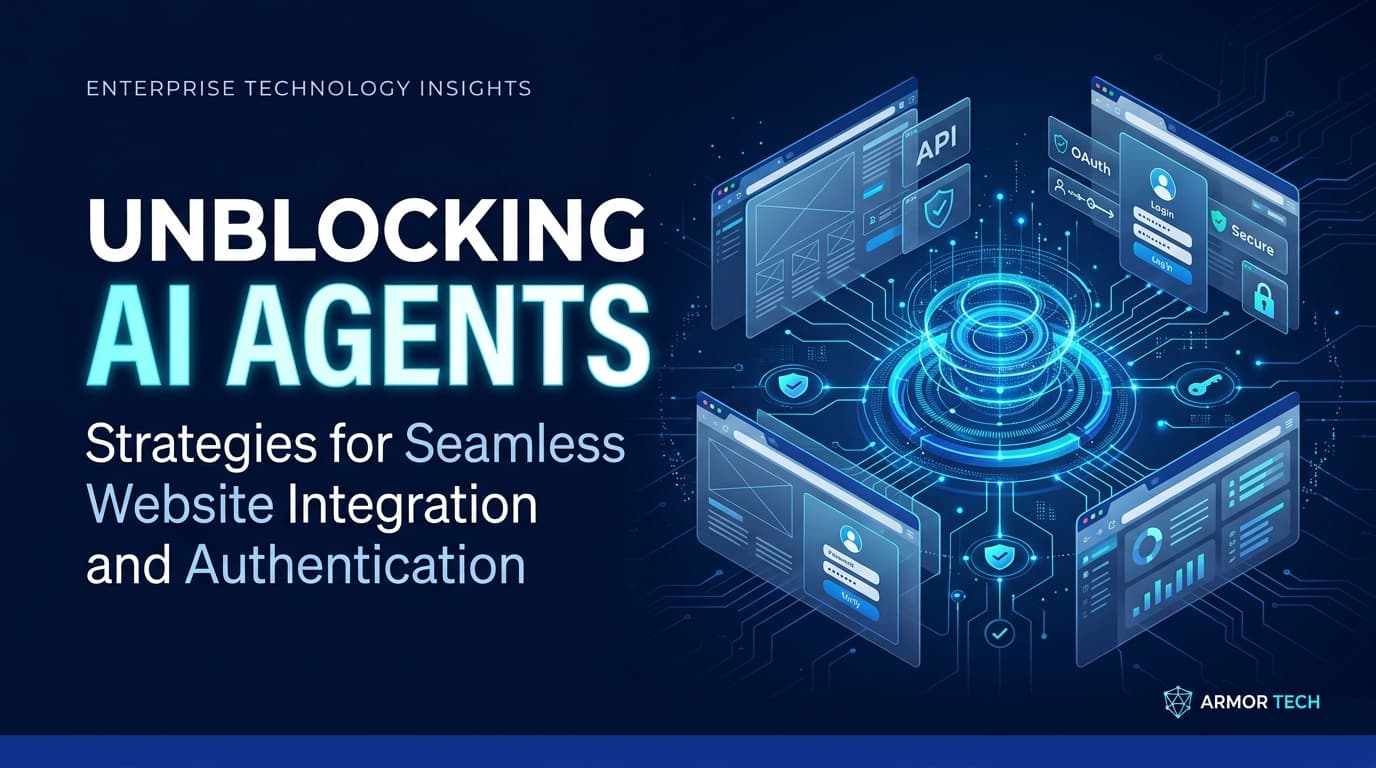
AI agents are ready to book your flights and order your groceries, but the web's immune system keeps rejecting them. The problem isn't agent capability—it's that every site runs its own mix of CAPTCHAs, bot detectors, and legal terms designed for a pre-agent era.
What's Actually Breaking
Meta's Muse gets blocked by Amazon. Walmart partners with Muse but their "verify you're human" button kicks the agent out anyway. Delta cites "unauthorized automated activity." United points to Terms of Use prohibiting robots. Yelp demands paid data licensing. eBay suspends accounts for agent use. Google kicks out Instinct during Gmail cleanup.
The pattern: sites can't distinguish between a scraper training on their catalog and an agent buying a toaster on your behalf. Both look like automated traffic. Both trigger the same defenses.
The CAPTCHA Problem
Walmart's case is instructive. They want agent traffic—they announced the partnership at Meta Connect. But their human-verification button creates a race condition: if the agent's flow interrupts the challenge, the session dies. This isn't malicious blocking. It's infrastructure that assumes a human holds the mouse.
Traditional bot detection relies on behavioral signals: mouse movement, keystroke timing, scroll patterns. An agent driving a headless browser or using CDP (Chrome DevTools Protocol) produces none of these. Even agents running in full Chrome instances with real user profiles trip heuristics because the interaction cadence is wrong—too fast, too precise, too consistent.
Cloudflare's Default Shift
On September 15, Cloudflare changed crawler defaults: sites previously blocking "AI bots for security" now block "AI agents on pages with ads." This caught legitimate agent traffic in the crossfire. Cloudflare's marketplace for AI bot data access and their Kitesurf browser for agents suggest they're building the toll booth before the road exists.
When asked about specific agent blocking, Cloudflare pointed to Radar—showing aggregate bot volume increases but no good/bot classification. The instrumentation gap is real: nobody's measuring agent success rates vs. scraper block rates.
The Emerging Standard
Meta, Walmart, Stripe, Sierra, Genesys, Rocket, NiCE, and Decagon are developing an open protocol for agent-to-business communication. The goal: cryptographic proof that an agent acts for a specific user, with scoped permissions and audit trails.
Think OAuth for agents. Instead of username/password handoff (which violates most ToS), the user delegates a signed capability token: "This agent may purchase items under $200 from my saved payment method on Walmart.com between 9 AM and 5 PM." The site verifies the token chain—user → identity provider → agent—and enforces the scope.
What the Protocol Must Solve
- Identity binding: Prove the agent represents the claimed user without sharing credentials
- Delegation scoping: Limit actions, spend, time windows, data access
- Revocation: User kills the token instantly; site honors it within seconds
- Auditability: Both sides get tamper-evident logs of what the agent did
- Liability allocation: Clear rules for who pays when the agent orders 500 rolls of toilet paper
Stripe's involvement signals payments integration—agents need to present payment instruments without exposing raw card data. Sierra and Genesys bring contact-center workflows: escalation to human agents when the bot hits a policy edge. NiCE and Decagon contribute enterprise governance requirements.
Current Workarounds Are Brittle
Today's agents rely on:
- Credential stuffing: User gives the agent their login. Violates ToS, triggers 2FA, breaks on password rotation.
- Session hijacking: Agent imports user's cookies. Fragile, expires, looks like account takeover to fraud systems.
- Browser automation: Playwright/Puppeteer/Stealth plugins. Arms race with bot detectors; maintenance burden grows weekly.
- Partner APIs: Where they exist. Walmart has one; Amazon doesn't for consumer agents. Fragmented, rate-limited, negotiated per partnership.
Meta's connector list inside Muse is essentially a curated allowlist of sites that either have partner APIs or tolerate the current automation approaches. It doesn't scale.
What Sites Actually Need
Blocking agents loses revenue. A user whose agent fails on Delta doesn't switch to manual booking—they switch to United or Southwest. But opening the gates blindly invites fraud, inventory hoarding, and training-data scraping.
The middle ground: agent-aware endpoints. Separate from the human HTML flow, these accept structured requests with signed delegation tokens. They return machine-readable responses (JSON-LD, schema.org actions) instead of rendered pages. No CAPTCHA, no rendering overhead, no layout shifts breaking selectors.
This parallels the mobile API transition ~2010. Sites didn't serve desktop HTML to phones; they built /api/v1 endpoints. Agents need the same treatment.
Incremental Adoption Path
Sites don't need to wait for the standard to finalize. They can:
- Add
Accept: application/agent+jsoncontent negotiation to existing checkout endpoints - Issue short-lived capability tokens via their existing OAuth/OIDC infrastructure
- Log agent actions alongside human actions in the same audit pipeline
- Start with read-only scopes (price checks, availability) before write (purchase, booking)
Our team at Armor Tech has been prototyping this pattern with two retail clients. The key insight: reuse your existing authZ system. Agents are just a new client type with delegated scopes.
Legal Uncertainty Slows Everyone
United's ToS prohibits "any robot, spider, other automatic device" without written permission. That language covers Googlebot, archival crawlers, and your agent equally. Sites enforce selectively—Googlebot gets a pass because traffic value exceeds legal risk.
Yelp's position is clearer: pay for data licensing or stay off. This treats agent traffic as commercial scraping regardless of user intent. The distinction matters: an agent booking a table for one user generates a cover; a scraper harvesting all menus for a competitor's training set doesn't.
eBay's "unauthorized agents and actions" policy is the most honest: they'll allow agents they approve, block the rest. This is the walled-garden model—partner APIs, negotiated terms, per-agent allowlisting. It works for top-10 sites; the long tail can't negotiate 500 partnerships.
Instrumentation Gap
Nobody knows the real failure rate. Cloudflare Radar shows bot volume up. Social media shows complaints. But there's no shared telemetry: agent success vs. block vs. silent failure (wrong item ordered, wrong date booked).
Agents should emit structured traces: site, endpoint, challenge type, resolution, latency. Sites should log: token presented, scope verified, action allowed/denied, reason. Without this, the standard process designs for anecdotes.
We've argued for standardized agent trace formats in the working group. Current proposal: W3C Trace Context extended with agent-id, delegation-chain-hash, and outcome codes.
What Changes When This Works
Not "seamless automation." That's marketing. The real shift:
- Users stop sharing passwords with third-party agents
- Sites get structured, attributable traffic instead of noisy browser automation
- Fraud systems gain a new signal: valid delegation token = lower risk baseline
- Agent developers compete on UX, not stealth browser engineering
- Long-tail sites participate without negotiating individual partnerships
The standard won't eliminate bot detection. It gives detection a new input: "this request carries a valid user delegation." That signal is stronger than mouse-movement heuristics.
Frequently Asked Questions
Do I need to wait for the open standard to support agents on my site?
No. You can issue capability tokens today using your existing OAuth/OIDC provider. Define scopes like agent:checkout:read and agent:checkout:write:max_amount=500. Accept them at your API endpoints alongside session cookies. The standard will unify token formats and discovery—your implementation won't be throwaway work.
How do I prevent agents from bypassing my fraud checks?
Treat the delegation token as a strong identity signal, not a bypass. Run your existing risk engine on the token metadata: user history, device reputation, velocity rules. The token proves who authorized the request; your risk engine still decides whether to allow this specific action. Revocation propagation (seconds, not hours) limits blast radius from compromised agents.
What about sites that rely on ad impressions from human browsing?
Agent-aware endpoints don't serve ads—they serve structured data. This is a feature, not a bug. Sites can monetize agent access directly (per-call fees, revenue share on completed transactions) instead of indirectly via ad views. Cloudflare's marketplace attempts this but at the network layer; application-layer pricing gives sites control over which actions are billable.