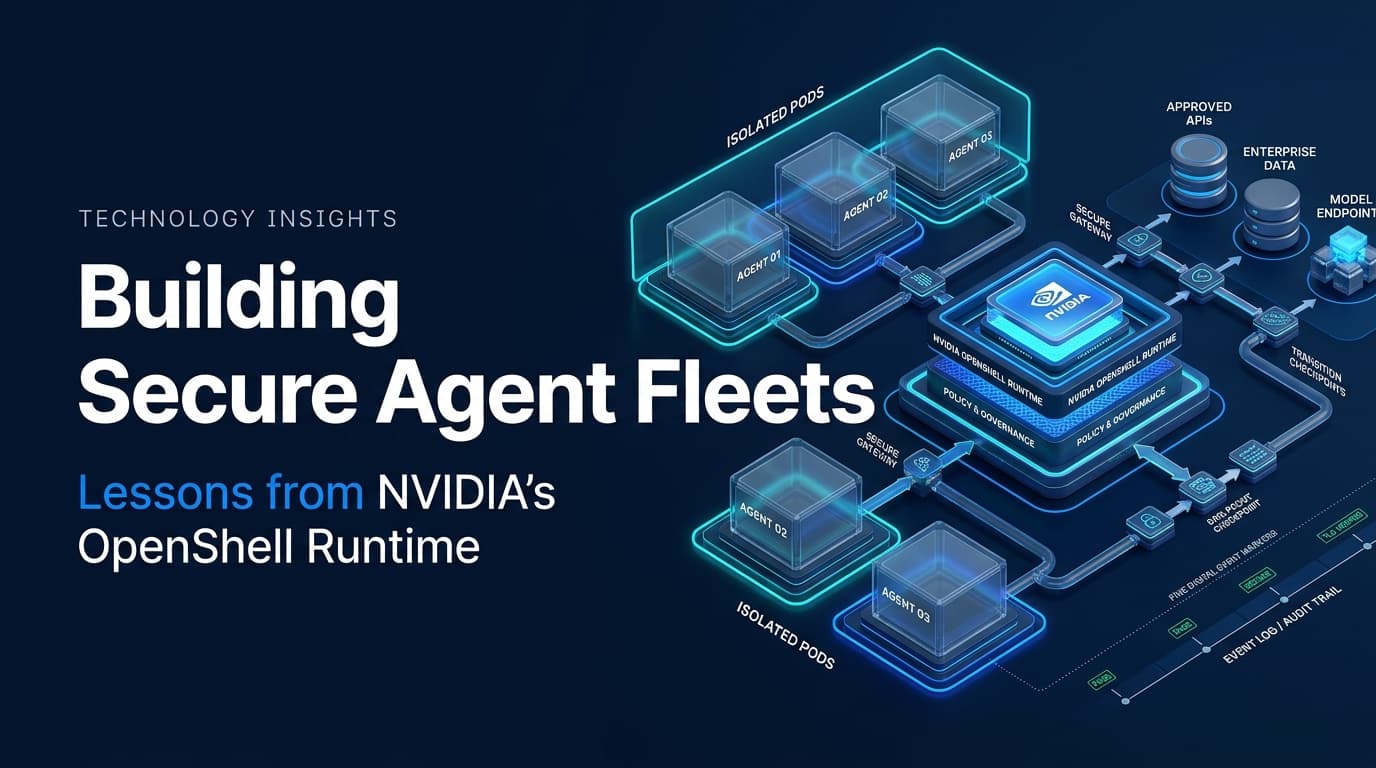
When an AI agent acts autonomously, security stops being a prompt problem and becomes a runtime problem. The failure mode is not only a bad instruction. It is a tool call, memory write, network request, or delegated action that the agent pipeline was not designed to handle safely. NVIDIA OpenShell is a useful starting point for that conversation because it names runtime-oriented security concepts, but our research pass could not use the GitHub source material: the fetch returned a 403 access error. OpenShell capabilities should therefore be treated as unverified until checked against official sources.
The architectural point is straightforward. A secure agent fleet needs a control layer between agent intent and effects. The sections below are a conceptual framework, not a verified OpenShell implementation guide.
Why Secure Agent Fleets Need a Runtime Layer
Single-agent runtimes often assume one agent, one task, and one policy. Fleet systems break that assumption. Multiple agents may share tools, memory, credentials, or downstream services. They may run concurrently or hand work between one another. A misconfigured agent can become a larger risk because its action lands in a shared or semi-trusted context.
For engineering teams, the useful shift is from agent-level permissions to action-level controls. The runtime layer becomes the place to enforce what an agent can do, when, with which credentials, and under what conditions. That includes tool boundaries, approval requirements, sandboxing, and audit logging.
In a fleet, the questions multiply:
What can this agent invoke?
What inputs and data sources are allowed?
What network endpoints are reachable?
What memory operations are permitted?
When does a human need to approve?
Without controls at these layers, fleet safety depends heavily on prompt design and developer discipline. That is fragile when agents coordinate.
A fleet is not just a collection of isolated sandboxes. The risk often comes from how actions cross boundaries between agents, tools, and shared services. Runtime design should therefore treat permissions as contextual, scoped, and testable rather than static.
OpenShell as a Runtime Starting Point
OpenShell appears in the brief as a runtime starting point for secure agent fleets. The research value is conceptual: it keeps the discussion focused on runtime guardrails, sandboxing, policy enforcement, and tool boundaries. The limitation is practical. The GitHub source fetch was blocked with a 403, so this pass had no usable research content from the project.
That means claims about OpenShell should not drive engineering decisions. Specifics such as sandbox behavior, policy language, tool allowlisting, network controls, approval flows, observability, and compatibility remain unverified. A responsible build would start from official OpenShell documentation, release notes, and source, then map those claims to fleet requirements.
The better starting exercise is requirements-first. Define the runtime guarantees the fleet needs. Then evaluate whether OpenShell or another runtime meets them. If source access is blocked, write the policy schema, threat model, and test cases first.
Until that verification happens, OpenShell remains a design hypothesis. That is fine for a conceptual post, but not for a production architecture decision.
Autonomous AI Agents and Runtime Boundaries
Autonomous AI agents make permission design harder because behavior is not fully known in advance. The agent may plan, select tools, call models, write memory, or trigger workflows. Runtime boundaries should cover tools, memory, network, and approvals. The exact split depends on the agent’s role, but the design questions are consistent.
A tool boundary might allow read-only database access for one agent and write access for another. A memory boundary might restrict persistence or retrieval. A network boundary might allow an internal API but not arbitrary internet egress. An approval boundary might require human sign-off before sending messages, deploying code, or moving funds.
Auditability matters because autonomy removes the human in the loop by default. Teams should log decisions, tool calls, inputs, outputs, policy checks, and approval state where relevant. Human oversight should exist for high-risk actions, not as an abstract layer that never gets used.
These are design patterns, not claims about a specific vendor’s implementation. The runtime should make action safety observable rather than relying on the model to behave.
Least privilege also means scoped credentials, not one shared key. Approvals should be contextual, tied to the action, the agent, and the risk class. That is more work than a single global allowlist, but it is the work that makes fleets manageable.
Agent Fleet Management and Orchestration
Fleet management adds orchestration concerns on top of runtime controls. Task routing, state handling, retries, and coordination need their own failure analysis. A runtime may enforce local boundaries, but a fleet may need a controller to assign tasks, manage state, and sequence actions.
Observability and rollback are part of the same problem. If agents act autonomously, teams cannot rely on manual inspection during execution. They need traces of decisions and tool invocations, ways to pause or stop activity, and mechanisms to revert agent actions where possible.
Coordination risks include one agent’s output influencing another without validation, shared state races, and runaway loops. The runtime layer may not solve orchestration. It may need to sit alongside an agent framework, scheduler, or custom control plane.
Secure AI Deployment Governance
Governance turns runtime design into organizational process. Policy enforcement should be explicit, versioned, and testable. Stop conditions or kill switches may be part of production architecture, though their availability must be verified in the chosen runtime. Evaluation should cover permission boundaries before autonomous fleets are trusted.
Compliance and human oversight requirements vary by domain. For a general agent fleet, the starting point is usually least privilege, scoped credentials, approval gates, and audit logs. For regulated or safety-critical use, add formal review, monitoring, and escalation paths.
The governance layer should not weaken runtime controls. It should define when controls apply, how exceptions are approved, and how incidents are handled. That includes policy versioning, change control, and clear ownership of agent behavior.
From Prototype Runtime to Production Deployment
A prototype runtime can prove a concept. Production deployment needs more. Consider sandboxing and secrets management as first-class requirements. A prototype may hardcode credentials or use broad network access; production needs scoped secrets and isolated execution.
Monitoring and incident response should be planned before launch. What signals matter? Tool calls, policy denials, approval waits, memory writes, network egress, model outputs. Who responds? How is the agent stopped? How is state cleaned up?
Validation before production should include permission tests, adversarial tool-use tests, and failure simulations. The goal is not to eliminate all risk. It is to make runtime behavior observable and bounded.
How Armor Tech Can Help
Armor Tech helps organizations design and implement secure AI agent environments with controlled access, isolated execution, protected credentials, and auditable workflows. From integrating AI agents with enterprise systems to defining runtime permissions, monitoring agent activity, and implementing human approval for sensitive operations, we help businesses build practical security into their AI architecture. Our approach supports responsible scaling while keeping agent autonomy aligned with business requirements, operational risk, and organizational security policies.
Frequently Asked Questions
Does the research verify OpenShell’s autonomous agent capabilities?
No. The research pass returned a GitHub access error, so no usable OpenShell source content was retrieved. Official documentation and source should be checked before relying on OpenShell for autonomous agent fleets.
What should a secure agent fleet runtime control?
It should address tool permissions, memory boundaries, network access, approval requirements, and audit logging. Specific enforcement details depend on the runtime and must be verified.
Is OpenShell enough for production agent fleets?
Not based on this research pass. Compatibility, licensing, deployment guidance, and production behavior require validation from official sources and hands-on testing.
Closing Notes
The practical takeaway is not to adopt OpenShell because of a brief or a source fetch. It is to treat runtime security as an architectural requirement for autonomous fleets. Define the boundaries you need, verify them against official sources, then build or integrate the control layer.
For teams evaluating custom agentic AI systems and secure deployment context, a focused architecture review can help pressure-test these assumptions before code is written.