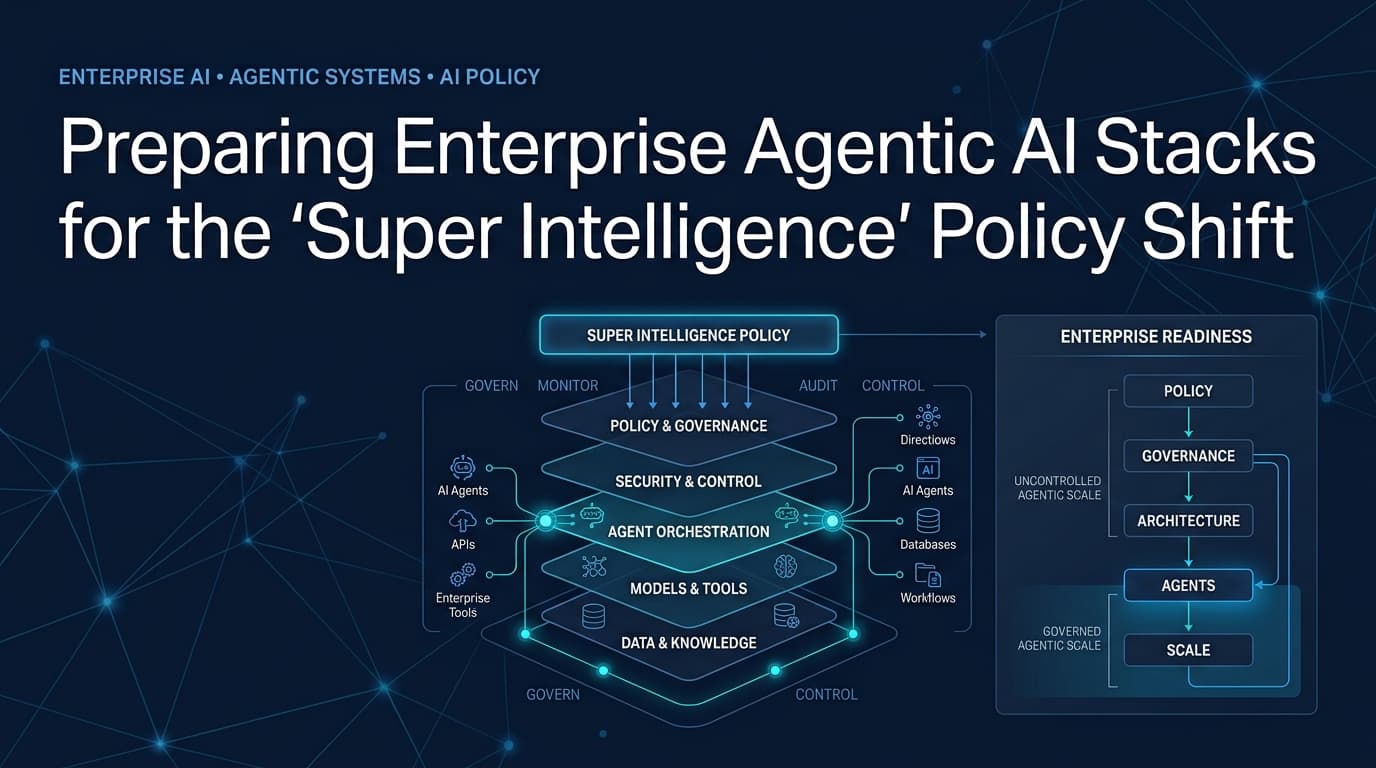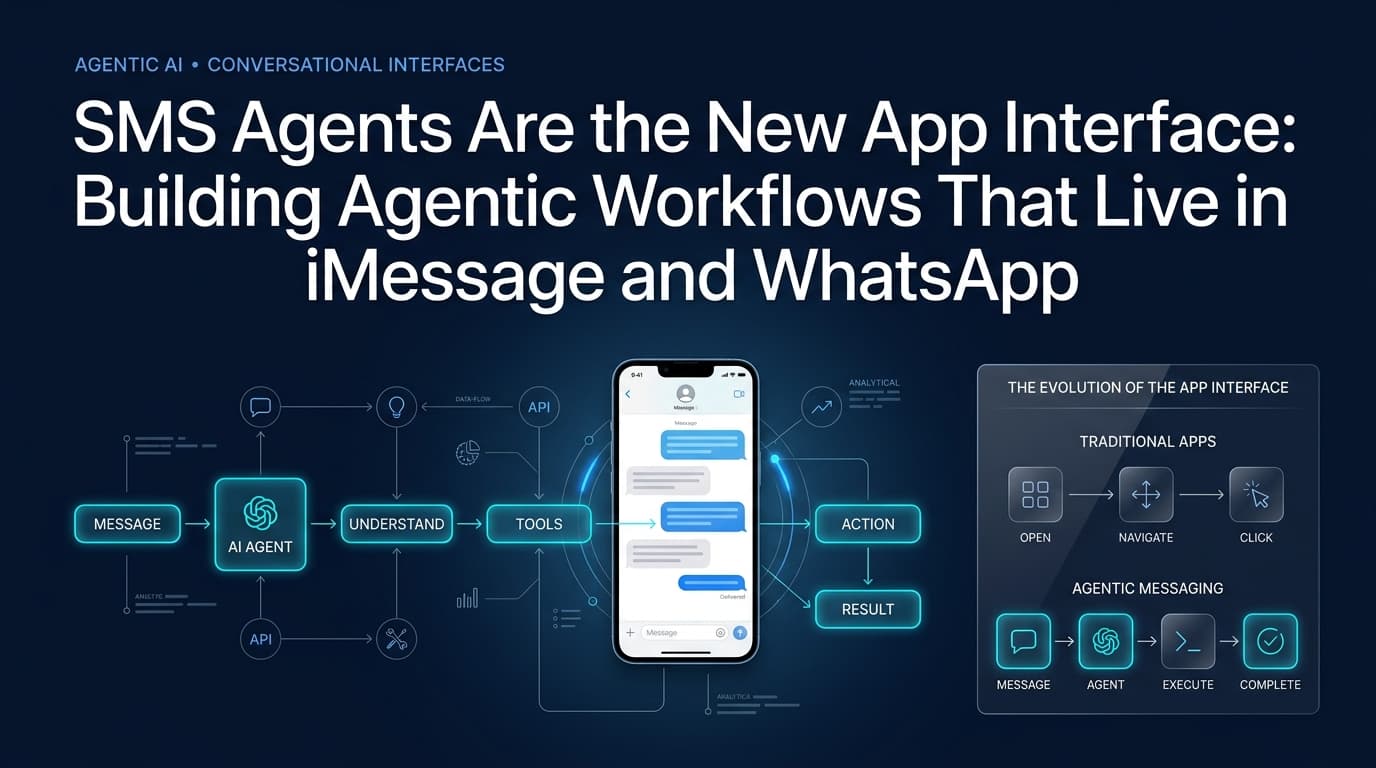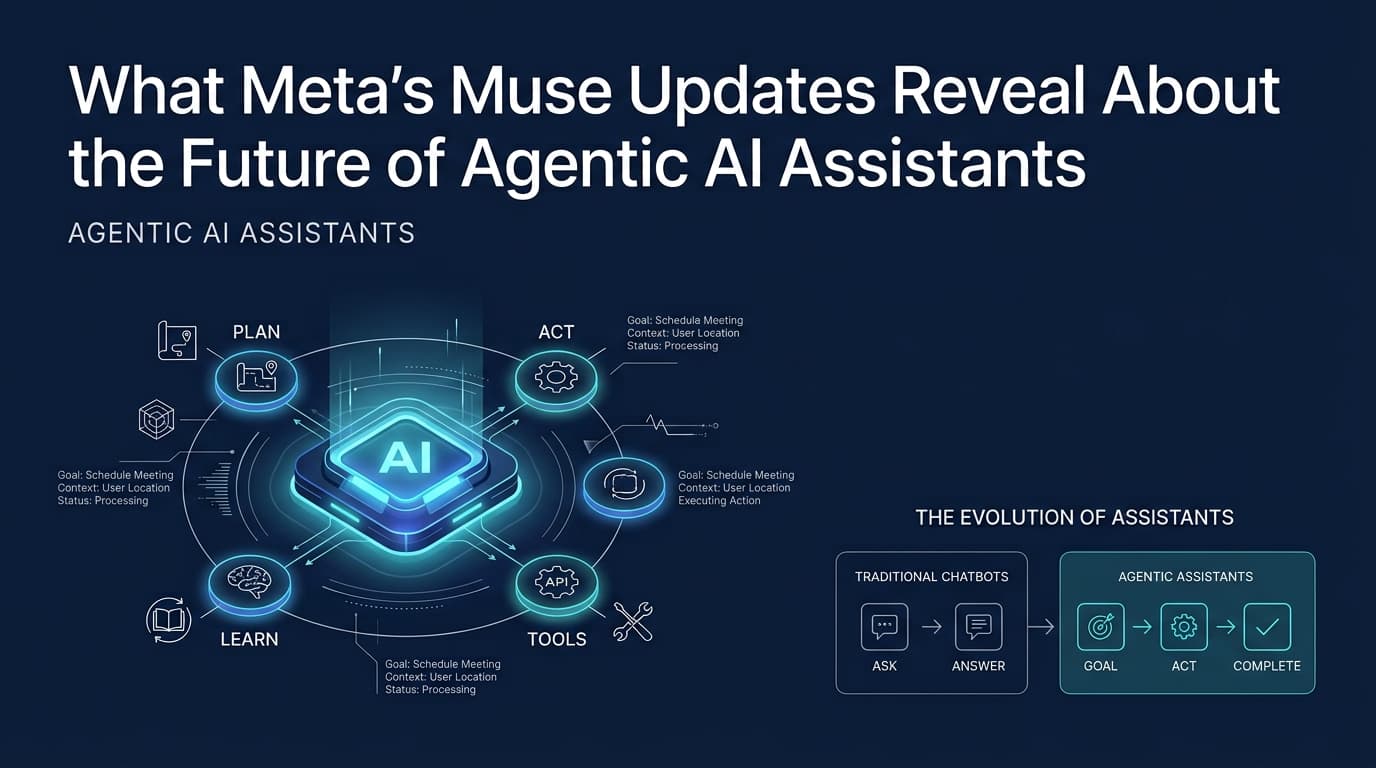
Building agentic AI SaaS means solving a different class of infrastructure problem than traditional software. The compute, data, and orchestration layers don't just scale linearly with users — they compound as agents chain tools, maintain context across sessions, and iterate on their own outputs. Blackstone's recent bets — up to $600 million in Neysa's AI compute infrastructure and a $1.5 billion joint venture backing Anthropic's implementation arm — signal where the capital intensity actually lives: not in model training, but in the operational substrate that keeps agentic systems reliable at production scale.
The infrastructure trap underneath agentic workflows
Most teams start with a framework — LangChain, LlamaIndex, or a custom orchestrator — and a vector database. That gets a demo working. The problems appear when you add concurrent users, long-running tasks, and the need for deterministic replay. An agent that calls three tools in sequence isn't three API calls; it's a distributed transaction with partial failure modes, state that must survive process restarts, and observability gaps that make debugging feel like archaeology.
The capital requirements Blackstone is funding reflect this reality. Neysa isn't building models; they're building the compute substrate — GPUs, networking, data center capacity — that agentic workloads consume unpredictably. A RAG pipeline that retrieves, reranks, and synthesizes for a single query might use 10x the tokens of a simple chat completion. Multiply that by thousands of agents running async workflows, and the inference bill becomes a function of architecture decisions made six months earlier.
Where the compute actually goes
Agentic systems spend tokens in three places that surprise teams coming from chat interfaces:
- Planning loops: An agent that reflects, revises, and retries can generate 5-20x the tokens of a single-pass response. Each iteration is a new inference call with full context.
- Tool call overhead: Every function call, API request, and result serialization adds prompt tokens. A workflow with 15 tool invocations accumulates context that won't fit in standard context windows without aggressive summarization — which then loses nuance.
- Evaluation and guardrails: Running critic models, safety classifiers, and regression tests on every output doubles or triples the inference volume.
These aren't optimization problems you solve later. They're architecture constraints you encode in the first design review. The teams that scale without raising infrastructure-specific rounds treat token economics as a first-class design parameter — choosing smaller models for planning, caching aggressively, and batching evaluation async.
RAG pipelines that don't collapse under agentic load
Retrieval-augmented generation looks different when the querier is an agent rather than a human. Humans ask one question, scan results, refine. Agents issue dozens of queries per task, each with different intent, and they don't tolerate latency variance. A retrieval pipeline optimized for p50 latency will kill agent throughput when p99 spikes during index refresh or embedding model warm-up.
Architecture patterns that hold
Production agentic RAG systems tend to converge on a few patterns:
- Tiered retrieval: A fast, cheap first pass (BM25 or small dense encoder) filters candidates before expensive reranking. The agent gets results in <100ms for the common case; complex queries fall through to the full pipeline.
- Query decomposition with caching: Agents break complex questions into sub-queries. Caching embedding results and intermediate retrievals across sub-queries avoids recomputing the same vector searches within a single workflow.
- Deterministic reranking: Cross-encoders are expensive and non-deterministic across hardware. Teams that need replayable agent behavior often swap to learned sparse retrieval (SPLADE) or distilled rankers that produce identical scores across runs.
- Index versioning: When the knowledge base updates, agents in mid-workflow can retrieve from stale and fresh indexes simultaneously. Version-pinned indexes let you replay a failed workflow against the exact corpus state it saw originally.
These patterns require engineering investment upfront — not the kind that shows up in a Series A pitch deck, but the kind that prevents a $2M/month inference bill at Series B. The Blackstone/Ode joint venture around Anthropic's implementation layer suggests the market is pricing this operational maturity higher than raw model performance.
Automation workflows as durable execution
"AI automation workflows" is a marketing term for what engineers recognize as durable execution with probabilistic steps. The difference from Temporal or Cadence is that your activity workers are LLMs — non-deterministic, expensive, and occasionally hallucinating. You need the same guarantees: exactly-once semantics, saga compensation, visibility into stuck executions.
Building the control plane
Teams that ship agentic automation in production build three layers that pure RAG teams often skip:
- Execution ledger: Every agent decision — tool choice, parameters, result, token count, latency — writes to an append-only log. This isn't observability; it's the replay substrate. When an agent produces a wrong answer three weeks later, you replay the exact trace with a patched prompt or updated tool schema to verify the fix.
- Compensation primitives: Agents that mutate external state (send emails, update CRMs, trigger deploys) need undo operations. The workflow engine must track which steps are idempotent, which have compensating actions, and which require human approval. This is standard saga pattern work, but the "activities" are prompt templates and model configs.
- Policy-as-code guardrails: Instead of hardcoding rules in prompts, define policies (max tokens per step, allowed tools per agent type, PII redaction requirements) in a config the orchestration engine enforces. This lets you change safety posture without redeploying agent code.
The capital intensity here isn't GPUs — it's engineering time building infrastructure that doesn't differentiate your product but prevents catastrophic failure. Blackstone's perspective, per Khaira's Disrupt session framing, is that companies surviving the momentum-to-endurance transition are the ones investing in this unglamorous layer before they're forced to.
Capital decisions as architecture decisions
The research text highlights a tension: founders make financing decisions "long before they know whether early momentum will turn into an enduring business." In agentic SaaS, the financing decision is an architecture decision. Raising a large infrastructure round lets you own GPUs, negotiate reserved capacity, and optimize for throughput over latency. Raising a smaller round forces you onto serverless inference APIs with per-token pricing, rate limits, and no control over model versions.
Neither is wrong. But they demand different architectures:
- Owned infrastructure path: You can run larger open models, batch aggressively, amortize fixed costs. You need ML ops talent, capacity planning, and tolerance for GPU utilization below 40% during development phases.
- API-dependent path: You optimize for token efficiency — smaller contexts, aggressive caching, model routing by task complexity. You accept vendor lock-in and plan migration paths for when (not if) pricing or availability changes.
The Anthropic/Ode joint venture — $1.5B for "implementation, not models" — suggests the market believes the winning play is helping companies execute on the API-dependent path well, rather than every company building their own Neysa. For a SaaS founder, the question isn't which path is better in abstract; it's which path your runway and hiring plan can actually execute.
What enduring agentic companies actually optimize for
Khaira's framing — "what separates momentum from staying power" — maps to three technical differentiators that compound over time:
1. Token efficiency as a product metric
Teams that treat tokens as a cost center rather than an abstraction build different features. They invest in prompt compression, semantic caching, and model routing layers that send simple classifications to 7B models and complex reasoning to frontier models. This shows up in margins, but more importantly in latency — users feel the difference between a 2-second and 15-second agent response.
2. Eval-driven development loops
Momentum-driven teams ship features and check vibes. Enduring teams ship evals first: golden datasets, regression suites, A/B frameworks that measure task success rate, not just latency or error rate. When the model provider updates their API (and they will), you know within hours whether your agents degraded — not when customers churn.
3. Human-in-the-loop as a first-class primitive
Agentic systems that pretend to be fully autonomous hit a ceiling. The durable ones design for escalation: structured handoff points where a human reviews, corrects, or approves. This isn't a failure mode — it's the product. The workflow engine treats human review as another activity with SLAs, reassignment logic, and audit trails. Blackstone's implementation-focused thesis aligns here: the value isn't the agent acting alone; it's the system that combines agent speed with human judgment at the right points.
The hiring reality
Building this requires a talent mix that doesn't map to traditional SaaS org charts. You need:
- ML engineers who understand serving infrastructure, not just model training
- Platform engineers who treat prompt templates and tool schemas as deployable artifacts with versioning, rollback, and canary releases
- Data engineers building the feedback loops — capturing human corrections, feeding them back into fine-tuning or few-shot selection
- Product engineers who design UX for non-determinism: loading states that show agent reasoning, interfaces for correcting agent mistakes, trust calibration
The capital Blackstone is deploying funds exactly this team composition at portfolio companies. The $600M Neysa investment includes talent acquisition for the infrastructure layer; the Ode joint venture is explicitly an implementation services play — hiring the people who make agentic systems work in customer environments.
Practical starting points
If you're building agentic SaaS today, three decisions determine whether you'll need a Neysa-scale infrastructure round or an Ode-scale implementation partnership:
- Choose your orchestration layer early. Don't build a custom workflow engine unless workflow is your product. Use Temporal, Prefect, or a purpose-built agent framework with durable execution. Migrate later is a rewrite.
- Instrument token usage per feature, not per request. Know which product capabilities cost what. This data drives every subsequent architecture decision — model routing, caching strategy, pricing tiers.
- Build the eval harness before the second feature. The first feature proves the concept. The eval harness proves you can maintain it when the underlying model changes. Our RAG evaluation framework guide covers the pattern we see working across client implementations.
These aren't glamorous. They don't make demo videos. But they're the difference between a company that raises a Series B on momentum and one that raises it on unit economics that survive a model price war.
Closing thoughts
The investor perspective Khaira brings — capital as a tool for building endurance, not just velocity — maps directly to the engineering choices that compound. Agentic SaaS makes the infrastructure visible in a way traditional SaaS doesn't. Every token, every tool call, every human escalation is a line item you can optimize or ignore. The companies Blackstone backs are the ones treating those line items as engineering leverage, not tax.
If you're architecting an agentic system now, the most valuable question isn't "which model?" but "what's the cost structure of a successful task completion at 10x current volume?" Answer that, and the infrastructure, hiring, and fundraising decisions follow. Our agentic architecture patterns reference walks through the concrete tradeoffs we see teams navigating.
Frequently Asked Questions
How do I estimate infrastructure costs for an agentic SaaS before launching?
Model a single successful task completion: count the planning iterations, tool calls, retrieval queries, and evaluation steps. Multiply by your target tokens per step and current API pricing (or amortized GPU cost if self-hosting). Then apply a 3-5x safety factor for retries, edge cases, and eval overhead. The result is your marginal cost per task — use that to price tiers and model routing thresholds.
When should I invest in custom eval infrastructure versus using vendor tooling?
Vendor eval tools (LangSmith, Braintrust, Weights & Biases) cover 80% of needs for teams under 10 engineers. Invest in custom infrastructure when you need: regression testing against proprietary golden datasets that can't leave your VPC, integration with your CI/CD for automated promotion gates, or evaluation metrics that combine model outputs with business outcomes (e.g., "did this agent workflow actually close the ticket?").
What's the minimal viable orchestration stack for a two-person founding team?
Start with a managed workflow engine (Temporal Cloud or Prefect Cloud) + a lightweight agent framework (LangGraph or Pydantic AI) + structured logging to a queryable store (ClickHouse, Postgres with JSONB, or a managed observability platform). Avoid building your own state machine, retry logic, or replay tooling. The managed services cost more per seat but save months of infrastructure engineering that doesn't differentiate your product.