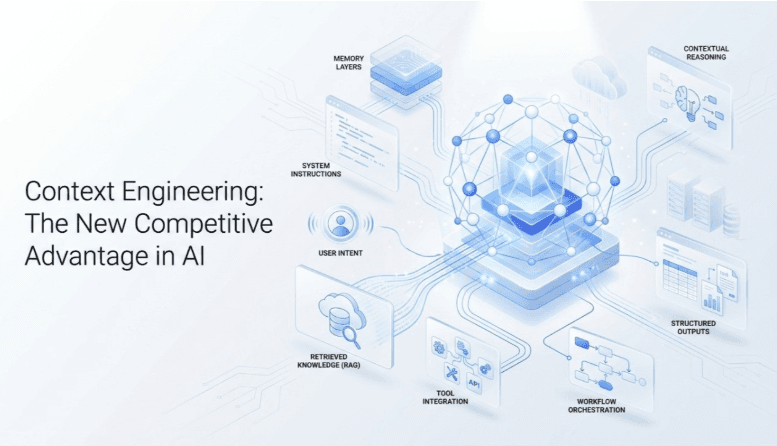
Artificial intelligence has advanced rapidly over the past few years, with organizations investing heavily in larger models, advanced prompting techniques, and AI-powered workflows. Yet many enterprise AI initiatives continue to struggle with accuracy, consistency, and real-world usefulness. The reason is simple: even the most capable AI model can only perform as well as the information available to it. As businesses move beyond experimentation and toward production-scale AI systems, attention is shifting from prompt engineering to a more critical discipline context engineering. By ensuring AI has access to the right knowledge, user history, business data, and real-time information, organizations can create systems that deliver more reliable insights, make better decisions, and generate greater business value. In many ways, context engineering is becoming the foundation of successful enterprise AI.
What is Context Engineering?
Context engineering is the practice of designing, organizing, and delivering the most relevant information to an AI system at the moment it is needed(Source:Anthropic Documentation).
It involves managing not only the prompts provided to a language model but also the additional context that shapes its responses, such as company knowledge, conversation history, user data, memory, and outputs from connected tools. The goal is to ensure the AI has access to the right information at the right time, enabling more accurate, reliable, and context-aware results.
Context Engineering vs. Prompt Engineering: Understanding the Difference
One of the most common misconceptions in AI development is assuming that context engineering and prompt engineering are the same thing. While both influence AI performance, they address very different challenges(Source:Medium Documentation).
What Is Prompt Engineering?
Prompt engineering focuses on crafting clear and effective instructions for an AI model. The goal is to improve outputs by refining the wording, structure, and detail within a prompt. In most cases, it is a relatively static approach that concentrates on what is directly asked of the model.
What Is Context Engineering?
Context engineering takes a much broader view. Instead of focusing solely on the prompt, it ensures that the AI receives all the relevant information needed to complete a task effectively. This includes retrieving, organizing, filtering, and structuring data from various sources before the model generates a response.
The Key Difference
Prompt engineering is about telling the AI what to do. Context engineering is about providing the AI with everything it needs to know in order to do it well.
A well-written prompt can improve results, but without the right context, even the most advanced AI models can produce incomplete or inaccurate responses. Context engineering bridges this gap by delivering the right information at the right time.
A Simple Analogy
Think of prompt engineering as writing a well-crafted email instruction. Context engineering, on the other hand, is the system that gathers the information needed before that email is written ,reviewing previous conversations, checking schedules, retrieving customer details, and understanding the broader situation. By the time the AI generates a response, it is working with a complete picture rather than a single instruction.
This shift from prompts to context is becoming increasingly important as organizations deploy AI agents and enterprise AI systems that require greater accuracy, personalization, and decision-making capabilities.
The Four Disciplines of Effective Context Engineering
Effective context engineering relies on four key practices that help AI systems deliver accurate and relevant result(Source:Medium Documentation)..
1. Write and Select
Not all information deserves a place in the context window. Including unnecessary data can distract the model and reduce performance. The goal is to provide only the information that is relevant to the task.
2. Compress
As interactions grow over time, context must be condensed efficiently. Summaries, key insights, and structured memory help preserve important information without overwhelming the model.
3. Structure and Order
The way information is organized has a significant impact on output quality. Well-structured and prioritized context helps models understand and use information more effectively than unorganized data dumps.
4. Isolate
In multi-agent environments, each agent should receive only the context relevant to its specific role. This reduces unnecessary complexity, improves efficiency, and keeps agents focused on their assigned tasks.
Together, these disciplines help organizations build AI systems that are more accurate, efficient, and scalable.
The Key Components of Context Engineering for AI Agents
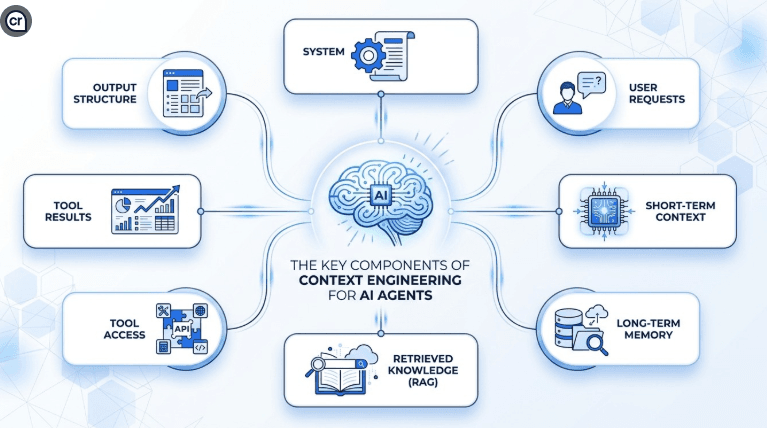
Context engineering is the process of ensuring that an AI agent receives the right information at the right time. The effectiveness of an agent depends not only on the model itself but also on how its context is designed and managed.
Several elements contribute to a well-engineered context:
System Instructions – Define the agent’s role, behavior, and objectives.
User Requests – The specific task or question the user wants the agent to address.
Short-Term Context – Information from the current conversation or workflow.
Long-Term Memory – Relevant knowledge retained from previous interactions.
Retrieved Knowledge (RAG) – External information dynamically fetched from documents, databases, or knowledge sources.
Tool Access – The tools and functions available to the agent for completing tasks.
Tool Results – Data and outputs returned after the agent uses a tool.
Output Structure – Formatting guidelines and response requirements that help produce clear and consistent outputs.
Each of these components plays a critical role in agent performance. When any part is missing or poorly managed, the quality of the agent’s decisions and responses can suffer not because of model limitations, but because the agent lacks the context needed to perform effectively.
Conclusion
As AI continues to evolve from simple chat interfaces to intelligent agents capable of supporting complex business operations, the importance of context has never been greater. While powerful models remain an essential part of the equation, their success ultimately depends on the quality of the information, memory, and tools available to them. This is why context engineering is emerging as a critical discipline for organizations looking to maximize the value of AI. By delivering the right knowledge, at the right time, in the right format, businesses can build AI systems that are more accurate, reliable, and capable of producing meaningful outcomes. In the years ahead, the companies that excel at managing context not just prompts will be the ones that unlock the full potential of enterprise AI.
How Armor Tech Can Help
At Armor Tech, we help businesses build AI solutions that go beyond powerful models by focusing on the context that drives better outcomes. From RAG-powered knowledge systems and AI agents to intelligent automation, we ensure AI has access to the right information, tools, and business knowledge when it matters most. The result is more accurate, reliable, and efficient AI systems that support smarter decision-making and improved operational performance.
References
Effective Context Engineering.Anthropic Documentation
https://www.anthropic.com/engineering/effective-context-engineering-for-ai-agents
Context Engineering…Medium Documentation
https://medium.com/@vovance/context-engineering-is-the-new-moat-for-ai-teams-d394e4cc346f