Voice AI has billions in funding but no ChatGPT-style inflection point. PolyAI and Otter execs reveal the technical and trust barriers—fast reasoning, ASR accuracy, emotive nuance, transparency—that keep production voice agents from mainstream SME adoption.
Investors have poured billions into voice AI startups across model makers, customer service platforms, meeting tools, and dictation apps. Yet no single product has triggered the mass-adoption inflection point that ChatGPT created for text LLMs. Executives at PolyAI and Otter confirm the gap: full-duplex models now exist, but reasoning latency, ASR accuracy, trust mechanics, and transparency requirements keep production voice agents from mainstream SME deployment.
## The Missing ChatGPT Moment: Where Voice AI Stands Today
The funding curve looks vertical. Startups building everything from foundational speech models to verticalized customer-service agents have absorbed billions in venture capital. Weekly releases claim human-like conversation. On the ground, however, the experience fragments. PolyAI CTO Shawn Wen, speaking at the HumanX conference, put it directly: full-duplex architectures—which speak while listening—have arrived, but the reasoning layer cannot fetch answers fast enough to preserve conversational rhythm. Without that speed, every interaction feels like a stilted walkie-talkie exchange rather than dialogue.
Otter CMO Alex Gay frames the same problem from the meeting-productivity side. Transcription, he notes, was never the end product; it was the substrate for automation. Speaker identification, intent capture, and linkage to organizational knowledge are what turn raw audio into action. Until those layers work reliably, voice remains a demo-grade interface instead of a daily driver for SMEs.
## Reasoning Speed: The Hidden Bottleneck Behind Natural Conversation
Full-duplex solves half the physics. The other half is an end-to-end latency budget that spans ASR → LLM reasoning → TTS. Wen emphasizes that models must "fetch answers quickly" so the conversation feels natural. In production terms, that means the reasoning step—whether a RAG lookup, a function call, or a knowledge-base query—must complete inside the conversational pause window humans expect, typically under 800 ms round-trip for the target use case.
Architecturally, this pushes teams toward cached knowledge layers, streamlined retrieval pipelines, and edge deployment for the TTS component. A model that reasons brilliantly in 2 seconds creates dead air that callers interpret as incompetence. The fix isn't a bigger model; it's a narrower, faster retrieval path for the specific domain.
## First Three Turns: How Voice Agents Earn (or Lose) Caller Confidence
Wen observed that callers decide within two or three turns whether to stay or demand a human. Robotic prosody, misunderstood intent, or silence erodes trust instantly. The design pattern that works: proactive confirmation ("So you'd like to reschedule Thursday's 2 PM slot—correct?"), graceful fallback ("Let me pull that up a different way"), and sentiment-aware pacing that slows when frustration markers appear.
For SMEs deploying a first agent, this means conversation design isn't copywriting—it's a confidence-building protocol. Validate the first three turns with at least five real users before any production traffic. Measure containment not by whether the bot answered, but by whether the caller voluntarily continued past turn three.
## Beyond Transcription: Speaker ID, Intent Capture & Organizational Knowledge
Gay's distinction is sharp: transcription is table stakes. The automation layer requires speaker identification (who said what), intent capture (what they meant), and marriage to organizational knowledge (what the business knows). Otter's digital-twin experiments underscore the same point—an avatar that cannot convey debate, strategic nuance, or relational undercurrents is just a Q&A chatbot with a voice skin.
The implication for SMEs: a voice agent that cannot write to the CRM, open a ticket, check the knowledge base, or read the calendar is a toy. Integration hooks are not optional; they are the product. AI automation workflows with n8n and Make illustrate how voice agents connect to existing stacks without custom middleware.
## ASR Accuracy: The Silent Killer of Downstream Automation
Both executives converge on ASR as the silent failure mode. Wen notes that missed keywords break context for all downstream steps. Gay traces the cascade: wrong transcript → wrong summary → wrong action → lost trust. The platform survives a hallucinated summary; it does not survive an action taken on a phantom keyword.
For SME buyers, the evaluation criterion is domain-specific word error rate. Generic benchmarks on clean audio are irrelevant. Test the ASR on your acronyms, product names, and accent mix before signing. A 5 % WER on your vocabulary is a practical ceiling; above it, every downstream automation becomes a liability.
## Transparency & Trust: Declaring AI Without Killing Conversion
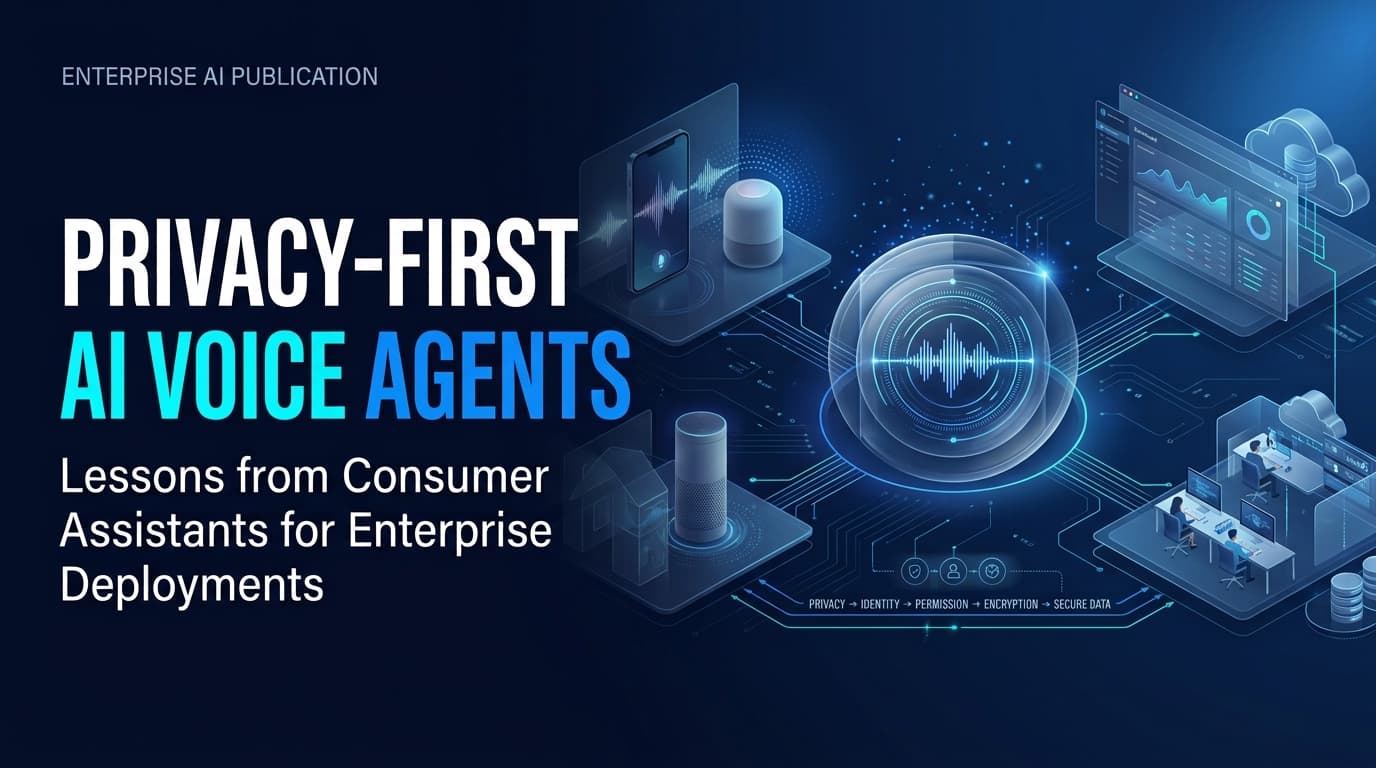
Compliance and UX collide at the disclosure moment. Both execs agree: callers must know they are speaking to AI or being recorded. Otter experiments with in-chat notifications even when the bot isn't present, normalizing the signal. Wen stresses that enterprise calls need an upfront declaration that the counterparty is an agent.
Design patterns that survive legal review: a brief, human-toned disclosure at call start ("Hi, I'm an AI assistant for Acme Corp. This call is recorded for quality."), an immediate opt-out path ("Press 1 for a human"), and immutable audit logs for every interaction. The goal isn't to hide the AI; it's to make the disclosure feel like service, not a legal disclaimer.
## Your Pre-Deployment Checklist: From Pilot to Production-Grade Voice Agent
Synthesizing the gaps above into a go/no-go framework for SME buyers:
- Latency budget: end-to-end < 800 ms for the target use case (ASR → reasoning → TTS).
- ASR word-error-rate on your domain vocabulary < 5 %.
- Confidence-building conversation design validated with 5+ real users across the first three turns.
- Integration hooks: CRM, ticketing, knowledge base, calendaring—live, not mocked.
- Transparency & consent flow reviewed by legal; opt-out within one turn.
- Fallback path to human within two turns, with context transfer.
- Monitoring dashboard: CSAT, containment rate, escalation reason codes, ASR confidence distribution.
Teams that treat this checklist as a pilot gate—not a wish list—avoid the common trap of shipping a demo that collapses under real traffic. agentic AI systems for voice automation are built around these constraints from day one.
## Frequently Asked Questions
What is the single biggest technical blocker to a ChatGPT-style breakout for voice AI?
Reasoning latency inside the full-duplex loop. Models can now speak while listening, but they cannot retrieve and synthesize answers fast enough to maintain natural conversational rhythm, so every interaction feels delayed.
How should an SME evaluate ASR accuracy for their specific domain?
Run a representative sample of your actual call audio—acronyms, accents, background noise—through the candidate ASR. Measure word error rate on your vocabulary, not generic benchmarks. Target < 5 % WER before any automation depends on the transcript.
Does mandatory AI disclosure kill conversion rates?
Data from PolyAI and Otter suggests it doesn't—if the disclosure is brief, human-toned, and paired with an immediate opt-out path. Callers who stay past the disclosure tend to treat the agent as a capable channel rather than a barrier.
Ready to stress-test a voice agent against your real call data? Book a 30-min technical discovery call and we'll map latency, ASR accuracy, and integration gaps before you commit budget.