From Chat to Co-Worker: What 'Agentic' Actually Changes in Gemini
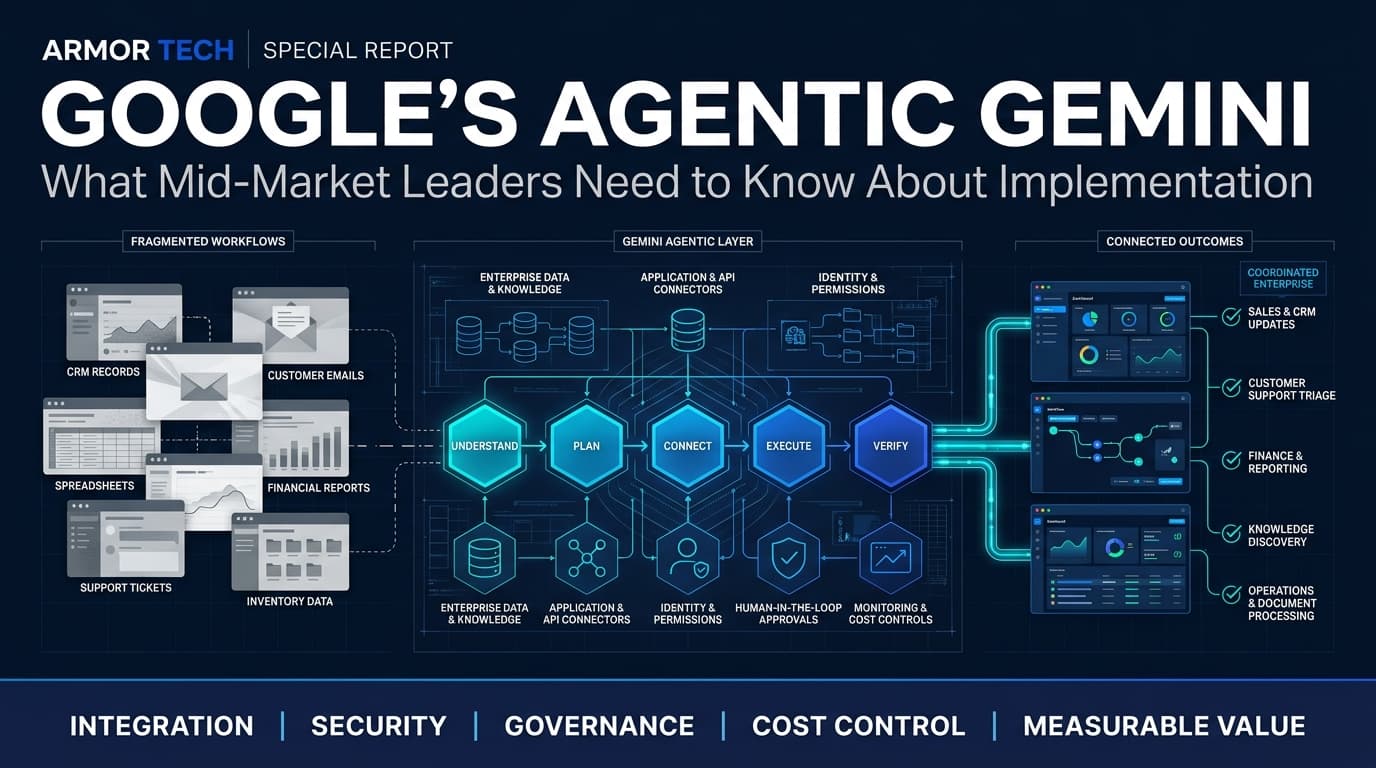
The core paradigm shift is objectives over instructions. Instead of a prompt-response loop, you hand the agent a goal — "reconcile Q3 vendor invoices against purchase orders and flag discrepancies" — and it plans the work, selects tools, spins up subagents, and reports progress through a tasks inbox. That inbox surfaces the agent's thinking, delegation decisions, code execution, and skill loading in real time.
The agent gets its own Workspace identity: email address, calendar awareness, team membership knowledge, time zone context, and approval chain visibility. You interact with it by tagging, emailing, sharing docs, or adding it to group chats. Every action writes an audit trail attributed to the agent, not the human who invoked it. This is a meaningful departure from impersonation-based automation — it creates a clean accountability boundary for compliance reviews.
For mid-market teams, the immediate mapping exercise is identifying workflows that currently stitch together multiple scripts, RPA bots, or manual handoffs across Workspace, Jira, Git, and internal databases. The agent's value concentrates where context switching and tribal knowledge create latency.
Integration Surface: Where the Agent Lives in Your Stack
Google's announced default connectors cover the typical mid-market SaaS backbone: Google Workspace, Microsoft 365, Slack, Jira, Confluence, Git. On the data layer: BigQuery, Databricks, Postgres, Snowflake. The critical extensibility point is Model Context Protocol (MCP) server support — the agent can connect securely to any MCP server inside or outside your network. This is where custom ERPs, proprietary APIs, and internal tooling plug in.
Access points span iOS, Android, Windows, Mac, CLI, ServiceNow, and Slack. That breadth matters for adoption: engineers can invoke from terminal, ops from ServiceNow, sales from Slack. But each surface introduces its own permission model and audit requirements. Plan your rollout by mapping which teams need which entry points first, rather than enabling everything at once.
The MCP connector story is the make-or-break for mid-market. If your internal systems already expose MCP endpoints (or can be wrapped), integration lift drops sharply. If not, you're building those adapters — which is where agentic AI systems development typically spends the first sprint.
Model Orchestration & Vendor Lock-In Realities
By default, Gemini routes each subtask to the model it judges best suited. Users can override manually. At launch, the third-party option is Anthropic's Claude models; the roadmap promises open-source and private model support. This creates a multi-vendor orchestration layer inside the Google console — useful for avoiding single-provider dependency, but it also means your governance policy must cover model selection criteria, data egress rules per model, and version pinning for reproducibility.
For architects, the key question is whether the routing logic is inspectable and overridable at the organizational level, not just per-session. If marketing tasks route to Claude by default but legal requires Gemini for data residency, you need policy-as-code enforcement, not user discretion. Google hasn't published the routing algorithm or an admin API for it yet — treat that as a gap to validate in pilot.
Security & Compliance Posture for Mid-Market
Google frames the agent's design around "harder problems around security, scale, and performance." The concrete controls announced: agent operates with its own credentials (no user impersonation), audit trails attribute to the agent, team and context awareness includes approval chains and calendars. For a mid-market company targeting SOC2 Type II or GDPR compliance, these map cleanly to evidence requirements — provided the audit logs are exportable, tamper-evident, and retainable per your retention policy.
Data residency isn't explicitly addressed in the announcement. If your contracts require EU-only processing, you'll need confirmation that agent execution, subagent spawning, and MCP calls honor region locks. The agent's Workspace identity also means it appears in Google Vault and Drive audit logs — verify that your existing eDiscovery workflows capture agent-authored content correctly.
Access control granularity matters: can you scope the agent's Jira access to specific projects? Its BigQuery access to specific datasets? The announcement says "connects to business data and systems" but doesn't detail least-privilege provisioning. Assume you'll need to configure this at the connector level, not the agent level.
Cost Governance: Spend Caps, Smart Routing, and Flexible Billing
Google positions cost control as a first-class concern: multi-model orchestration with smart routing, real-time spend caps, and "flexible spending options" (details TBD). The mechanism appears to be: route simpler subtasks to cheaper models, reserve expensive models for reasoning-heavy steps, and enforce a hard ceiling per project or billing period.
For finance and engineering leads, the modeling exercise is straightforward: estimate token volume per workflow type, apply model pricing tiers, set caps with buffer. But the unknowns are significant — routing efficiency at scale, latency overhead of model switching, and whether caps trigger graceful degradation or hard stops. Run a two-week shadow mode on a representative workload before committing budget.
The multi-model approach also means you're tracking cost across providers (Google + Anthropic + future open-source hosts) in a single console. Ensure your FinOps tooling can ingest that unified view, or plan to build the reconciliation layer.
Adoption Pathway: From Early Testers to Mid-Market Rollout
Early testers — On, Shopify, PayPal — operate at scale far beyond the mid-market. Their use cases (global supply chain, merchant onboarding, payments orchestration) involve dedicated AI engineering teams. The named Fortune 100 customers (BNP Paribas, Merck, Ulta Beauty, etc.) signal enterprise readiness, not mid-market turnkey.
A realistic phased approach for 50–2,000 employee companies:
- Weeks 1–2: Inventory high-leverage workflows across ops, engineering, sales, support. Score by frequency, manual handoff count, and context fragmentation.
- Weeks 3–4: Prepare MCP servers for internal systems. Define data contracts (schemas, refresh cadence, PII tagging). Draft approval matrices for agent-initiated actions.
- Weeks 5–8: Pilot on one workflow with a cross-functional squad. Measure: task completion rate, human intervention frequency, token cost per outcome, audit log completeness.
- Weeks 9–12: Expand to 2–3 workflows. Build internal runbooks for the tasks inbox — how triage works, when to escalate, how to retrain skills.
The tasks inbox itself is a change management surface. Teams used to ticket queues or Slack threads need new muscle memory for reviewing agent reasoning, approving subagent spawns, and correcting course mid-execution. Budget training time accordingly.
Build vs. Buy vs. Extend: Where Armor Tech Fits
Gemini provides the platform — model orchestration, connector framework, identity, audit. But platform capabilities don't equal production agents for your domain. That's the implementation layer: custom agents grounded in your proprietary knowledge, deterministic subprocesses for compliance-critical steps, voice interfaces for phone/front-desk automation.
We build RAG pipelines and AI automation workflows that sit on top of Gemini (or multi-model stacks) to handle the last mile: your product catalog schema, your escalation playbooks, your contract review checklists. The platform handles "how to use tools"; we handle "which tools, in what order, with what guardrails, for your business."
For voice and telephony workflows — appointment booking, tier-1 support, field dispatch — the agent's CLI and Slack access don't help. We extend the same orchestration layer to SIP trunking and IVR, so the agent that reconciles invoices can also take a vendor call and update the ERP.
Our recent enterprise deployments show the pattern: platform provides 60% (auth, routing, connectors), custom layer provides 40% (domain logic, eval harnesses, rollback procedures). Skip the custom layer and you get impressive demos that fail in production.
Frequently Asked Questions
When will agentic Gemini be generally available to mid-market customers?
Google has not published a general availability timeline for mid-market. The announcement references early testers (On, Shopify, PayPal) and Fortune 100 adoption, but no self-serve or SMB rollout date. Plan for a phased invite period; engage your Google Cloud account team for access signals.
Can the agent operate on-premises or in a VPC without internet egress?
The research text doesn't specify deployment models. The agent connects to MCP servers "inside or outside the company's network," which implies hybrid capability, but full air-gapped or VPC-isolated operation hasn't been confirmed. Validate this with Google pre-pilot if data sovereignty is a hard requirement.
How does the agent handle conflicting instructions from multiple users?
The agent has team awareness, approval chains, and its own Workspace identity — suggesting it can evaluate requests against organizational context. However, the announcement doesn't detail conflict resolution logic (priority, role-based precedence, queueing). Treat this as a pilot validation criterion: inject simultaneous requests from different stakeholders and observe behavior.
If you're mapping Gemini's agentic layer to your highest-ROI workflows, we can help you pressure-test the integration points, model routing policies, and cost guardrails before you commit pilot resources. Book a 30-min architecture review to walk through your stack and identify the first two workflows worth automating end-to-end.