Agentic AI systems can initiate actions—calling APIs, writing records, sending messages—without a human approving each step. That autonomy creates operational exposure that traditional model governance does not fully address. This post outlines a risk-aware framework for deploying agentic AI in enterprise environments.
Why Agentic AI Needs Dedicated Governance
Most AI governance discussions focus on model outputs: classification accuracy, generated text quality, bias in predictions. Agentic systems add a second dimension: action. An agent that can query a database, update a CRM record, or trigger a payment introduces risks that static models do not, including unintended state changes, data exfiltration through tool use, and permission creep as agents inherit access from the identities that invoke them.
A misconfigured agent can also create a blast radius far larger than a single bad prediction. Because agents can chain tool calls, one error can cascade across systems before a human observes the result. Regulatory attention on automated decision systems is increasing across sectors, and agentic workflows complicate accountability because the chain of causality passes through multiple tool invocations. Clear governance does not slow adoption; it removes ambiguity about what an agent is allowed to do, who is responsible when it acts, and how incidents are traced back to specific actions. This is a core concern in AI risk management.
Core Components of an Agentic AI Governance Model
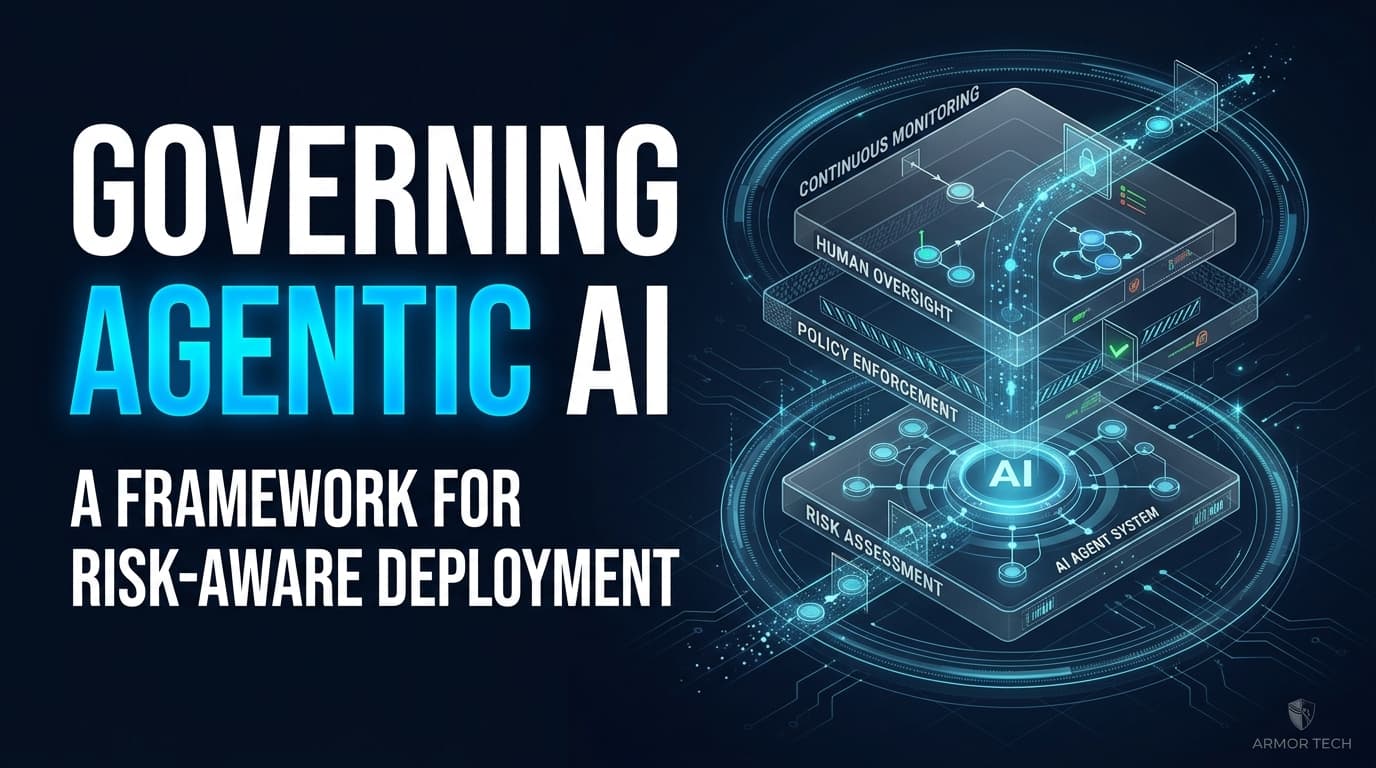
A practical governance model rests on four components: policy, oversight, risk assessment, and monitoring. Each should map to concrete engineering artifacts rather than abstract principles.
Policy. Purpose-built policies define agent behavior, permissible data sources, allowed tool targets, and retention rules for agent-generated logs. These should be version-controlled and reviewed on a fixed cadence, with changes tied to specific deployments.
Oversight. An interdisciplinary group—engineering, legal, security, and product—reviews new agent deployments and material changes to existing ones. The group needs technical members who can read agent traces and legal members who can interpret regulatory exposure. Oversight is not a gate for every inference; it is a gate for new capabilities and boundary changes.
Risk assessment. Assessments tailored to autonomous workflows consider the blast radius of a misstep, the sensitivity of tools an agent can reach, and whether actions are reversible. A low-risk agent might summarize documents; a high-risk agent might initiate financial transfers. Score agents on reach, reversibility, and data sensitivity.
Monitoring. Continuous monitoring and audit trails record agent actions, tool invocations, inputs, outputs, and triggering events. A useful audit trail answers what the agent did, why it did it, which policy governed the behavior, and which human or system authorized the run.
Designing Guardrails and Safety Controls
Guardrails exist to limit unintended outcomes without stripping agents of the autonomy that makes them useful. The controls below are engineering mechanisms, not governance theater.
Declarative constraints. Define allow-lists for domains, API endpoints, and data categories. An agent processing customer support tickets should be able to read ticket records but not write to payroll systems. Express these constraints in policy files that the agent runtime enforces before tool execution.
Spend and action caps. Limit the number of calls an agent can make per hour, the total value of transactions it can initiate, and the volume of data it can export. Caps fail closed when exceeded, forcing a review rather than silent overuse.
Escalation pathways. When an agent encounters a request outside its defined scope, it should hand off to a human or a more restrictive workflow rather than guessing. Escalation rules should cover high-dollar actions, data deletion, external communications, and any action flagged by a secondary classifier as anomalous.
Reinforcement learning from human feedback (RLHF). Human reviewers rate agent traces and correct unsafe behavior, feeding those corrections back into model fine-tuning or prompt engineering. This aligns agent behavior with organizational norms over time.
Sandbox environments. New agents run in isolated environments with mocked or restricted tooling before production deployment. Sandbox testing verifies that an agent respects boundaries under realistic load without exposing live systems.
Alignment with Enterprise AI Adoption Strategies
Governance should plug into the AI lifecycle already in place rather than running as a separate track. An effective agentic AI strategy treats governance as infrastructure, not an afterthought. Map governance checkpoints to each stage: design, build, test, deploy, monitor, and retire. At design, record intended tool use and data access. At build, lint policy files for conflicts. At test, run sandbox scenarios and adversarial prompts against the agent. At deploy, confirm policy files are active and audit logging is on. At monitor, review trace volumes and block rates. At retire, revoke credentials and archive logs according to retention policy.
Coordinate with existing compliance and IT governance bodies. If your organization maintains SOC 2, ISO, or internal audit processes, agentic AI should appear in the same control inventory and risk register. Resource allocation follows from that integration: budget and headcount for governance engineering, policy review, and audit support should be planned alongside model training and infrastructure costs. For enterprise AI adoption, governance metrics—such as the percentage of agents with current risk assessments—belong on the same performance dashboards used for deployment frequency and error rates.
Building a Culture of Responsible AI
Policy and tooling fail without the people who operate them. Cross-functional training should cover what agents can do, where they fail, and how to report anomalous behavior. Engineers need to understand liability boundaries; legal and compliance teams need to understand how agent traces work technically.
Open communication channels give operators a path to report concerns without friction. Periodic tabletop exercises help teams practice incident response for agent-driven failures, such as an agent that deletes records or exfiltrates customer data. Recognizing responsible AI milestones—such as completing a governance health audit or retiring an over-permissioned agent—reinforces that safety is part of delivery velocity, not an obstacle to it. Policies should be treated as living documents, refined based on real-world incidents and near misses.
Measuring Effectiveness and Iterating the Framework
Governance succeeds when it reduces harmful agent behavior and speeds up compliant deployment. Track quantitative indicators such as incident resolution time, the rate of compliance adherence for new agent deployments, the number of actions blocked by guardrails, and the percentage of agent actions with complete audit traces. Collect qualitative feedback from users and stakeholders to catch risks that metrics miss, such as subtle bias in automated routing decisions.
Conduct periodic governance health audits to verify that policies match current tooling and that audit trails are complete. Update controls as agent capabilities change—for example, when a new model supports multi-step planning or external tool chaining. The framework should be versioned like any other system component, with changelogs and rollback procedures for policy updates.
How Armor Tech Can Help
Armor Tech can help organizations design and implement practical governance frameworks for agentic AI systems, ensuring that autonomous capabilities operate within clearly defined business, security, and operational boundaries. This includes identifying potential risks, establishing agent permissions, implementing policy enforcement, defining approval requirements for sensitive actions, and integrating human oversight into critical workflows. Armor Tech can also help businesses develop monitoring and audit mechanisms that provide visibility into agent decisions, tool usage, and system interactions. Through structured testing, access controls, risk evaluation, and continuous performance monitoring, organizations can identify weaknesses before deployment and respond to unexpected behavior in production. By combining AI engineering with security-focused governance, Armor Tech helps businesses build agentic AI systems that are more accountable, transparent, controlled, and suitable for real-world enterprise environments.
Frequently Asked Questions
How is agentic AI governance different from standard AI governance?
Standard AI governance focuses mainly on model outputs and data inputs. Agentic AI governance adds a layer for autonomous action: what tools an agent may call, what state it may change, and how those actions are audited. It requires controls at the runtime and orchestration layer, not just the model layer.
Who should own agentic AI governance in an enterprise?
Ownership should be shared between engineering and a cross-functional oversight group that includes legal, security, and product. Engineering owns runtime enforcement and audit logging; legal and compliance own regulatory interpretation and risk appetite; product defines acceptable agent behavior in user-facing contexts.
Are guardrails a replacement for access controls?
No. Guardrails operate at the agent level—constraining what an autonomous system can request—while access controls operate at the identity and infrastructure level. Both are necessary. An agent should never inherit broader permissions than the human or service identity that invokes it.
Start by inventorying the agents you already have in development or production, listing the tools they can reach and the data they can touch. Apply the four governance components—policy, oversight, risk assessment, and monitoring—to the highest-risk agents first, then expand coverage as your deployment scales. If you want help scoping a framework for your environment, we offer AI governance consulting through our services, and you can explore related platform capabilities at our product page.