Why Traditional Automation Fails in Living Environments
Deterministic automation works when geometry is fixed and object classes are known — warehouses, factory lines, cities. Step outside those bounds and the same stacks go blind. Nature introduces unbounded variability: animals appear at unexpected angles, in novel combinations, under shifting light, and they learn. The FAA estimates wildlife strikes cost U.S. civil aviation about $272 million per year on average between 1990 and 2025. In France, SNCF reports more than 8,000 trains affected annually by animal strikes, with 120 collisions in Brittany alone during 2023 disrupting 660 services. Traditional deterrents — sirens, lights, fences, falcons, culling — are static. Animals habituate, and the deterrent becomes background noise.
Architecture Pattern: Perception → Reasoning → Actuation → Learning
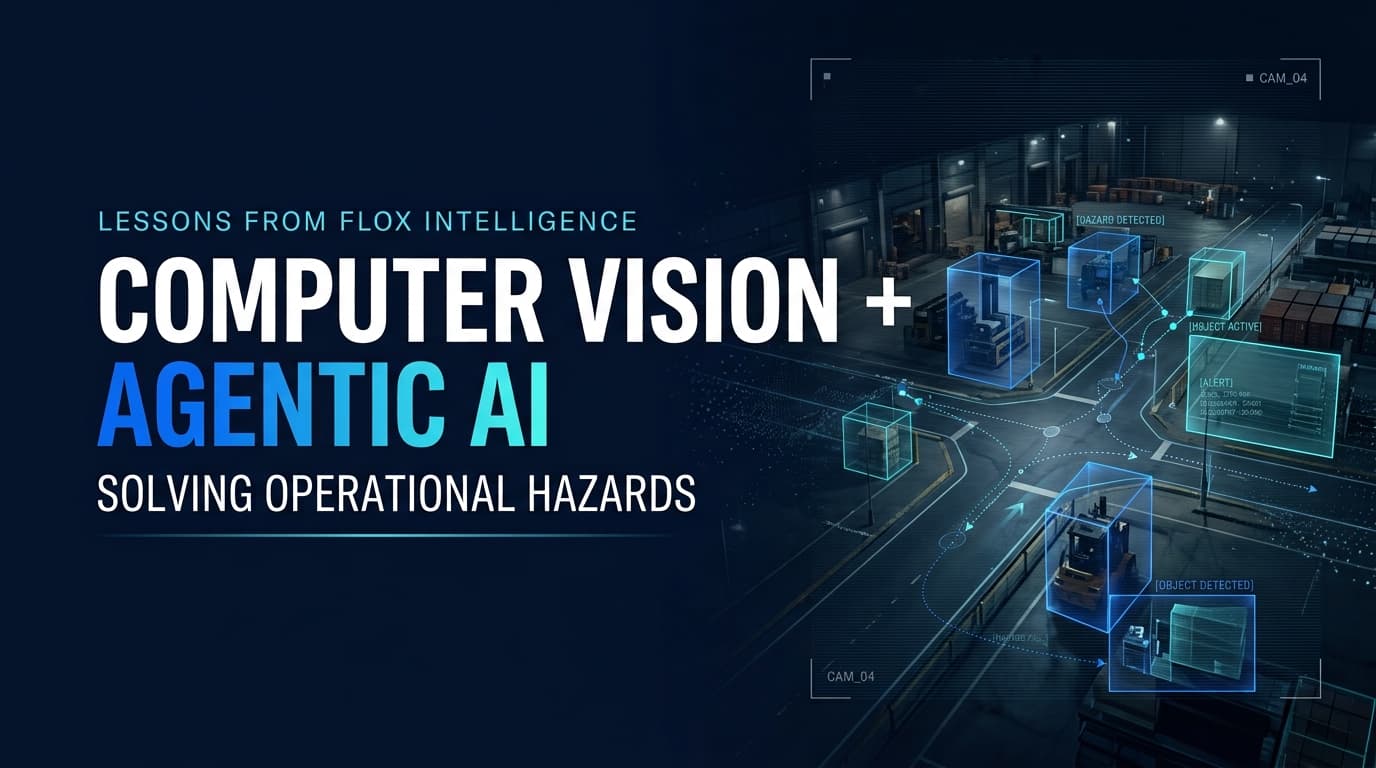
Flox Intelligence builds edge devices that close the loop between perception and action without a cloud round-trip. A motion sensor wakes the unit, an on-device computer-vision model identifies species and behavior in under 100 ms, and an agentic loop selects a species-appropriate deterrent from a sound library — varying intensity, timing, and spectral content so the animal cannot predict the response. The device updates its local policy from each encounter, then streams telemetry to a central platform where fleet-wide model improvements are compiled and pushed back. This perception → reasoning → actuation → learning cycle is the reusable blueprint for agentic AI platform components operating in any messy, alive environment.
Edge Perception Under Latency Constraints
The CV models run on battery-powered poles mounted at fence ends, railway crossings, airport perimeters, and substation corners. No cloud dependency means the system works where connectivity is intermittent or non-existent. Model inference targets sub-100 ms latency so the deterrent fires while the animal is still in the decision zone — not after it has cleared the track or crossed the runway threshold.
Agentic Deterrent Selection
Rather than a fixed mapping from species to sound file, the onboard agent maintains a response policy. It observes the animal's reaction — flight initiation distance, hesitation, return latency — and adjusts the next deterrent's parameters. This prevents habituation by ensuring the stimulus remains unpredictable. The policy state persists across power cycles and is versioned for fleet-wide rollback if a regression appears.
Closed-Loop Learning
Each encounter generates a labeled tuple: species, behavior context, deterrent parameters, outcome. These tuples flow to the central platform where they augment the training set for the next model release. The flywheel is simple: more devices → more encounters → better models → more reliable deterrence → more deployments.
From Wildlife to Any Outdoor Operation: Transferable Use Cases
The same perception → reasoning → actuation → learning pattern transfers to any domain where the environment is alive and the cost of missed detection is high.
- Rail and road: Debris detection on tracks, trespasser alerts at grade crossings, track-condition monitoring via vibration and visual fusion.
- Energy: Vegetation encroachment on transmission lines, substation intrusion detection, transformer oil-leak spotting.
- Agriculture: Precision pest deterrence that distinguishes beneficial insects from crop predators, livestock monitoring for calving or predation events.
- Mining and construction: Equipment proximity safety for autonomous haul trucks, blast-zone clearance verification, tailings-dam seepage detection.
In each case the sensor modality may shift — thermal, multispectral, acoustic, radar — but the agentic loop remains: perceive, decide, act, learn.
Data Moats in Physical AI: Ground Truth Beats Synthetic
Flox's defensible asset is not the deterrent hardware or the sound library. It is the behavioral ground truth collected from 150 devices across North America, Europe, and Australia — what Sara Nozkova calls "ground truth on what actually makes a moose or a grizzly bear move safely." Synthetic data fails for rare, high-stakes edge cases: a sow with cubs at dusk, a habituated urban deer, a migratory flock hitting a runway at night. These scenarios appear in field logs at frequencies no simulation budget can match. Continuous deployment creates a compounding advantage: every device adds encounters, every encounter refines the model, every model improvement increases deployment appeal.
Operationalizing the Stack: Where Armor Tech Fits
Moving from prototype to fleet operation requires infrastructure that the research text does not cover but any field deployment discovers quickly.
- RAG pipelines ingest device logs, firmware manifests, and maintenance manuals so field technicians can query "why did unit 47 escalate to the high-intensity deterrent at 03:14?" and receive a sourced answer.
- n8n automation workflows route alerts to Slack, PagerDuty, or a CMMS based on severity, species, and location tags — closing the loop between detection and human response.
- Agentic voice agents let trackside crews ask "status of sector 3" hands-free while wearing PPE, receiving a synthesized briefing drawn from the latest telemetry.
- Multi-tenant SaaS dashboard provides fleet visibility, regulatory-compliance reports, and biodiversity-monitoring exports for stakeholders who never touch the edge hardware.
These are the RAG pipelines and n8n automation workflows that turn a working demo into an operable system.
Business Model Signals: Hardware + SaaS + OEM
Flox sells the edge unit up front (CapEx), then charges an annual software and AI subscription after the first year (OpEx). OEM licensing — exemplified by the Alstom partnership — extends reach without direct sales scale: the train manufacturer pays an annual fee to embed Flox software on its rolling stock. The Series A targets device-count scale (150 → thousands) rather than revenue alone, signaling that the moat is deployment density and the data flywheel it spins. Revenue of about $1.5 million expected for 2026 reflects early traction, not maturity.
Checklist: Is Your Operation Ready for Agentic Vision?
- Environment has high variability + safety-critical consequences. If the scene is static or failures are low-cost, deterministic rules suffice.
- Existing sensors generate data but no closed-loop response. Cameras, radar, or acoustic arrays already deployed? The missing layer is the agent that decides and acts.
- Regulatory or compliance reporting is manual today. Automated evidence collection (timestamped detections, deterrent actions, outcomes) transforms audit burden into a byproduct of operation.
- Team can maintain edge hardware or has an OEM partner. Battery swaps, firmware updates, and vandalism replacement require either internal field ops or a hardware partner with installed base.
Frequently Asked Questions
How does on-device learning differ from cloud-based model updates?
On-device learning updates the local response policy — deterrent selection parameters — immediately after each encounter. Cloud-based updates retrain the species-classification and behavior-interpretation models using aggregated fleet data, then push new model weights to all devices during the next connectivity window. The former adapts to individual animal behavior; the latter improves baseline perception accuracy across the fleet.
What prevents an animal from habituating to the entire deterrent library?
The agentic loop treats the deterrent library as a combinatorial space: it varies not just which sound plays, but amplitude envelope, spectral shaping, inter-pulse interval, and directional targeting. The policy state tracks each animal's response history (when identifiable) and constrains the next selection to regions of the parameter space the animal has not recently experienced. Habituation becomes a moving target.
Can the same edge hardware run non-wildlife models for other use cases?
The compute platform — an AI accelerator paired with a ruggedized camera and motion trigger — is agnostic to model weights. Swapping the wildlife CV model for a vegetation-encroachment or debris-detection model is a firmware update. The agentic loop architecture (perceive → decide → actuate → learn) remains identical; only the label taxonomy, action space, and reward function change.
Building computer-vision-driven automation for the field? Book a 30-min architecture review with Armor Tech to map your perception-to-action loop.