Long-running agentic systems fail when they forget. A single LLM call is stateless by default; it does not retain what happened three turns ago, much less three days ago. For SaaS products where agents execute multi-step workflows on behalf of users, memory architecture is the difference between a product that runs itself and one that requires constant human repair.
Why Memory Architecture Determines Agentic Reliability
Context loss is expensive in multi-step agent workflows. If an agent books a reservation, updates a CRM record, and then sends a confirmation, each step depends on outputs from the previous one. Without persistent memory, the agent repeats questions, loses track of tool results, or violates constraints it was given earlier in the same session.
The core distinction is between stateless LLM calls and stateful agentic sessions. A stateless call treats every prompt as independent. A stateful session rehydrates context before each inference, which means storing conversation history, tool-call results, and agent decisions in a retrievable form. For founders, the risk is an inconsistent user experience: a customer states a preference in step one, and by step four the agent has no record of it. That erodes trust faster than a slow response time.
Core Memory Layers for Long-Running Agents
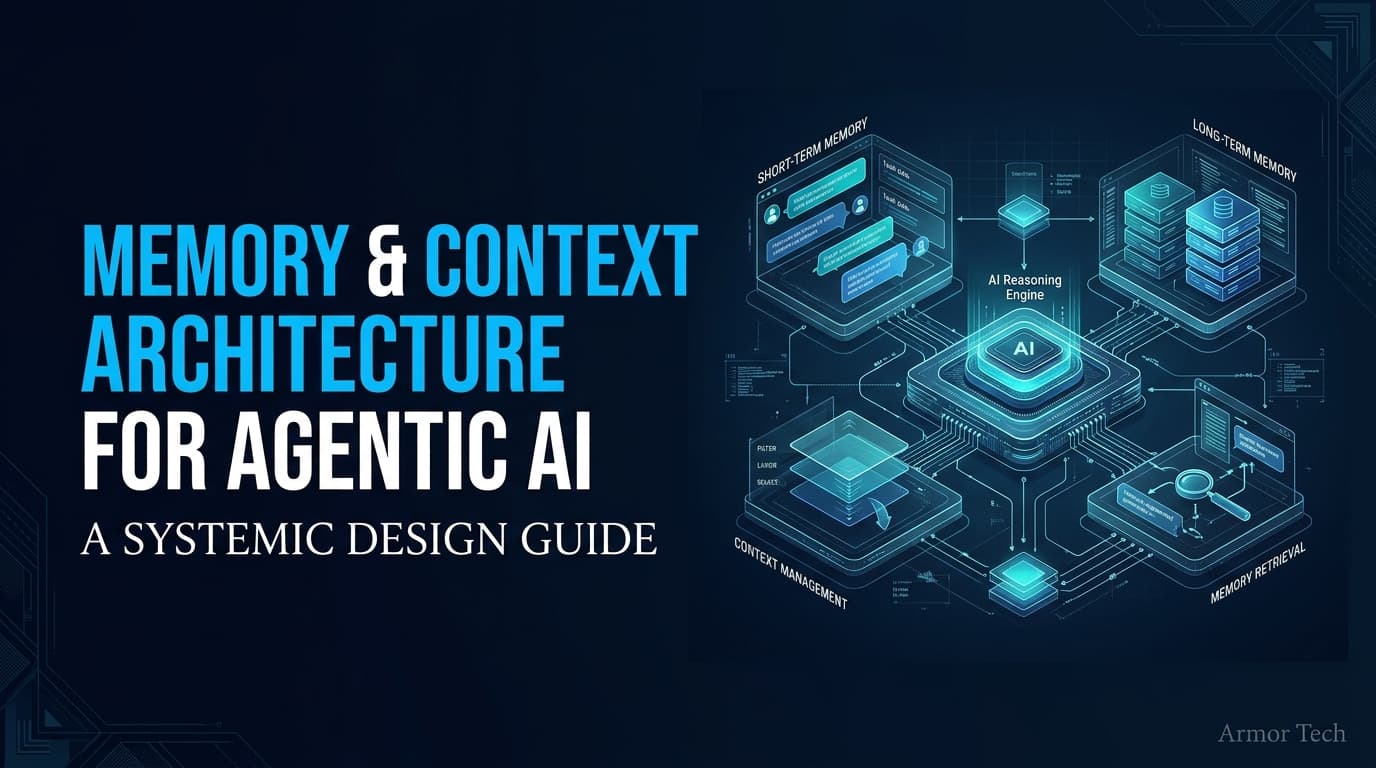
Rather than treating memory as a single database, it is more useful to think in layers. Each layer serves a different retention window and query pattern.
Layer Scope Persistence Typical store Working memory Current conversation Short term, within a session In-memory buffer, recent message list Episodic memory Past interactions and session history Medium term, across sessions Conversation database, event log Semantic memory Domain knowledge and facts Long term Vector index, document store, knowledge graph Procedural memory Workflows and tool-use patterns Long term Prompt templates, tool definitions, state machines
Working memory holds the most recent messages so the agent can maintain turn-to-turn coherence. Episodic memory stores what happened in previous sessions with the same user, which is essential for follow-up cases or returning customers. Semantic memory contains private knowledge the agent should reference, such as product documentation or internal policies. Procedural memory encodes how the agent should execute workflows—when to call which tool, what arguments to pass, and how to handle errors.
The failure mode most teams encounter is collapsing these layers into one store. Vector search is good for semantic memory but poor for verbatim session history. A relational table is good for episodic memory but inefficient for finding relevant facts across thousands of documents.
RAG as Context Retrieval, Not Just Search
Retrieval-augmented generation belongs inside the memory architecture, but it is not a substitute for memory. RAG indexes private knowledge so an agent can ground its answers in source material rather than training data. The distinction matters: search returns a list of documents; context retrieval selects the facts the agent needs for its current step and injects them into the prompt.
A production RAG pipeline for agents usually includes hybrid retrieval, combining semantic vector similarity with keyword matching. Semantic search catches conceptually related content; keyword search catches exact product names, error codes, or account numbers. Re-ranking follows, using a cross-encoder or similar model to score retrieved chunks for relevance before they enter the context window. Without re-ranking, agents often receive the most similar chunks rather than the most useful ones.
Citation and source attribution should be built into the retrieval layer, not bolted on afterward. When an agent answers from retrieved context, it should reference the specific document or chunk. This makes auditability possible and gives engineers a trail to debug when an agent cites outdated or incorrect information.
Context Window Management and Budgeting
Every LLM has a context limit, and agentic workflows consume tokens quickly. A long session with tool calls, retrieved documents, and conversation history can exceed that limit before the task is complete. Teams need a budgeting strategy rather than hoping the model figures it out.
A sliding window retains the N most recent messages and drops older ones. This preserves recency but loses early context. Summarization addresses that gap by compressing older turns into a condensed block that is re-injected as context. The agent sees verbatim recent history plus a compressed summary of everything before it.
Selective retrieval limits context injection to documents relevant to the current agent step. Instead of passing an entire knowledge base, the system retrieves only the chunks needed for the immediate decision. Prompt compression reduces token cost further by removing unnecessary whitespace, using shorthand labels for repeated fields, and recursively summarizing non-critical history.
The mechanism matters more than a specific token number. Teams should track how much of the context window is consumed by memory layers versus user input versus retrieved documents, then adjust retrieval depth and summarization thresholds based on observed failure rates.
State Persistence and Session Continuity in SaaS
Multi-user SaaS products require database-backed conversation and agent state. At minimum, this means tables for sessions, messages, and agent variables. The agent state table tracks values that persist across turns—such as a partially filled form, an open ticket ID, or the current step in a workflow.
Session isolation is non-negotiable in multi-tenant environments. Every state row must be keyed to a tenant and user, and queries must filter by those keys at the database or application layer. One customer’s agent must never read another customer’s session history or tool outputs.
Checkpointing supports long-running workflows that span hours or days. Instead of keeping the entire workflow in active memory, the system saves state at defined boundaries. If the process is interrupted, it resumes from the last checkpoint rather than restarting from scratch.
Concurrency handling becomes important when multiple agents or parallel branches act on shared context. Optimistic locking or versioned state prevents one agent from overwriting another’s changes. Without this, race conditions appear as corrupted order states, duplicate messages, or lost tool results.
Evaluation and Observability for Memory Systems
Memory architecture should be measured, not assumed to work. Context hit rate tracks whether the agent retrieved the fact it needed for a given step. Retrieval relevance measures how often returned chunks are actually useful, typically through precision at K. Latency introduced by memory lookups and RAG calls should be tracked separately from model inference time, because external retrieval often dominates response time.
Hallucination reduction is a claimed benefit of grounded memory, but it must be verified against source documents. If an agent cites a retrieved chunk, an evaluator can check whether the answer is supported by that chunk. Human-in-the-loop feedback loops let users correct agent memory, and those corrections should be written back into episodic or semantic storage so the agent does not repeat the same mistake.
Observability should trace a request through memory retrieval, context assembly, model inference, and tool execution. When an agent fails, engineers need to know whether the failure was due to missing context, wrong context, or a reasoning error after the context was provided.
Build vs Buy: When to Engage Armor Tech
Building memory infrastructure in-house makes sense when the agent’s workflow is simple, session length is short, and context requirements are predictable. Buy—or partner—when the product requires persistent state across users, long-running workflows, private knowledge retrieval, or multi-tenant isolation.
Armor Tech designs custom agentic AI memory architecture for SaaS platforms, deploys RAG pipelines, and integrates automation tools such as n8n or Make. Teams working on AI voice agents also need persistent context across voice turns, which introduces its own state management challenges. For examples of production agentic implementations, see the portfolio, and for service offerings including agentic AI, RAG, and automation, review Armor Tech's services.
How Armor Tech Can Help
Armor Tech can help organizations design and implement scalable memory and context architectures that enable AI agents to retain relevant information, retrieve useful knowledge, and maintain context across complex workflows. This includes developing short-term memory systems for active tasks, long-term memory solutions for persistent knowledge, and retrieval mechanisms that connect agents with relevant business information. Armor Tech can also integrate vector databases, traditional databases, retrieval-augmented generation (RAG), and context-management strategies to improve information access and reduce irrelevant or outdated context. For advanced agentic applications, memory updates, access permissions, retention policies, and information validation can be incorporated to maintain data quality and security. Through careful architecture design, retrieval optimization, monitoring, and testing, Armor Tech helps businesses build AI agents that use information more effectively, support multi-step operations, and maintain reliable context as their applications scale.
Frequently Asked Questions
Is RAG a replacement for agent memory?
No. RAG retrieves external knowledge; memory retains conversation history and session state. An agent usually needs both: memory to know what the user already said, and RAG to know what the product documentation says.
How do you handle context window limits without losing early conversation details?
Use a sliding window for recent turns and summarize older turns into compressed blocks that are re-injected as context. The agent sees recent verbatim history plus a compressed summary of everything before it.
What does session isolation look like in a multi-tenant SaaS?
Every conversation and agent state row is keyed to a tenant and user. Queries filter by those IDs at the database or application layer so one customer’s agent never reads another customer’s session history.
Next Steps
Memory and context architecture should be treated as infrastructure, not an afterthought. Teams evaluating agentic AI for SaaS products can start by mapping their workflow steps to memory layers and identifying where state is currently lost between turns. Book an architecture review with Armor Tech to design production-ready memory and context systems for your agentic AI product.