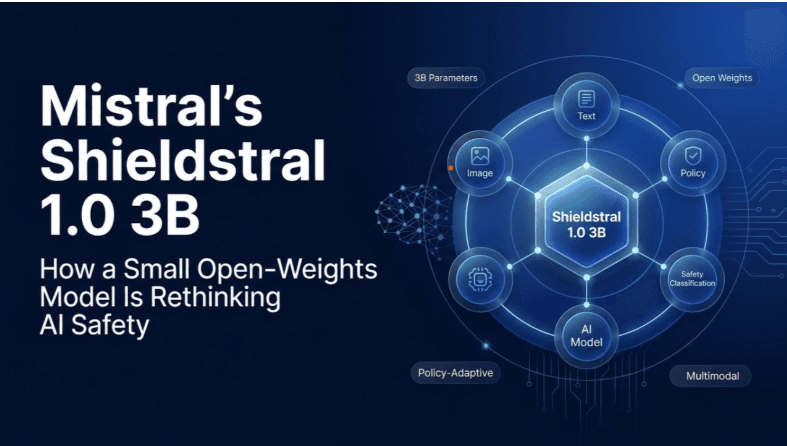
Mistral AI has introduced Shieldstral 1.0 3B, a new open-weights, policy-adaptive multimodal safety classifier designed to make AI moderation more flexible, efficient, and adaptable to different safety requirements. Built with 3 billion parameters, Shieldstral is designed to evaluate both text and multimodal content against policies expressed as natural-language questions rather than relying solely on fixed moderation categories. According to Mistral’s research, the model can match or outperform models nearly 7× its size on text safety benchmarks while achieving state-of-the-art performance in multimodal safety classification. The release highlights a broader shift in AI safety: instead of continuously scaling guardrail models, organizations may be able to build smaller safety systems that adapt their behavior to changing policies at inference time.
What is Shieldstral
Shieldstral is a 3-billion-parameter, open-weights multimodal safety classifier developed by Mistral AI. It is designed to help AI systems detect unsafe or policy-violating content across text and other modalities.
Its key advantage is its policy-adaptive approach, which allows organizations to evaluate content according to their own safety requirements instead of relying only on fixed moderation categories. Despite its relatively small size, Shieldstral is designed to deliver performance comparable to models up to seven times larger on text-safety benchmarks, while achieving strong state-of-the-art results in multimodal moderation(Source:Mistral ai Docs).
Training Strategy: How Shieldstral Was Built
Mistral’s training approach focused on solving four major challenges:
1.Standardizing Different Safety Datasets
Public safety datasets often follow different taxonomies, labels, and annotation formats. To make them consistent, Shieldstral converts each dataset into a common instruction–query–document format while varying the wording to prevent the model from becoming overly dependent on a single style.
2.Learning Policy-Specific Discrimination
Rather than teaching the model to memorize predefined policy labels, Mistral created contrastive pairs using closely related policies. In these pairs, safe content is intentionally rewritten so that it violates one policy but remains acceptable under its sibling policy. This helps Shieldstral learn the difference between specific policies and improves its ability to generalize to policies it has not encountered before.
3.Improving Image-Based Safety Understanding
High-quality visual safety datasets are relatively limited. To address this, Mistral supplemented existing moderation data with general-purpose image datasets as high-quality negative examples. The team also augmented queries and used a vision-language reranker to evaluate and filter image–query pairs, helping reduce incorrectly labeled training data.
Combining Complementary Model Checkpoints
Shieldstral’s final training process uses LoRA fine-tuning followed by SLERP model merging. This combines three complementary checkpoints: one calibrated on public datasets, another trained to improve fine-grained policy discrimination using generated data, and the original base instruct model(Source:Mistral ai Docs).
Why Shieldstral Matters
Traditional guardrail models are generally trained around a predefined set of harmful-content categories, which can make them difficult to adapt when safety requirements change. This creates two major challenges(Source:Medium Docs):
New policies or domains may require retraining, making adaptation slower and more resource-intensive.
A single checkpoint may not work equally well across different applications. For example, the safety requirements for cybersecurity research can differ significantly from those of a mental health support system, making it difficult to maintain the right safety calibration across both.
Shieldstral takes a different approach by framing moderation as a binary question-answering task. Instead of embedding every safety policy directly into the model, the policy can be provided as part of the input.
The process works through three main components:
<Instruct>
This section provides the model with the relevant context and defines how strictly the safety policy should be applied.
<Query>
The model is given a specific question, such as: “Does this content promote physical violence?”<Document>
The document can contain text, an image, or both, depending on what needs to be assessed.
The model then produces a single yes/no token as its classification. This output can subsequently be renormalized into a continuous safety score, making the approach flexible enough to support different policies and moderation requirements.
Benchmarks
Mistral evaluated Shieldstral against open guard models up to 7× its size across four axes (all samples held out from training)(Source:Mistral ai Docs):
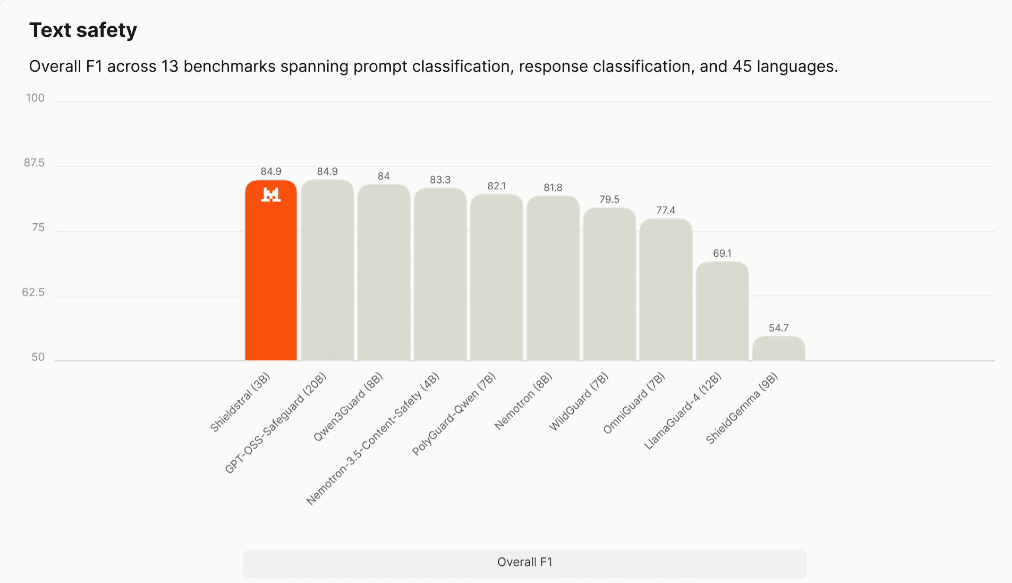
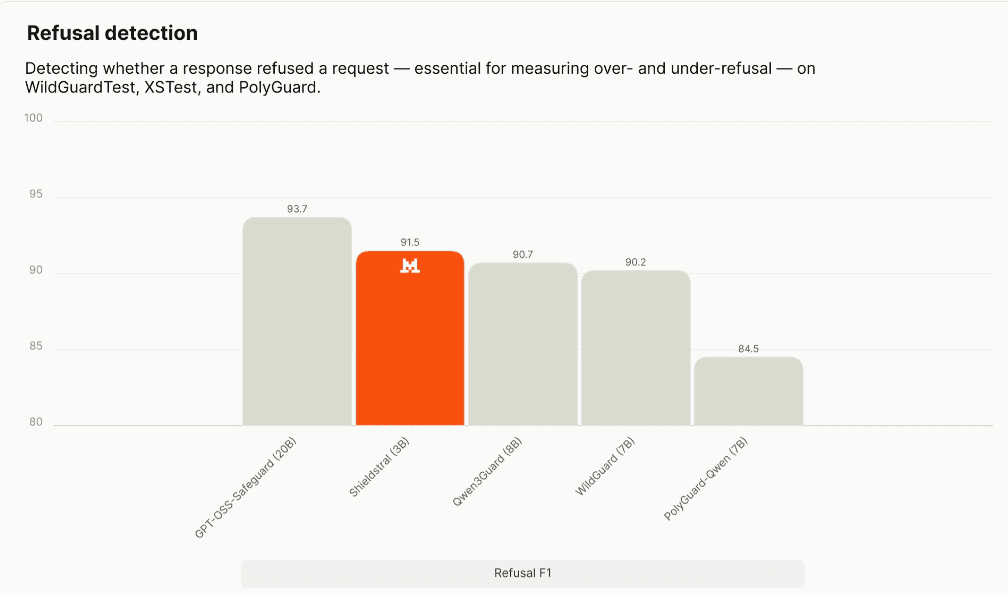
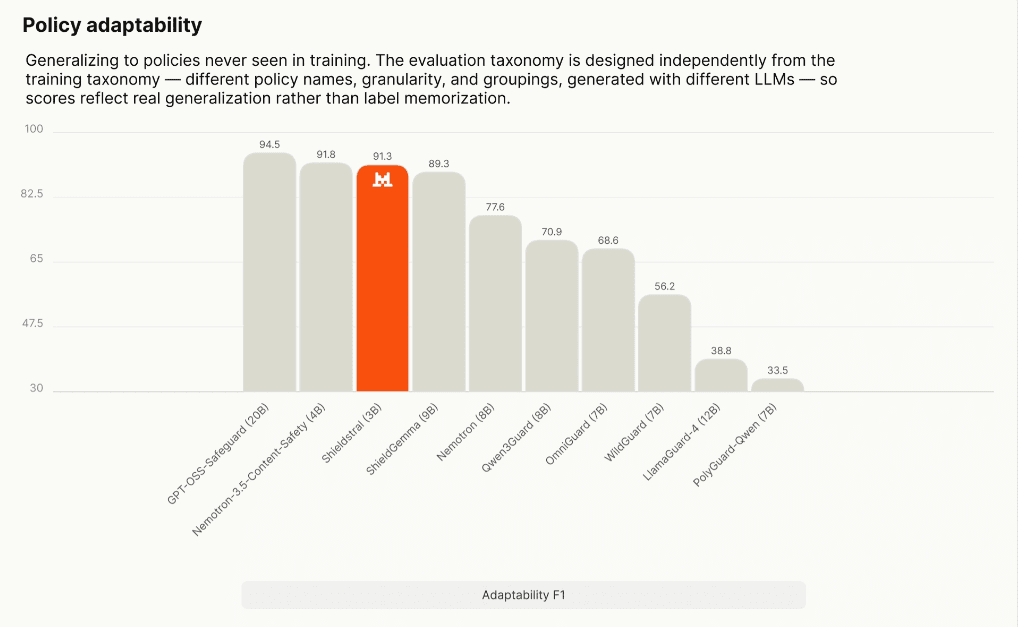
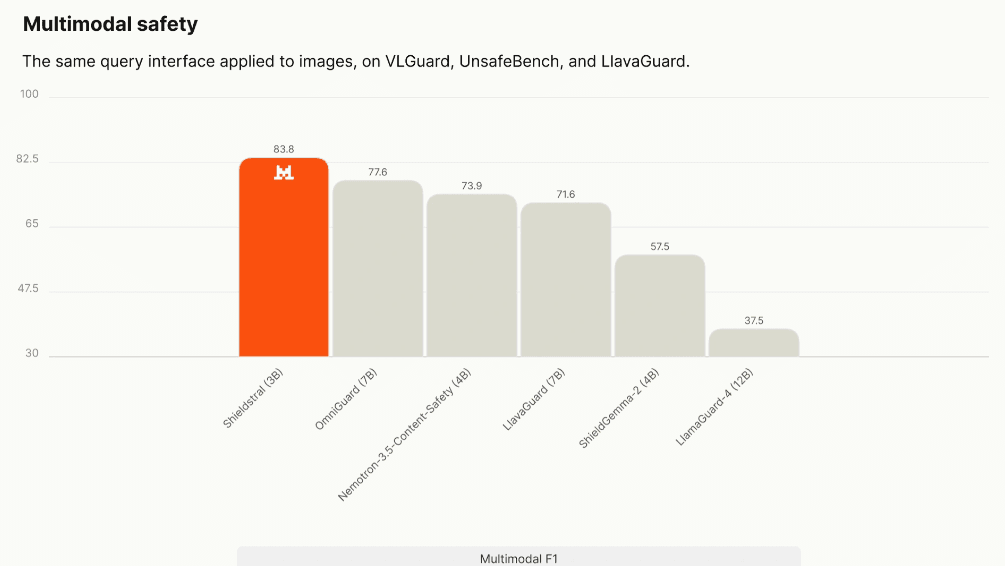
(Images Source:Mistral ai Docs)
Conclusion
Shieldstral 1.0 3B shows that effective AI safety does not always require larger models. Its open-weights, multimodal, and policy-adaptive approach allows organizations to evaluate content against changing safety requirements without relying entirely on fixed moderation categories. With strong reported performance despite its compact size, Shieldstral highlights a broader shift toward smaller, flexible, and adaptable AI safety systems .An approach that could become increasingly important as AI agents and enterprise AI applications continue to evolve.
How Armor Tech Can Help
As AI systems become more capable, businesses need more than powerful models. They also need reliable safety and governance layers around them. Armor Tech helps organizations build and integrate AI solutions with custom guardrails, AI agents, RAG systems, automation, and multimodal capabilities. By combining the right models with practical safety and monitoring approaches, businesses can build AI systems that are not only more capable, but also reliable, scalable, and better aligned with their specific requirements.
References
1.Mistral AI Docs
https://mistral.ai/news/shieldstral/
2.Medium Docs