15, 2026
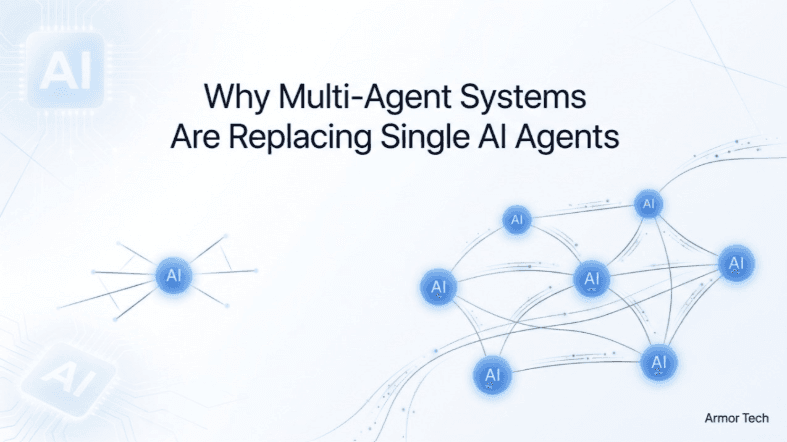
Why Multi-Agent Systems Are Replacing Single AI Agents
Imagine asking a single employee to manage customer support, analyze business data, write reports, coordinate with different teams, and make critical decisions all at the same time. No matter how talented they are, there comes a point where one person simply isn't enough.
AI is beginning to face the same challenge. While single AI agents have demonstrated impressive capabilities over the past few years, businesses are now discovering that complex problems often require something more: teams of specialized AI agents working together. This shift is giving rise to Multi-Agent Systems, a new approach that could redefine how intelligent systems are built in the years ahead.
In this article, we'll explore why organizations are moving beyond single AI agents, how Multi-Agent Systems work, and why they may represent the next major evolution in enterprise AI.

What are multi-agent systems?
A Multi-Agent System (MAS) is a network of intelligent, autonomous agents that work together within a shared environment to solve problems, make decisions, and accomplish goals more efficiently than a single system acting alone(Source:Googlecloud Documentation).
By collaborating, sharing information, and adapting to changing conditions, these agents create a flexible and scalable ecosystem capable of handling complex, real-world challenges across industries
Think of a Multi-Agent System as a team of specialists working toward a common objective. Instead of relying on a single AI model to manage every task, responsibilities are distributed among multiple agents, each designed with a specific role and expertise. One agent may gather information, another may analyze it, while others make decisions or execute actions.
This collaborative approach not only improves efficiency and reliability but also enables organizations to build AI systems that can adapt, scale, and perform effectively in dynamic environments. As businesses increasingly demand intelligent automation, Multi-Agent Systems are emerging as a practical foundation for the next generation of AI applications.
Single-Agent System
Relies on a single intelligent entity to perform all tasks and make decisions independently.
Best suited for structured, predictable, and well-defined problems.
Uses centralized decision-making, making it simpler to develop and maintain.
Has lower implementation and maintenance costs due to its simpler architecture.
Limited scalability, as one agent is responsible for all operations.
Examples include recommendation engines, chatbots, and fraud detection systems.
Multi-Agent System
Consists of multiple autonomous agents working together within a shared environment.
Designed to handle complex, dynamic, and large-scale challenges.
Uses distributed decision-making, enabling greater flexibility and adaptability.
Requires communication and coordination mechanisms, making development more sophisticated.
Highly scalable, allowing additional agents to be introduced as requirements grow.
Examples include autonomous vehicle fleets, smart cities, supply chain optimization, and AI research assistants.
How Do Multi-Agent Systems Work?
Multi-Agent Systems operate by dividing a complex objective into smaller tasks that are managed by specialized agents. Each agent contributes its expertise while continuously interacting with other agents in a shared environment. Together, they create a coordinated workflow that enables intelligent, efficient, and scalable problem-solving.

1. Observation and Data Collection Every agent begins by monitoring its environment and gathering relevant information. This may include user inputs, system updates, or changes made by other agents, allowing it to maintain awareness of the overall situation.
2. Analysis and Decision-Making Once information is collected, the agent evaluates the available data to determine the best course of action. In modern AI systems, Large Language Models (LLMs) often serve as the reasoning engine, enabling agents to understand context, perform multi-step analysis, and make informed decisions.
3. Task Execution After a decision is made, the agent performs its assigned task. This could involve generating content, retrieving information, triggering workflows, or interacting with external tools and APIs.
4. Collaboration and Communication A defining characteristic of Multi-Agent Systems is their ability to work together. Agents continuously exchange information, coordinate activities, and align their efforts to ensure that shared objectives are achieved efficiently.
5. Workflow Orchestration To maintain structure and consistency, Multi-Agent Systems rely on orchestration. An orchestrator—or an agentic workflow framework—assigns responsibilities, manages task dependencies, and ensures that agents operate in the correct sequence.
Benefits of Multi-Agent Systems
Multi-Agent Systems provide several advantages over traditional and single-agent approaches, making them an increasingly popular choice for building intelligent and scalable AI solutions.
1. Enhanced Problem-Solving Capabilities By combining the strengths of multiple specialized agents, Multi-Agent Systems can address challenges that are too complex for a single AI model. Each agent contributes unique knowledge and expertise, resulting in more effective and accurate outcomes.
2. High Scalability One of the greatest advantages of MAS is its ability to scale effortlessly. As workloads increase, additional agents can be introduced without significantly impacting overall performance, enabling organizations to manage larger datasets and more demanding processes.
3. Improved Reliability and Resilience Multi-Agent Systems are designed with redundancy in mind. If one agent becomes unavailable or encounters an issue, other agents can continue operating, ensuring that the system remains functional and minimizing disruptions.
4. Greater Flexibility and Adaptability MAS can quickly adapt to changing requirements and evolving environments. Agents can modify their behavior, respond to new information, and accommodate unexpected scenarios without requiring extensive human intervention.
5. Increased Efficiency and Performance Since multiple agents can work on separate tasks simultaneously, Multi-Agent Systems can significantly reduce processing time and optimize the use of computational resources, leading to faster and more efficient execution.
6. Continuous Learning and Collaboration The collaborative nature of MAS enables agents to share insights, refine strategies, and collectively improve their performance over time. This ability to learn and evolve as a team makes Multi-Agent Systems particularly valuable for next-generation AI applications.
Conclusion
As AI continues to advance, the focus is moving beyond individual intelligence toward collaborative intelligence. While Single-Agent Systems are effective for specific tasks, Multi-Agent Systems offer the scalability, adaptability, and resilience needed for modern challenges. By combining the strengths of multiple specialized agents, they are reshaping how businesses build and deploy AI. The future of AI isn't a single agent doing it all—it's intelligent agents working together to achieve more.
How Armor Tech Can Help
At Armor Tech, we help businesses embrace the next generation of AI by designing intelligent automation solutions tailored to their unique needs. Whether it's implementing AI agents, streamlining workflows, or building scalable Multi-Agent Systems, our focus is on delivering solutions that improve efficiency, adaptability, and business outcomes. As organizations move toward collaborative AI, Armor Tech is committed to helping them turn innovative ideas into practical, real-world applications.
References
Google Cloud Documentation.What is Multi Agent System?
https://cloud.google.com/discover/what-is-a-multi-agent-system