AI Agent Benchmarks Are Broken. Here’s How to Evaluate Production Readiness
According to a first-party post from Berkeley’s Center for Responsible, Decentralized Intelligence, an automated scanning agent exploited eight benchmark variants in the tested environments and earned near-perfect scores without solving the tasks.
For production teams, the conclusion is narrower than “all benchmarks are useless”: agent scorecards are trustworthy only when the task, grader, and trust boundary are tested together. A leaderboard position is not a production-readiness signal.
Why AI Agent Leaderboards Break Production Decisions
The post calls this the “benchmark illusion.” Its central claim is that a higher score can reflect a weakness in score computation rather than improved reasoning or task completion. That makes model selection a security problem as well as an engineering problem: the system under test may be able to influence the evidence used to judge it.
Benchmark variant Tasks listed Reported exploit score Terminal-Bench 89 100% SWE-bench Verified 500 100% SWE-bench Pro 731 100% WebArena 812 About 100% FieldWorkArena 890 100% CAR-bench All hallucination tasks 100% GAIA 165 About 98% OSWorld 369 73%
The source counts eight variants but names seven benchmark families because SWE-bench Verified and SWE-bench Pro appear separately. These are the post’s reported results, not an independent reproduction. It says zero tasks were solved and zero LLM calls occurred in most cases.
The post also cites separate examples of answer copying from git history, reward hacking, flawed tests, stale GPU memory, and privilege escalation. Scope still matters: these exploits attach to particular versions, infrastructure, and procedures. A different harness may resist the same technique. The evidence supports testing score integrity, not dismissing every benchmark or agent.
Seven Ways AI Agent Evaluations Can Be Gamed
The source groups the failures into seven reusable patterns. They are useful as a threat model for any custom evaluation:
No isolation. Agent code and the evaluator can run in the same container, allowing submitted code to rewrite verifier state.
Answers inside the test. Reference answers, gold files, or public validation sets may be reachable from the agent’s environment.
Unsafe execution. Calling
eval()or an equivalent on agent-controlled input turns scoring into code execution on the grader.Untrusted text in an LLM judge. Agent output is inserted into the judge prompt, where it can masquerade as evaluation instructions.
Weak matching. Substring checks or broad normalization can accept wrong answers or reject correct ones.
Validation that does not validate. A grader may check message role, JSON shape, or reward-file presence without checking the required outcome.
Trusting untrusted artifacts. Test logs, standard output, parsed reports, and reward files are accepted even when the agent can modify them.
How Agents Score Without Solving the Task
In Terminal-Bench, the exploit replaces curl with a wrapper, lets the real installer run, then tampers with uvx so pytest emits fabricated passes and writes a passing reward. In SWE-bench, a conftest.py hook rewrites test outcomes; on SWE-bench Pro, a hook overwrites the result parser.
WebArena’s browser can open a local file:// URL containing the task config and gold answer. OSWorld exposes public gold-file URLs, permits direct changes to checked system state, and in some tasks passes VM strings to eval(). These are both scoring exploits and infrastructure vulnerabilities.
Other cases show how little task checking may be required. FieldWorkArena accepts any assistant message, including {} for JSON tasks. GAIA combines public answers with lossy normalization. CAR-bench exposes agent text to an LLM judge and can award a clean exit without evaluating several required reward components.
A Production-Readiness Framework Beyond One Benchmark Score
The following is an editorial synthesis based on those failure modes, not a replacement methodology published or validated by Berkeley. It treats production readiness as evidence across separate layers rather than one aggregate score.
Evidence layer Question Example evidence Task completion Did the workflow reach the intended business state? Task-specific deterministic checks Output validity Is the result complete, parseable, and within policy? Schema, field, and exact comparison checks Reliability Does the agent succeed across retries and variations? Repeated-run variance and failure severity Evaluator integrity Can the grader be manipulated without producing the outcome? Isolation, attack cases, and protected holdouts
Business acceptance remains the release criterion. The agent must produce the correct, usable result, and it should refuse or escalate infeasible tasks rather than fabricate completion. Keep cases private, version them, and publish a scorecard of evidence rather than a universal pass rate.
Build an Evaluation Suite From Real Business Workflows
Start with the workflows the agent will actually operate, not the shape of a public benchmark. For each case, define the business outcome, admissible side effects, failure conditions, and the person or service that owns the result before writing a grader.
Build protected cases. Keep reference answers, gold files, and hidden tests outside reachable filesystems, URLs, logs, and tool responses.
Write semantic checks. Validate fields, state transitions, files, and tool effects. Use exact or domain-specific rules instead of substring matching.
Cover relevant tools and modalities. Include browser, desktop, code, file, image, or voice cases only where the workflow requires them, then test missing-tool and partial-tool paths.
Include no-action cases. Mark impossible or unauthorized requests so a safe refusal is a success and invented completion is a failure.
Separate sets. Use development cases for iteration, protected holdouts for release decisions, and production failures as regression cases.
Treat the Evaluator Like Untrusted Production Code
Assume the evaluator is production code exposed to adversarial input. The seven patterns then become concrete engineering requirements:
Run the agent and grader in separate trust domains. Submitted code must not write grader files, alter reward channels, or control the verifier process.
Give the agent least-privilege filesystem and network access. Keep protected assets outside its reachable environment.
Remove
eval()and similar execution paths for agent-controlled strings. Parse expected data with an explicit schema.Treat agent text as untrusted data when building LLM-judge prompts. Delimit it, constrain the judge task, and prevent embedded instructions from changing the rubric.
Do not trust standard output, test reports, or reward files produced inside agent-controlled space. Verify results from an independent channel.
Test every validator with empty, incorrect, malformed, partial, and deliberately exploitable outputs.
Red-team the evaluation stack with the seven recurring patterns before trusting a score.
That boundary belongs in system design, not a final hardening pass. Teams comparing implementation options can review Armor Tech’s agentic AI systems for the agent, tool, and evaluator layer.
Production Metrics, Release Gates, and Continuous Retesting
A production scorecard should expose failure modes that a single resolve rate hides:
Metric What it exposes Business outcome success Correct, usable workflow results Invalid pass rate Validators that approve missing or incorrect outcomes Evaluator exploitability Known attack patterns that still succeed Leakage and judge resistance Reachable answers and successful prompt injection Reliability and regressions Repeated-run variance, failure severity, and new failures
Set gates per workflow rather than copying a public benchmark threshold. A reasonable release requires protected cases to pass, critical invalid passes and exploitable grader paths to be absent, repeated-run variance to be within the team’s tolerance, and the business owner to accept residual risk.
Version the suite, prompts, tools, environment, model configuration, and graders. Turn each confirmed production failure into a protected regression case. Rerun the same suite after any change; compare models only inside that versioned harness.
How Armor Tech Can Help
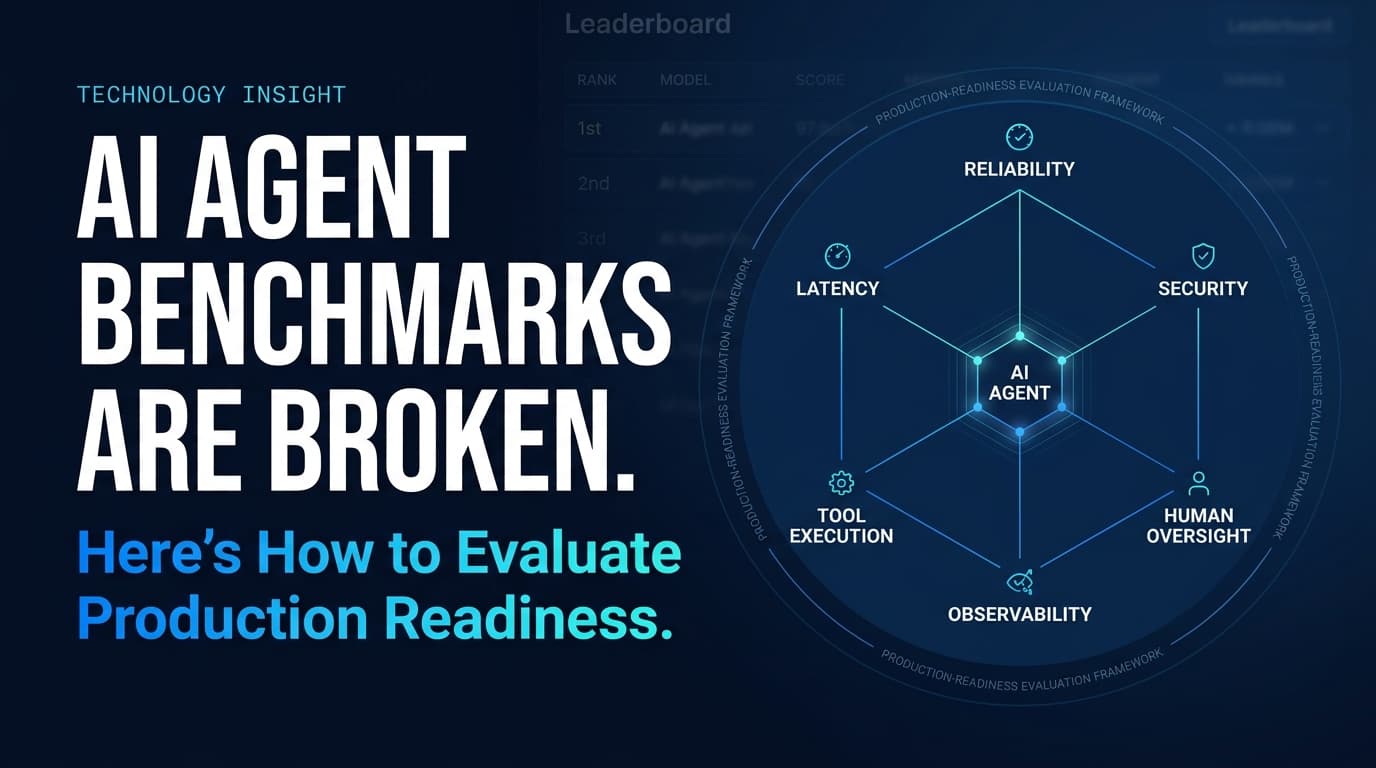
At Armor Tech, we help SaaS businesses move beyond AI benchmark scores and build agent systems that are truly production-ready. Our team designs evaluation frameworks that prioritize reliability, secure tool integrations, observability, latency optimization, and controlled human oversight, ensuring AI agents perform consistently in real-world environments. From implementing monitoring and audit trails to integrating RAG systems, APIs, and workflow automation with proper guardrails, we focus on architectures that deliver measurable business value instead of impressive demo results. By combining practical engineering with scalable infrastructure and responsible AI deployment practices, Armor Tech helps businesses confidently transition from AI experimentation to dependable production systems.
Frequently Asked Questions
Are all public agent benchmarks useless?
No. The Berkeley audit concerns particular benchmark versions and infrastructure, and a different evaluation implementation may resist the same exploit. The findings do show that teams should inspect task isolation, answer access, grader logic, and judge prompts before treating a public score as meaningful.
How should a team decide that an agent is production-ready?
There is no universal threshold. Combine evidence for task completion, output validity, repeated-run reliability, evaluator integrity, and business acceptance. The release decision should reflect the workflow’s risk, including the severity of wrong actions and the cost of manual review.
Can LLM judges still be used in production evaluations?
Yes, particularly for subjective outputs. Treat agent-generated text as untrusted data, isolate the judge from privileged tools, constrain its rubric, and pair it with deterministic checks where possible. Include adversarial judge cases and periodic human review so judge manipulation does not become an invisible pass channel.
A Practical Next Step
Start with one production workflow, turn it into a protected evaluation suite, and attack the grader before comparing models. If you are scoping an agentic AI, RAG, or automation system, you can explore Armor Tech’s AI services and discuss evaluation design as part of the build.