The Agent Economy: Why Spotify Is Building for AI Agents, Not Humans
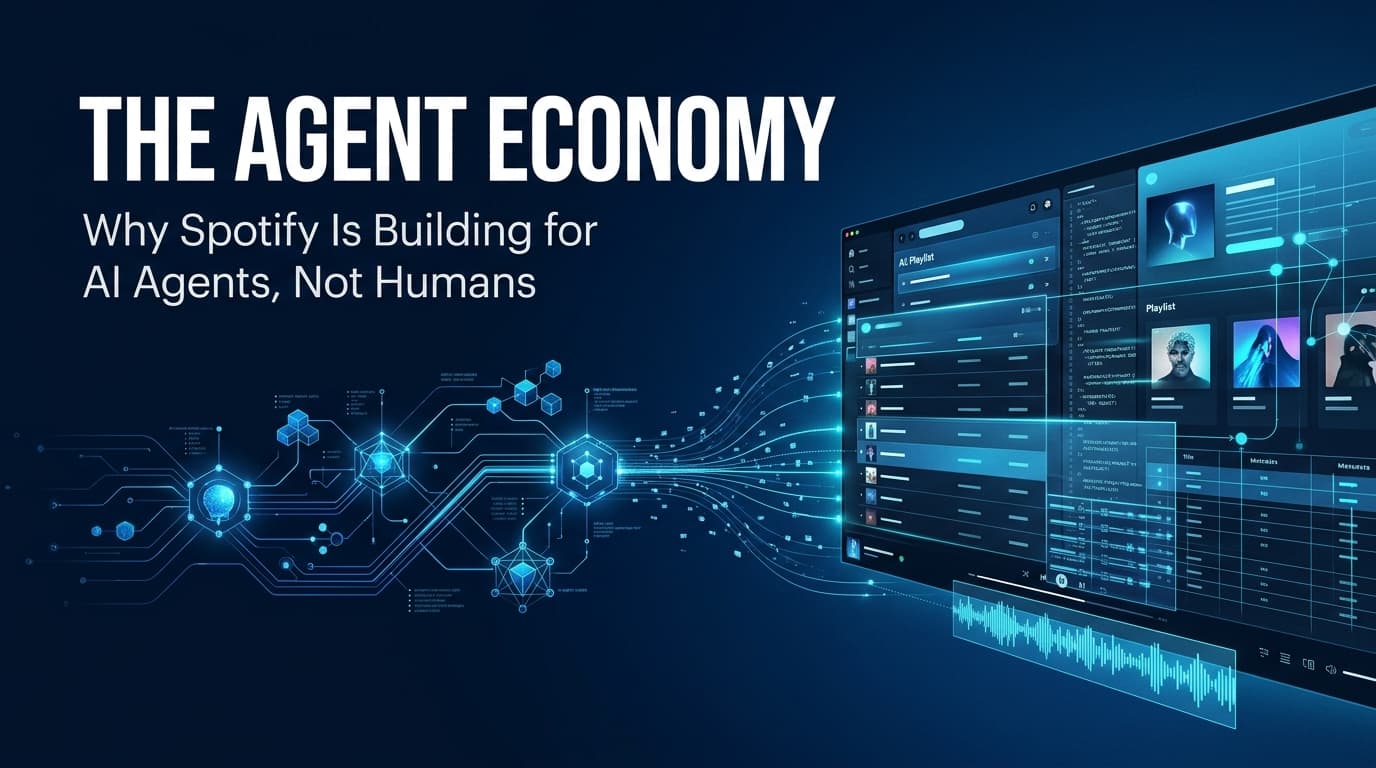
Spotify is positioning itself as the default media service for AI agents, transforming from a consumer-facing streaming platform into an infrastructure layer for third-party agents. The company's leadership frames this as a strategic pivot toward the "agent economy," where autonomous agents handle routine tasks while humans focus on creative and emotional engagement. Rather than viewing AI agents as threats to traditional music discovery, Spotify sees them as growth engines that will expand its addressable market beyond individual listeners. The core thesis rests on a simple observation: agents excel at replacing and managing chores, whereas entertainment remains inherently human. Listeners increasingly expect assistants to handle the mechanical aspects of their musical lives—curating playlists, adjusting settings, and discovering new content—while leaving the emotional and cultural dimensions to human curation. Spotify's vision is to be the service agents reach for, enabling conversational control over music rather than requiring users to open the native app.
Co-CEO Gustav Söderström** emphasizes that Spotify is uniquely positioned in the agentic age. He argues that the company stands to thrive precisely because agents automate the mundane, freeing humans to engage more deeply with music as art rather than utility. This reframing shifts the product strategy from "how do we help users listen?" to "how do we empower agents to orchestrate listening experiences?"
Redesigning APIs and UX for Agent Consumers
To serve AI agents effectively, Spotify is rethinking both its public APIs and user interface design. The company positions itself as the first music service to integrate with Meta's Muse assistant, establishing a precedent for broader agent partnerships. Beyond Meta, Spotify exposes open integrations with ChatGPT and Claude, enabling conversational control over playlists, recommendations, and discovery flows. The architectural philosophy here is B2B-first: Spotify treats its catalog and recommendation engine as a media service callable by any external agent. This requires APIs that prioritize simplicity, reliability, and security for external callers. Unlike traditional streaming interfaces designed around human interaction patterns, agent-oriented endpoints expose capabilities such as "generate a workout playlist based on current heart rate" or "create a mood-based mix for a meeting." The UX shift moves away from guided discovery toward natural language instruction, where agents can query Spotify directly rather than navigating menus. Armor Tech's API design framework offers relevant parallels for building agent-friendly integrations. By abstracting complexity behind stable, versioned endpoints, the framework enables developers to embed Spotify functionality into their agents without needing deep expertise in music metadata or streaming protocols. Building secure, scalable integrations becomes a prerequisite when agents can query sensitive user data on behalf of third parties. Spotify's approach ensures that agents receive curated, contextually appropriate responses derived from its own systems rather than raw listener information exposed to untrusted code paths.
Leveraging Listening Data as a Competitive Moat
Spotify's greatest asset for the agent economy is its decades-long listening history. The platform retains detailed records dating back to 2008, capturing favorites, skips, rediscoveries, and pattern shifts across millions of users. This depth of data enables advanced personalization that goes far beyond genre classification. The system can perform sophisticated operations like beat-stretching—speeding up or slowing down tracks to match a desired tempo—and sort by key and BPM. These capabilities allow agents to construct highly tailored playlists that adapt to physical activity, focus states, or social contexts. Crucially, Spotify does not share raw listener data with partner agents; instead, agents query Spotify directly and receive reasoning-based outputs. When a user requests a "high-energy morning mix," the agent receives a curated list of tracks optimized for tempo and energy, all chosen through Spotify's proprietary selection logic. This data-first approach creates a differentiated experience unavailable to competitors lacking long-term behavioral signals. Agents that leverage Spotify's historical understanding of individual taste patterns can deliver recommendations that feel intuitively correct even before explicit feedback occurs. The competitive advantage lies not in having more data, but in having deeper, more granular data that informs nuanced, context-aware decisions.
Agent Integration Use Cases: From Playlists to Contextual Media
Concrete applications illustrate how agents transform Spotify from a passive library into an active collaborator. One scenario involves running playlists generated on-the-fly from personal listening patterns—playlists that evolve as the user's preferences shift over time. Another involves integrating music into AI-generated podcasts or audiobook recaps, where background music must match narrative tone and pacing. Agent-driven discovery represents perhaps the most compelling use case. An agent can analyze a user's deep profile—artists repeatedly returned to, genres explored during specific life events, recurring mood associations—and suggest emerging artists who align with those patterns. The agent then handles the discovery loop entirely, presenting options to the user without requiring manual exploration. These use cases require seamless handoffs between agent conversation and actual playback. A user might tell an agent, "Create a study playlist that matches my current concentration level," and the agent must translate that intent into a sequence of tracks selected from Spotify's catalog, respecting volume levels, transitions, and flow. Such workflows demand reliable backend coordination between the agent's language model and Spotify's streaming infrastructure. Case studies in agent-integrated media demonstrate that successful implementations balance flexibility with predictability, allowing agents to act autonomously while maintaining user control over final selections.
Navigating Partner Friction and Data Privacy
Operating within a multi-platform ecosystem introduces significant friction. Amazon's blocking of Meta's Muse from accessing Spotify illustrates how platform owners may restrict external agents when concerns arise around access, security, privacy, or commercial control. This tension underscores a fundamental principle: Spotify does not share listener data with partner agents. Instead, agents query Spotify directly, and the service reasons about the request internally before responding. This architecture addresses several critical risks. First, it prevents unauthorized exposure of sensitive user behavior patterns. Second, it gives Spotify control over what data agents can see, aligning with regulatory requirements and user expectations. Third, it establishes commercial boundaries—agents pay for access rather than relying on implicit permissions that could change with platform policy shifts. Partner friction remains a persistent challenge. As more organizations adopt agent technologies, the risk of exclusion grows. Spotify's response focuses on transparency and clear governance, emphasizing that agents receive only the information necessary to fulfill their task. For founders building similar integrations, the lesson is to design APIs that minimize data surface area and provide auditable reasoning trails.
Strategic Implications for Founder-Led Product Strategies
For product leaders entering the agent economy, Spotify's approach yields several actionable insights. First, embrace agent growth rather than fear displacement. The market rewards companies that treat agents as legitimate users of their platform, not as competitors to be ignored. Second, design APIs that expose value without exposing raw data. The more context an agent can operate on without knowing underlying user identities, the safer and more effective the integration becomes. Third, leverage deep domain data to create defensible moats. Spotify's listening history provides a unique signal that competitors cannot easily replicate. Organizations building agent ecosystems should invest early in longitudinal behavioral capture, recognizing that such data compounds over time and becomes increasingly valuable for personalization. Finally, prioritize integration simplicity and privacy. Partners are more likely to adopt services whose APIs are intuitive and whose data practices are transparent. The path forward for founder-led teams is to build abstractions that hide complexity while preserving the richness of the underlying service.
Key Takeaways and Next Steps for Spotify's Agent Play
Spotify continues to expand integrations beyond Meta, ChatGPT, and Claude, signaling confidence in the agent economy as a long-term direction. Investment in richer contextual AI features—such as tempo-aware mixing and dynamic mood detection—will further differentiate its offering. Potential new monetization models could emerge around agent-driven media subscriptions, where premium access grants agents enhanced querying capabilities or exclusive content. Ongoing monitoring of platform policies will be essential to mitigate future partner friction. As more organizations experiment with agent integrations, the rules governing access will evolve. Companies building agent-first products should establish clear compliance frameworks now, anticipating potential restrictions on data sharing and API availability. The agent economy represents a fundamental shift in how media services are consumed—not merely as passive libraries but as active participants in workflow automation. Spotify's journey from music streaming to agent infrastructure exemplifies how legacy platforms can reinvent themselves by embracing the tools their customers are already using.
How Armor Tech Can Help
Armor Tech helps businesses prepare for the agent economy by integrating AI capabilities into existing products, APIs, and business workflows. From building agent-ready software architectures and personalized AI experiences to implementing secure integrations, access controls, and human oversight, we help organizations turn emerging agentic AI opportunities into practical solutions. Our focus is on creating systems that work reliably for people and the AI agents acting on their behalf.
Frequently Asked Questions
What distinguishes Spotify's approach to AI agents compared to other music platforms?
Spotify was the first music service to integrate with Meta's Muse assistant and maintains open integrations with leading LLMs like ChatGPT and Claude. Its focus is on becoming the media service agents use directly, rather than remaining confined to its own app interface.
How does Spotify protect user data in agent integrations?
Spotify does not share raw listener data with partner agents. Instead, agents query Spotify directly and receive reasoning-based outputs. This architecture ensures that only the information necessary to fulfill the agent's task is processed, minimizing exposure of sensitive behavioral patterns.
Can agents access listening history dating back to 2008?
Yes. Spotify retains detailed listening history spanning multiple decades, including favorites, skips, and rediscovery patterns. This deep temporal data enables advanced personalization that goes beyond static genre categorization, supporting dynamic playlist generation and context-aware recommendations.
Ready to build agent-first products? Contact us for a strategic consultation on AI integration and API design.