AI agents are reshaping commerce payment infrastructure by replacing static rule engines with adaptive, context-aware orchestration. This post frames a conceptual blueprint for agentic payment workflows built on n8n and Make, using general automation patterns and flagging where platform-specific details require verification. The shift moves payment authorization from fixed decision trees toward agent-driven evaluation of intent, inventory, and risk context.
The Shift from Static Checkout Rules to Agentic Payment Flows
Traditional ecommerce checkout flows rely on deterministic rule engines: if the cart total exceeds a threshold, apply a specific discount; if the selected payment method is a corporate card, route to a designated processor. These paths are efficient for predictable journeys but become brittle when purchase intent varies across dimensions such as cross-border eligibility, real-time inventory alignment, or dynamic pricing models. AI agents introduce a structural change by positioning the decision logic as a context-aware layer that evaluates intent before committing to a payment action. Agentic commerce is discussed in industry literature as a framework for this adaptive capability, enabling workflows to adjust fees, select corridors, or invoke fallback paths based on live data. Mastercard Pay for Machines is referenced in related discussions as a development in this space; however, capabilities, availability, and associated use cases require verification before any build guidance can be anchored to specific platform features.
How AI Agents Make Payment Decisions in an Agentic Commerce Stack
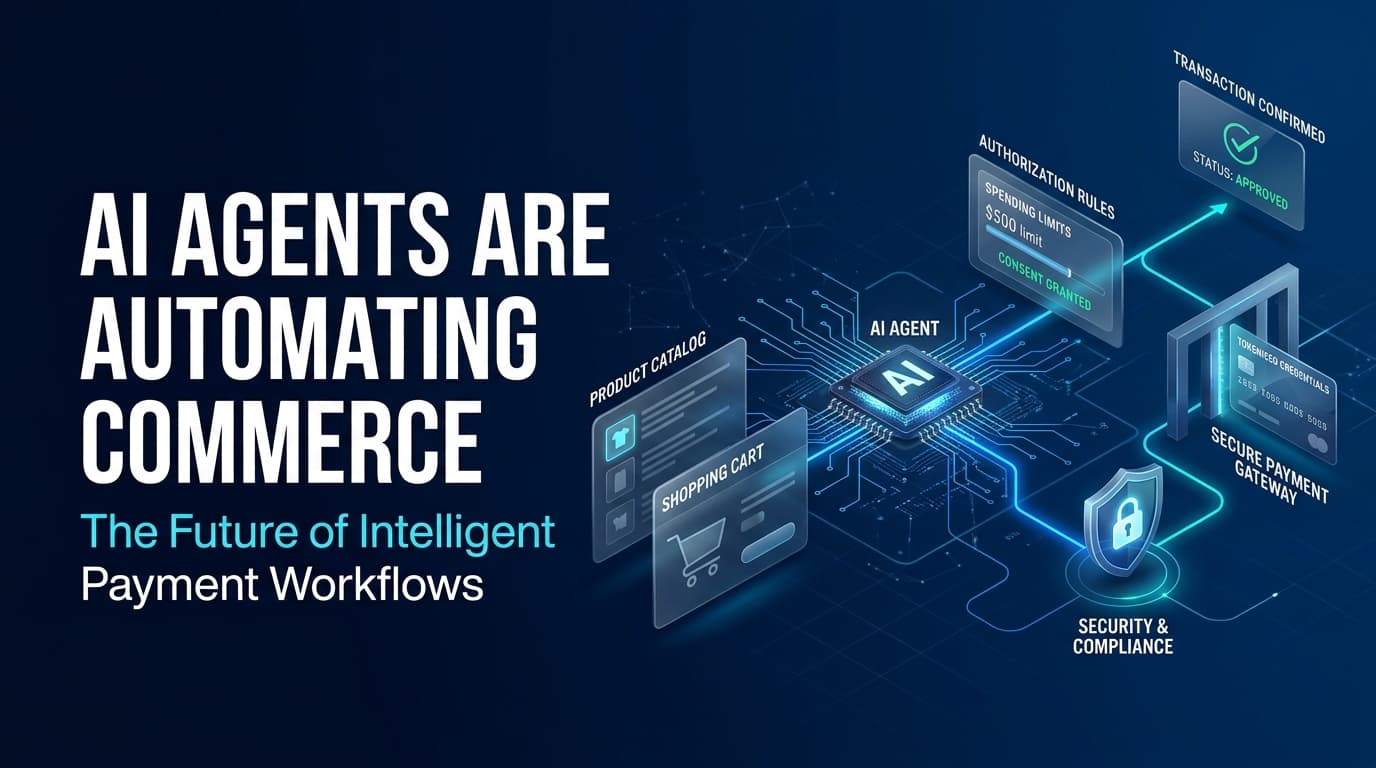
In an agentic commerce stack, the AI agent sits as the decision layer between customer intent and payment execution. The agent interprets structured or natural language intent—such as "authorize a $1,500 transaction for next-day delivery to a EU address using the company's virtual card"—and evaluates multiple conditions before proposing or executing a payment. These conditions may include available balance, jurisdictional restrictions, provider fee structures, and compliance checks. This decision logic differs from the static branches typical of n8n or Make workflows, where each node follows a prewritten path based on fixed input comparisons. In an agentic setup, the agent may call an intermediate orchestrator, query a rules engine, or invoke a payment API, then reassess the response before proceeding. The framework and orchestration details governing how agents hand off to payment nodes remain an area for verification, as implementations vary across agent frameworks, model providers, and integration layers.
Building Agent Payment Workflows with n8n
n8n operates as a workflow engine that connects triggers, decision nodes, and action nodes through a directed graph. A conceptual agentic payment flow might begin with a webhook trigger receiving a purchase intent payload, which is then passed to an agent evaluation step. The agent's output—such as a selected payment method, authorized amount, or risk flag—conditions downstream nodes. For instance, if the agent indicates that 3D Secure authentication is required, the workflow follows a branch that invokes the appropriate API; otherwise it proceeds to a reconciliation step. n8n's "If," "Switch," and "Set" nodes can model this branching and state management, while a final reconciliation node compares the payment provider's confirmation (authorization code, settlement ID) against an internal ledger to flag discrepancies. The actual fit of specific n8n nodes for a given agentic payment scenario must be verified against the intended workflow requirements, including provider API compatibility and data transformation needs. Teams exploring this architecture may find it useful to review the product page for context on custom agentic AI builds.
Building Agent Payment Workflows with Make.com
Make.com provides a visual scenario builder that orchestrates actions across apps and services through modular components. In an agentic payment context, a scenario could start with a trigger module pulling order data, then pass the context to an AI agent endpoint via a web request node. The agent's response—such as "use Visa, authorize $1,200 for shipping to Frankfurt"—triggers downstream Make modules that call the payment gateway, update the order status, and log the transaction. Make's "Filter" and "Iterator" modules allow the scenario to branch based on the agent's decision, while "Error" handlers provide fallback paths if the agent's output is malformed or the payment request fails. The suitability of Make.com's module set for a particular agentic payment flow depends on the specific gates, providers, and compliance requirements involved, and platform-specific feature fit should be confirmed before committing to a build. For teams reviewing prior work, the portfolio section may contain references to automation projects.
Governance, Security, and Reconciliation for Autonomous Payments
Autonomous payment flows introduce governance challenges that deterministic workflows do not inherently address. A human-in-the-loop pattern can surface critical decisions for reviewer approval: if the agent's confidence score falls below a configured threshold, or if the transaction amount exceeds a predefined limit, the workflow pauses and routes the request to a human operator for validation. Security design must account for agent credential management, ensuring that API keys, secret references, and authentication tokens are rotated regularly and stored outside the workflow definition, such as in a dedicated secrets manager. Reconciliation design typically involves a matching step that compares the payment provider's acknowledgment—such as an authorization code or settlement reference—against the internal order ledger, flagging discrepancies for audit trails. These patterns are generic design considerations; specific implementations should be validated against the payment providers and compliance frameworks in scope.
From Prototype to Production: Sequencing an Agentic Commerce Build
A phased approach helps mitigate risk when moving from concept to deployed agentic payment systems. A typical sequence might begin with discovery, where stakeholder requirements, acceptable risk thresholds, and integration touchpoints are documented. This is followed by simulation, where agent decision logic is tested against historical order data without touching live payment providers, allowing teams to validate intent evaluation and branch behavior in a controlled environment. The third phase designs the agentic workflow itself, defining triggers, agent prompts, conditional branches, and reconciliation steps in the chosen orchestrator—whether n8n, Make.com, or a custom framework. Guardrails are installed during this phase: confidence thresholds, amount caps, and mandatory reviewer approvals. The final phase involves verification and testing, including unit tests for each workflow node, end-to-end simulations with mock providers, and a staged rollout to a limited merchant cohort before full production. Each phase includes review checkpoints that determine whether the build proceeds, reworks, or pauses for additional requirement gathering.
How Armor Tech Can Help
Armor Tech helps businesses explore AI-driven commerce and payment automation through intelligent workflow design, secure API integrations, and governed agentic systems. From automating purchasing and invoice processing to connecting payment services with accounting platforms and reconciliation workflows, we help organizations reduce repetitive manual work while maintaining clear authorization boundaries. Our approach prioritizes secure credential handling, spending controls, transaction monitoring, auditability, and human approval for sensitive financial actions.
Frequently Asked Questions
What is agentic commerce?
Agentic commerce refers to commerce systems where autonomous AI agents interpret purchase intent and determine next steps in the payment flow, rather than following fixed rule branches. The agent evaluates context such as available funds, jurisdictional rules, and provider capabilities before authorizing or suggesting a payment action.
How do n8n and Make.com support agentic payment workflows?
Both n8n and Make.com serve as workflow orchestration platforms that can connect triggers, decision nodes, and action modules. In an agentic setup, an AI agent's output can conditionally route the workflow through "If," "Switch," or "Filter" constructs, enabling branches such as provider selection, 3D Secure invocation, or reconciliation. The specific nodes and their capabilities should be verified against the intended payment providers and compliance requirements.
What oversight patterns apply to autonomous payment agents?
Human-in-the-loop oversight is a common pattern: if the agent's confidence score is below a set threshold, or if the transaction amount exceeds a predefined limit, the workflow pauses and routes the request to a human reviewer for approval. Additional security measures include credential rotation, encrypted storage of API secrets, and reconciliation steps that match provider acknowledgments against internal ledgers for audit consistency.
Teams building agentic payment infrastructure should treat the orchestration layer—whether n8n, Make.com, or a custom framework—as one component of a broader system that also includes agent decision logic, payment provider integration, and governance controls. A structured discovery sprint can help map specific workflow requirements against available tools and identify verification points before commit.