Why Agent Authentication Needs a New Model
AI agents now perform tasks that traditionally required manual login, ranging from email management to financial account operations. Static credential handoff creates a copy of each password that lives outside the user’s control. As agents become trusted proxies, security teams lose visibility into which actions are approved and which are unauthorized. The existing pattern of sharing passwords or API keys with agents expands the attack surface and eliminates audit trails for user consent.
How 1Password's Trust Layer Works
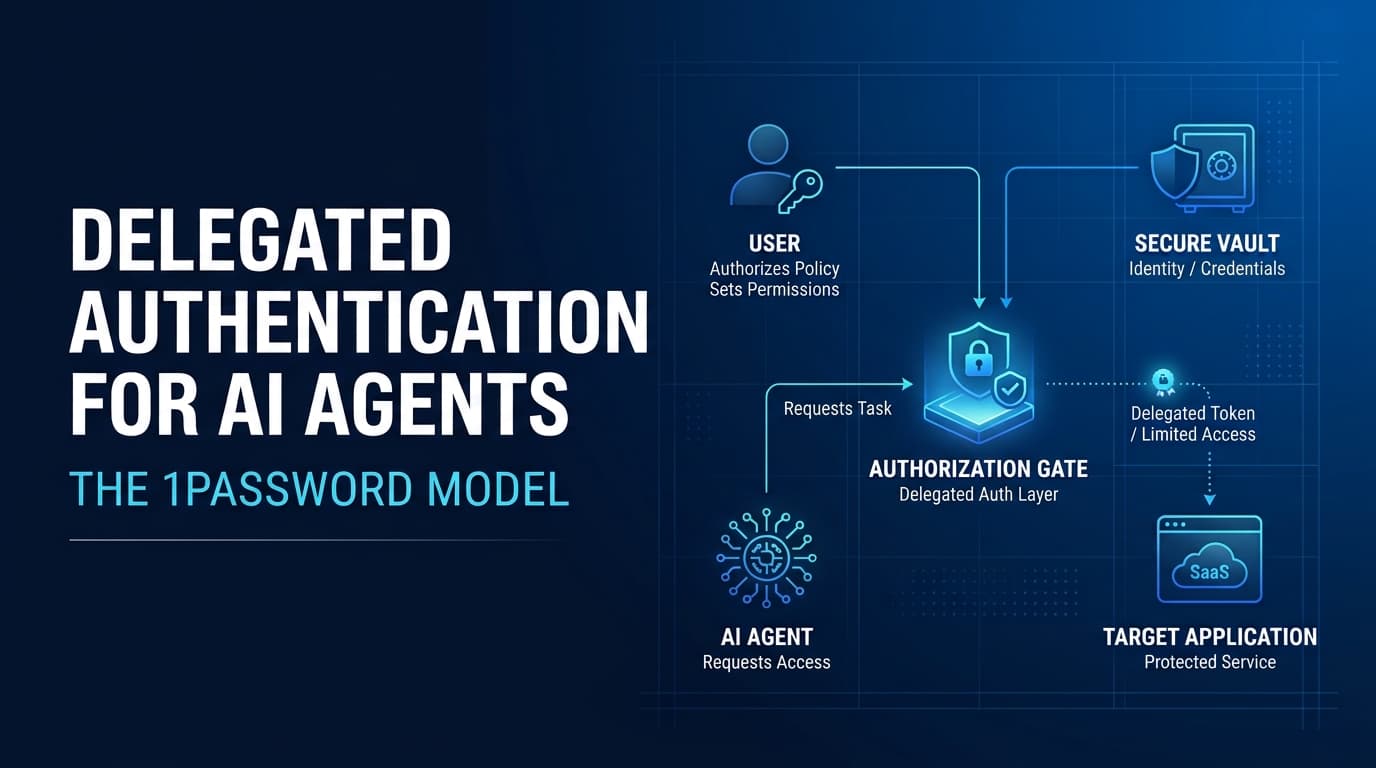
The 1Password trust layer separates agent identity verification from credential access. When an agent initiates a login, it first sends a digital key that 1Password uses to verify the agent’s public identity. This key is exchanged over a secure channel and never contains a password. The system then alerts the user with a concise description of the requested action, prompting an approve or deny decision. If the user confirms, 1Password cryptographically signs the agent into the target service, programmatically filling the required credentials without ever exposing them to the agent. The agent receives only a session token or signed assertion that grants temporary access. This design ensures that the agent never holds a reusable credential and that each login is tied to an explicit user approval event.
Supported Agents and Ecosystem Integration
1Password launched the trust layer with a set of popular agents, including Claude Duet from Anthropic, OpenAI’s Dots and ChatGPT Work, Grok Bot, Meta’s Muse, and Town agents. The model is vendor‑neutral, allowing users to select any compatible agent regardless of the underlying provider. Integration follows a standard flow: the agent registers a public key with 1Password, obtains a short‑lived authentication token for each delegated session, and presents that token to downstream services. The implementation does not require changes to the password manager’s core credential store; it merely adds a verification step before credential injection.
Zero-Trust Principles for Agent Access Control
When translating the 1Password approach to a custom SaaS platform, three core principles guide the design. First, never trust an agent with long‑lived static credentials; replace them with short‑lived tokens that expire after a bounded window. Second, enforce user‑facing approval workflows for every delegated action, ensuring that consent is captured and recorded. Third, separate agent identity verification from credential storage, maintaining distinct data stores for signing keys and password vaults. This separation simplifies rotation of agent keys without disturbing credential management. Fourth, keep an audit trail that links each delegated session to the exact user approval event, timestamp, and requested resource.
Real‑World Risks: Agent Activity in Financial Services
Recent reports from U.S. banks reveal that automated agentic activity inside user accounts is being detected at scale. While many instances stem from legitimate consumer delegation, the lack of granular consent logging makes it difficult to differentiate authorized from unauthorized actions. A Chase spokesperson warned customers against handing over usernames and passwords to any third‑party service. These observations underline the need for a model that provides granular, auditable delegation rather than blanket credential sharing.
Building Secure Delegation Into Your Own Agent Platform
Developers seeking to adopt a similar pattern can follow a pragmatic roadmap. Begin by designing an approval gateway that sits between the agent and credential stores. The gateway validates the agent’s identity using a registered public key, then presents a concise request to the user. User interaction can be a web prompt, a push notification, or a modal overlay, depending on the UI constraints of your platform. Upon approval, the gateway issues a signed session token that includes the scope of allowed actions, the expiration time, and a reference to the user’s consent record. This token is delivered to the agent, which presents it to downstream APIs. Because the token contains an explicit scope, the downstream service can enforce least‑privilege access and log the delegation event.
Integrate the approval gateway with existing identity providers using OAuth 2.0 or OpenID Connect flows. These standards provide well‑understood token formats and revocation mechanisms that can be leveraged for agent authentication. When exposing APIs to agents, require mutual TLS or token‑based authentication to prevent credential leakage. Implement token rotation on a per‑session basis, ideally using short‑lived access tokens refreshed via a secure refresh token exchange that also records the new approval.
User consent prompts should be visible and unambiguous. Include enough context for the user to recognize the target service, the requested permission, and the time window of access. Provide an easy way to revoke delegated access, such as a dashboard where users can list active delegations and terminate them instantly. This revocation capability ties back to the audit trail, ensuring that any token issued can be invalidated system‑wide.
To support extensibility, define a clear contract for agent registration. Agents must provide a public key, a unique identifier, and optionally a set of allowed scopes. Store these keys in a key‑management service that supports fast rotation and revocation. The service should enforce rate limits on authentication attempts and monitor for anomalous patterns, such as rapid token issuance to new agents.
Testing this flow requires simulating both legitimate and malicious agent behavior. Write unit tests for token validation, integration tests that verify the approval gateway enforces consent, and end‑to‑end tests that confirm a user can approve or deny a request in real time. Automated security scans should check that no credentials are logged or exposed in client‑side code.
Implementation Checklist
Register each agent with a unique public key in a key‑management store.
Define an approval gateway that authenticates the agent and presents a concise request to the user.
Issue short‑lived signed tokens that encode scope, expiration, and consent identifier.
Integrate with OAuth 2.0/OIDC for identity federation and token revocation.
Provide a user dashboard for listing and revoking active delegations.
Log every consent event with timestamps, agent identifier, and target resource.
Enforce mutual TLS and rate limiting on agent API endpoints.
Run automated tests for token validation, consent capture, and revocation flows.
How Armor Tech Can Help
At Armor Tech, we help SaaS businesses build secure AI agent workflows that interact with business applications, APIs, and sensitive resources without relying on uncontrolled credential sharing. Our team can implement delegated authorization patterns, integrate secrets-management solutions, configure least-privilege permissions, and establish secure authentication flows for AI-powered applications. We also focus on session management, credential lifecycle controls, audit logging, and human approval checkpoints to help reduce unauthorized access and improve accountability. Whether your organization is developing custom AI agents or integrating third-party agent platforms, Armor Tech helps design maintainable security architectures that balance automation with appropriate access restrictions and human oversight.
Frequently Asked Questions
What is the role of the digital key in 1Password’s delegation model?
The digital key serves as a proof of agent identity. It is sent to 1Password during a login attempt, allowing the password manager to verify that the requesting agent is a registered entity without exposing any credentials. This key is never reused as a secret and is only used to authenticate the agent’s right to request a delegated session.
How does user approval integrate with the authentication flow?
Once the agent’s digital key is validated, 1Password generates an alert for the user describing the requested login. The user receives a prompt to approve or deny the request. If approved, 1Password signs the agent into the target service and injects the necessary credentials. The approval event is recorded as part of the audit trail, linking the delegated session to an explicit consent action.
Can existing SaaS platforms adopt this model without redesigning the credential store?
Yes. The trust layer separates agent verification from credential storage. A platform can keep its existing vault or secret manager unchanged and simply add an approval gateway that intercepts agent requests, validates identity, and issues temporary tokens. This approach minimizes disruption while introducing the same zero‑trust delegation guarantees.
Closing Thoughts
Scheduled agentic workflows demand a security model that preserves user control while enabling automated access. 1Password’s trust layer demonstrates how a digital key, user approval loop, and signed credential injection can eliminate credential exposure. By extracting the core principles—short‑lived tokens, explicit consent, separation of concerns, and auditability—developers can embed secure delegation into any SaaS offering. For teams looking to harden their agent platforms, exploring the concepts outlined here provides a concrete foundation for building zero‑trust authentication at scale. If you need guidance on integrating these patterns into your own services, check out the product page or review our AI automation workflow expertise to see how Armor Tech can help design safe delegation workflows for your platform.