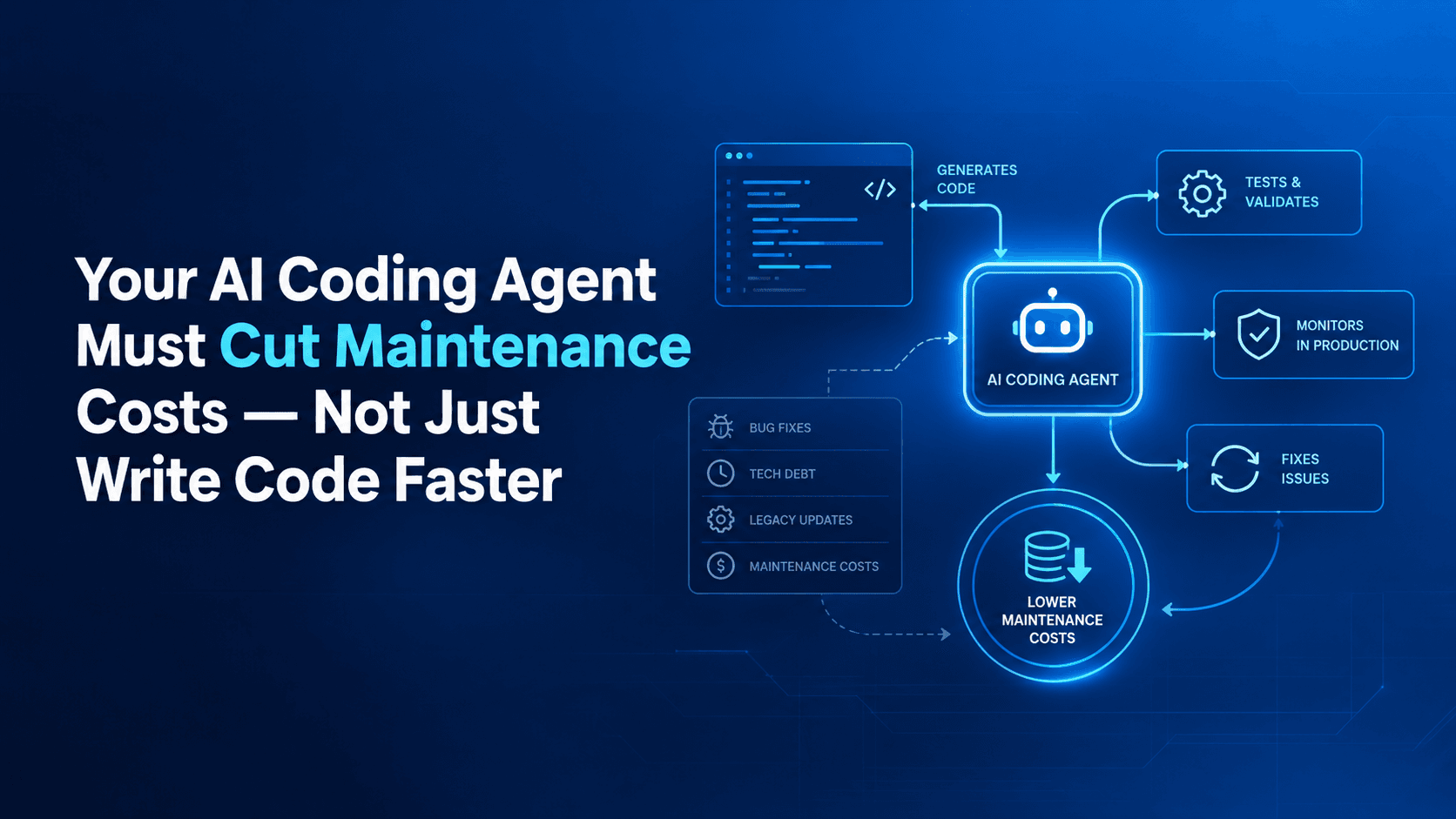
Engineering leaders optimizing for code-generation speed are walking into a maintenance trap they can't escape. James Shore's compounding-cost model demonstrates that unless AI coding agents reduce maintenance costs in inverse proportion to speed gains, short-term velocity becomes permanent technical debt. The break-even math is unforgiving: 2x output requires 0.5x maintenance cost to sustain gains beyond a few months.
The Velocity Trap: Why Speed Metrics Mislead Engineering Leaders
Every line of code incurs recurring annual maintenance — bug fixes, dependency upgrades, cleanup — forever. Shore's Wisdom-of-Crowd model estimates 10 days of maintenance per month of new code in year one, then 5 days per year after. At that rate, a baseline team crosses the 50% maintenance-overhead threshold at 31 months. Halving maintenance pushes that crossover to 68 months; doubling it crashes you below 50% productivity in 10 months.
Current benchmarks (HumanEval, SWE-bench) measure generation throughput, not maintainability. They ignore the compounding burden that determines real productivity over a codebase's lifetime. Chasing velocity without measuring maintenance cost ratio is like optimizing a car's 0-60 time while the brakes are failing.
The Math That Breaks the Business Case
Shore's spreadsheet model reveals three scenarios that should terrify any procurement committee:
2x output + 2x maintenance cost: Gains erased in 5 months. Permanent long-term penalty below pre-AI baseline.
2x output + 1x maintenance cost (code equally maintainable): Gains erased at 19 months. Net negative at 40 months.
2x output + 0.5x maintenance cost: Sustained gains permanently. Only this inversion preserves ROI.
The mechanism is compounding: each month's output adds to the maintenance base. Doubling output while holding maintenance constant still doubles total maintenance load. The spreadsheet is available for custom scenario modeling — plug in your team's actual maintenance hours and see when the crossover hits.
Why Today's Agents Worsen the Maintenance Burden
Anecdotal consensus from Hacker News and practitioner reports indicates current agentic tools increase, not decrease, maintenance costs. Three mechanisms drive this:
Harder-to-understand generated code increases cognitive load for reviewers and future maintainers.
PR volume drowns review capacity → rubber-stamp approvals → defects escape to production.
Dependency churn and hallucinated patterns create hidden debt that surfaces months later.
No current AI coding agent demonstrably halves maintenance costs while doubling output. Most optimize for token throughput, the metric that matters least for long-term ROI.
Two Levers That Actually Move the Needle
The model demands only two architectural approaches satisfy the inversion requirement:
Lever 1: AI that writes inherently more maintainable code
Simpler abstractions, better test coverage, self-documenting patterns. This requires the agent to optimize for readability and changeability, not just correctness-on-first-run.
Lever 2: AI that makes maintenance itself cheaper
Automated refactoring, dependency upgrades with semantic versioning intelligence, bug detection before human review. agentic AI systems that target maintenance workflows pursue this lever directly — reducing the recurring cost of existing code rather than just adding new code faster.
Most tools pursue neither. They measure success in lines generated, not maintenance hours eliminated.
A New Scorecard for Evaluating AI Coding Tools
Replace velocity-only procurement criteria with these measurable metrics:
MetricDefinitionTargetMaintenance Cost Ratio (MCR)Maintenance hours / new feature hours over 12 monthsDecreasing quarter-over-quarterMean Time to Safe Refactor (MTTSR)Calendar time from refactor intent to merged, tested change with AI vs without50% reduction vs baselinePR Review ThroughputMeaningful reviews completed per engineer per day (not rubber-stamps)Stable or increasingDefect Escape RateProduction defects per 1k lines of AI-assisted code vs human-onlyLower than baseline
Requirement: vendor must share MCR data from production deployments in codebases comparable to yours. If they can't, they're selling velocity, not productivity.
Building the Maintenance-Reducing Agent: What It Takes
A maintenance-first agentic architecture looks fundamentally different from a code-generation one:
RAG pipelines over codebase + institutional knowledge for context-aware changes that respect existing patterns and constraints.
Automated regression test generation and mutation testing in CI so every change validates against actual behavior, not assumed behavior.
Dependency upgrade agents with semantic versioning intelligence that distinguish breaking changes from safe updates and generate migration patches.
n8n/Make workflows that codify maintenance runbooks as executable automation — RAG pipelines and AI automation workflows turn tribal knowledge into repeatable, auditable maintenance operations.
This is not a wrapper around an LLM. It's a system where the agent's primary output is reduced maintenance burden, with new code as a byproduct.
Stop Trading Speed for Indenture
Before renewing or buying any AI coding tool, answer these questions with data:
Does this tool reduce our 12-month MCR? By how much — show the measurement methodology.
What happens to our productivity if we turn it off in 18 months? (Shore's model: maintenance costs persist, velocity gains vanish.)
Can the vendor demonstrate maintenance-cost reduction in a codebase like ours — same language, age, team size, domain?
Next step: run a 90-day maintenance-cost pilot, not a velocity pilot. Measure MCR, MTTSR, and defect escape rate before committing budget.
The spreadsheet doesn't lie. You can check out any time you like, but you can never leave the maintenance costs you've already incurred.
How Armor Tech Can Help
At Armor Tech, we help SaaS businesses integrate AI coding agents into their software development workflows with a focus on long-term maintainability, code quality, and measurable cost savings. Our team identifies opportunities to automate repetitive engineering tasks, improve testing and validation, simplify legacy code, and streamline debugging without introducing unnecessary complexity. By combining AI-assisted development with structured code reviews, automated quality checks, and appropriate human oversight, we help businesses reduce maintenance overhead while keeping their software reliable and scalable. Whether you are modernizing an existing application or building a new AI-powered product, Armor Tech focuses on engineering solutions that deliver lasting value not just faster code generation.
Frequently Asked Questions
How do I measure our current Maintenance Cost Ratio without a dedicated tracking system?
Sample two sprints: tag every ticket as "new feature," "maintenance," or "other." Divide maintenance hours by new-feature hours. Repeat quarterly to establish trend. The absolute number matters less than the direction.
What if our AI tool improves velocity but we can't measure maintenance impact yet?
Assume the worst case in Shore's model: normal maintenance cost on doubled output. That scenario erases gains at 19 months and goes net negative at 40. Budget for a maintenance-cost pilot before the 12-month mark or you're deciding blind.
Can't we just hire more engineers to handle the increased maintenance load?
Adding people increases communication overhead and onboarding maintenance. Shore's late-stage startup clients tried this — it's the "keep adding people because it's never enough" path. The model compounds; headcount scales linearly. Math wins.