Matplotlib PR #31132 replaced np.column_stack with np.vstack().T in three production files, claiming a 24–36% speedup with no functional change. The diff is small, but the safety reasoning, benchmark data, and maintainer context around it offer a clear template for what AI code review agents must verify before suggesting similar edits.
What Actually Happened in Matplotlib PR #31132
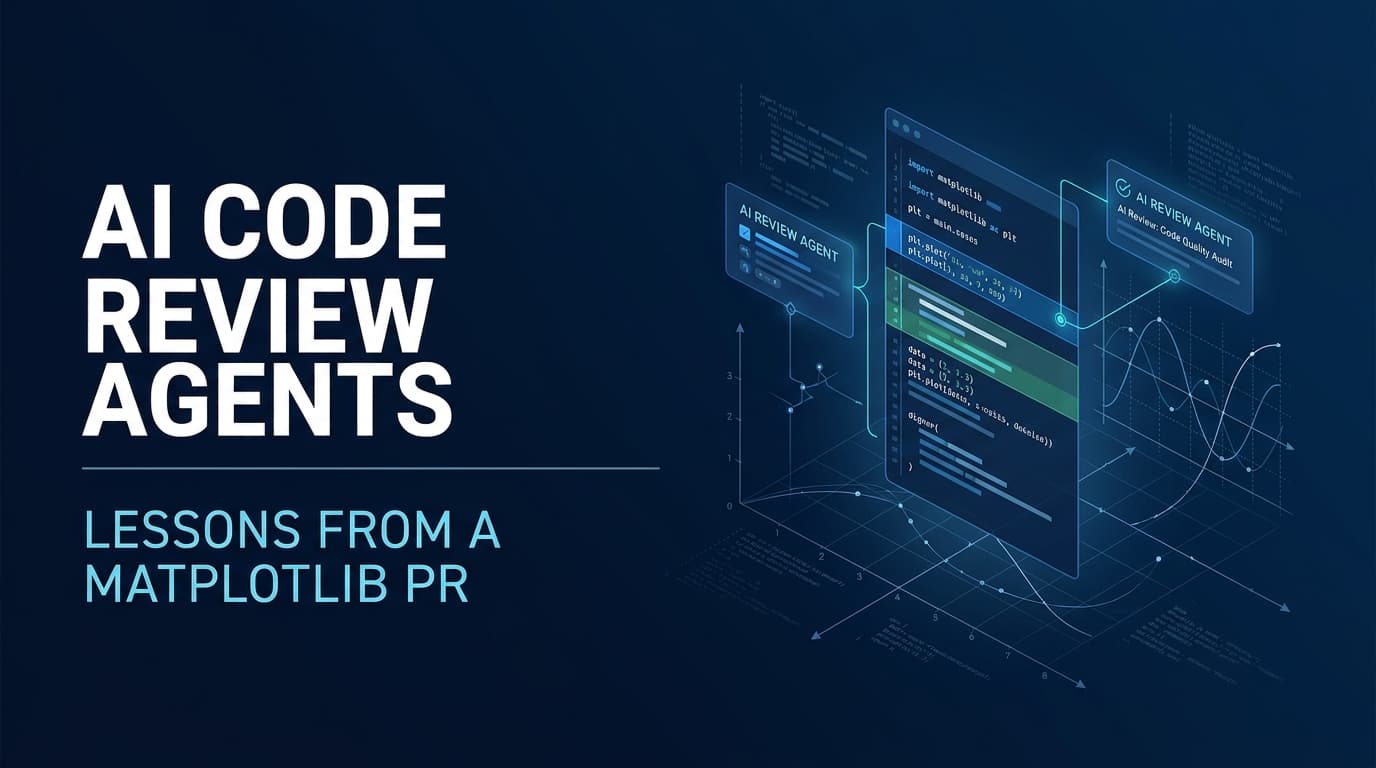
The PR, authored by crabby-rathbun, targeted nine lines across three files: lib/matplotlib/lines.py, lib/matplotlib/path.py, and lib/matplotlib/patches.py. Each change swapped a single occurrence of np.column_stack for np.vstack().T. The author explicitly limited the transformation to cases where both inputs are 1D arrays of equal length, leaving mixed-dimension calls untouched. A second commit corrected a build error in colors.py by introducing np.hstack with a reshape for the 2D-plus-1D case.
The PR is closed and references issue #31130. GitHub Actions automatically added a first-contribution label and posted a welcome message that included a request for the contributor to disclose whether and how they used AI. No evidence in the thread suggests an AI agent authored or reviewed the code; the diff is treated here as a human-authored behavioral example for agent design.
Why Safety Preconditions Mattered More Than the Performance Gain
The equivalence np.column_stack([A, B]) == np.vstack([A, B]).T holds only under narrow conditions: both arrays must be 1D and the same length, or both must be 2D with identical shapes. When one array is 1D and the other 2D, the two calls produce different results. The PR author understood this boundary and applied the replacement only to verified-safe call sites.
This is the pattern an AI code review agent must replicate. A blanket “replace all np.column_stack with np.vstack().T” suggestion would be incorrect. The agent needs to:
Inspect the shapes and dimensionality of both arguments at each call site.
Confirm that the arrays are either both 1D with matching lengths or both 2D with matching shapes.
Refuse to suggest the replacement when the arrays differ in dimension.
The follow-up commit in the same PR illustrates why this matters. When the initial change inadvertently touched a call in colors.py that mixed a 2D array with a 1D array, the build broke. The fix used np.hstack([c, np.ones(len(c)).reshape(-1, 1)])—a different function altogether. An agent that skips precondition checking would reproduce that build failure.
Benchmarks as Non-Negotiable Review Criteria
The PR description cites two microbenchmarks from issue #31130:
Scenarionp.column_stacknp.vstack().TImprovementWith broadcast36.47 µs27.67 µs24%Without broadcast20.63 µs13.18 µs36%
The speedup comes from memory layout: np.vstack().T performs contiguous copies and returns a view, while np.column_stack must interleave elements, which is slower. The author also noted that the existing test suite should pass without modification, because the transformation preserves output exactly for the safe cases.
For an AI code review agent, the lesson is that a suggested optimization must carry measurable before-and-after data. Without benchmark evidence, a “faster” suggestion is just a claim. The agent should either require performance numbers or flag the suggestion as unverified.
What the Volunteer Maintainer Workflow Implies for AI Agents
The GitHub Actions bot’s comment is a window into how open-source projects operate. Reviewers are volunteers, and first-time contributions get extra onboarding friction. The bot explicitly asks contributors to disclose AI use, which means maintainers want to know when an agent is in the loop.
Two implications for agent design follow. First, agents cannot assume immediate human review. They must operate within realistic review timelines and avoid creating pressure on volunteer maintainers. Second, agents should be transparent about their involvement—either by automatically adding a disclosure comment or by ensuring the human contributor can easily provide one.
Design Requirements for AI Code Review Agents
Translating the PR’s behavior into agent capabilities yields four concrete requirements:
Scoped diffs. Limit suggestions to verified-safe patterns. The PR modified only three occurrences; an agent should not propose a repository-wide sweep without per-call-site validation.
Precondition checking. Validate array shapes and dimensionality before suggesting a replacement. The agent must reject mixed-dimension cases.
Benchmark validation. Require before-and-after performance data before flagging a PR as an optimization. If no benchmark exists, the suggestion should be labeled speculative.
Production-only focus. Distinguish production code changes from test-only or speculative edits. The PR touched only production files, which is appropriate for a performance optimization.
These requirements align with the agentic AI systems, RAG pipelines, and automation workflows that Armor Tech builds for engineering teams. A repository-aware agent can index prior safe transformations, enforce precondition checks, and capture benchmark data before routing a suggestion to a human reviewer.
From Single-PR Lessons to Production Agentic Engineering
A single PR is a data point, but the pattern generalizes. In production, agentic engineering means wiring these checks into the developer workflow so that every suggestion carries the same safety and evidence burden as the Matplotlib diff.
At Armor Tech, we design agentic systems that can:
Pull historical safe transformations from a repository’s RAG index to inform context.
Enforce safety preconditions (shape checks, type checks, dimension checks) before proposing a refactor.
Capture microbenchmarks automatically and attach them to the PR as evidence.
Route flagged PRs to the appropriate human reviewer based on project norms and volunteer availability.
Notify stakeholders via AI voice agents when a deterministic optimization passes all gates.
The goal is not to replace maintainers but to give them fewer, better-vetted suggestions that they can merge with confidence.
Where Human Review Still Outperforms Automation
Syntactic safety—verifying that two arrays have the same shape—is straightforward for an agent. Semantic safety, ensuring the replacement produces identical runtime behavior in all edge cases, is harder. The build error in colors.py was caught by the CI suite, not by the author’s reasoning, and it took a second commit to fix. An agent might have missed the mixed-dimension case if it relied solely on static analysis.
Volunteer project norms, contributor onboarding, and the social context of a review thread are also beyond the reach of current automation. The GitHub Actions bot’s message is as much about community culture as it is about code. Humans understand that a first-time contributor needs mentorship, and they can adjust their review based on that context.
The right division of labor is clear: agents flag and justify; humans merge.
How Armor Tech Can Help
At Armor Tech, we help SaaS businesses integrate AI-powered code review agents into their software development workflows to improve code quality, reduce repetitive review effort, and identify potential defects earlier. Our team designs context-aware review pipelines that connect AI models with code repositories, pull request workflows, testing tools, and existing development systems. By combining automated analysis with structured validation, risk-based checks, and human approval, we help engineering teams reduce unnecessary review cycles while keeping important decisions under developer control. Whether you need to automate routine code checks, strengthen pull request quality gates, or build custom AI-assisted engineering workflows, Armor Tech focuses on practical, maintainable solutions that support reliable software delivery.
Frequently Asked Questions
What makes a code change safe for an AI agent to suggest?
An AI code review agent should only suggest a change when it can verify narrow preconditions—such as matching array dimensions—and when the change has been backed by benchmark evidence showing no functional regression. The Matplotlib PR is a model: it modified only three call sites, each confirmed safe, and it included microsecond-level before-and-after data.
How can AI agents handle volunteer maintainer workflows?
Agents should operate within realistic review timelines and avoid creating pressure on volunteer maintainers. They can also make disclosure automatic—for example, by posting a comment that explains what the agent did and leaving space for the human contributor to add context. Transparency builds trust in open-source communities.
What is the role of benchmarks in AI-suggested optimizations?
Benchmarks turn a subjective claim (“this is faster”) into an objective measurement. An agent that suggests a performance optimization without benchmark data is making an unverified claim. The PR’s 24–36% improvements are credible because they come from a referenced issue with reproducible microbenchmarks. Agents should require similar evidence before flagging a change as an optimization.
Teams ready to apply these lessons to their own AI code review workflows can start with an agentic AI engineering audit. We will design safety gates, benchmark capture, and human-in-the-loop routing that fit your repository’s specific patterns.