Translating Stanford’s CS336 Guidance-First Principles into Production‑Grade Agentic AI Workflows
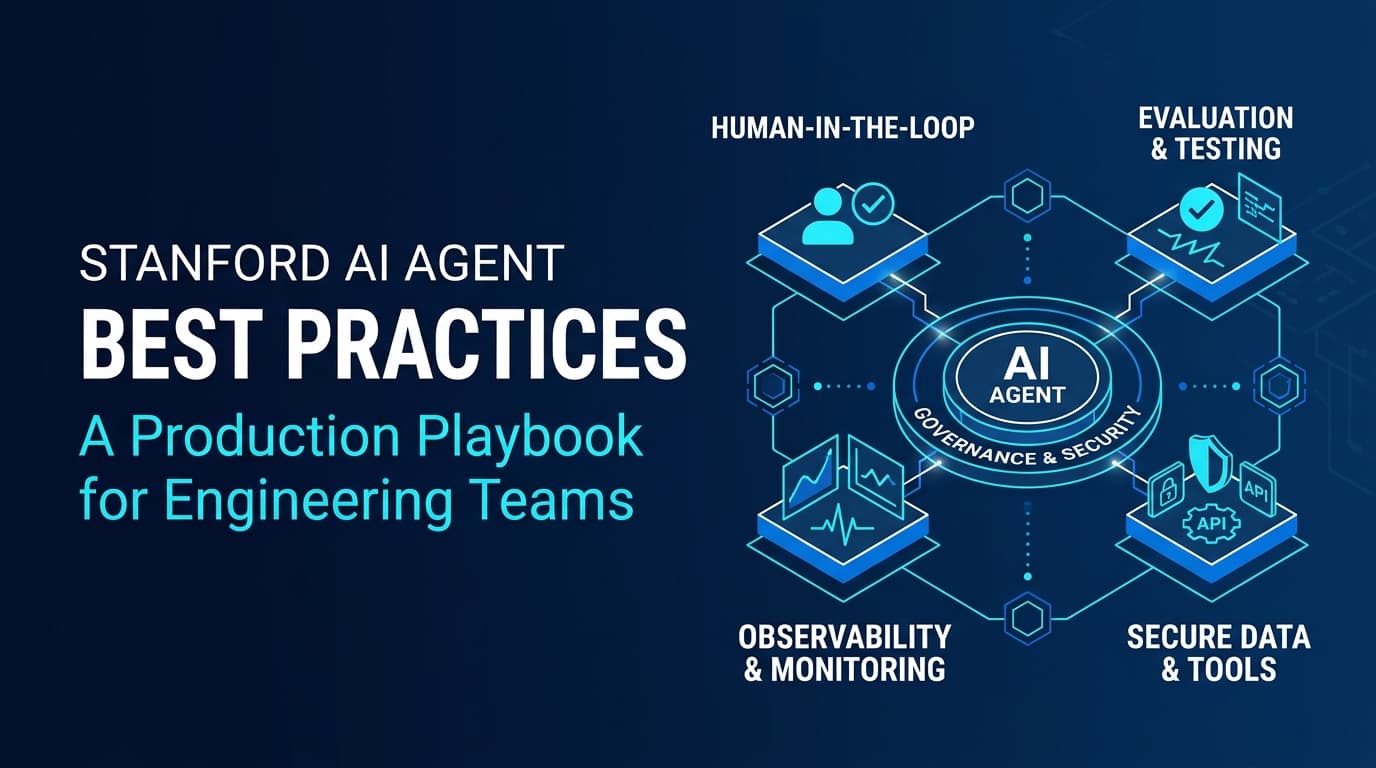
Stanford’s CS336 course treats AI coding assistants as teaching aids rather than solution generators, a philosophy that translates naturally to production AI agent development. The core idea—guide learners toward discovery rather than delivering ready-made answers—maps onto the need for agentic systems that remain interpretable, debuggable, and maintainable as they scale. This article extracts actionable patterns from the CS336 AI agent guidelines and reframes them as production‑ready checklists, evaluation frameworks, and RAG integration strategies for engineering teams.
Teaching as Development: Adopt a Guidance‑First Mentality
In the CS336 framework, AI agents are instructed to ask clarifying questions, reference lecture materials, and point students toward edge cases rather than writing code for them. For production teams, this mentality becomes a framework for code reviews, debugging sessions, and design discussions. When an agent produces unexpected behavior, the default response should be to surface the underlying assumption or data flow that triggered it, not to patch the symptom directly. Teams can operationalize this by embedding prompting patterns that ask "What have you tried so far?" or "Which invariant might be violated here?" before surfacing a fix. This keeps the human engineer in the learning loop and prevents the accumulation of opaque,black‑box fixes that degrade long‑term system health.
The guidance‑first approach also shapes how teams structure AI‑assisted code reviews. Rather than accepting a diff and merging it, reviewers can require that the AI explain the rationale behind each change, cite the invariant it enforces, and propose a targeted test that would catch a regression if the change were wrong. This mirrors the CS336 practice of reviewing code and suggesting improvements through dialog rather than directly giving solutions.
Designing Agentic Workflows with Built‑In Checkpoints and Invariants
The CS336 guidelines explicitly encourage the use of tests and invariants over fixes. In a production agentic pipeline, this translates to inserting sanity checks at every agent node. Shape assertions, for instance, can verify that a tool’s output tensor matches the expected dimensionality before downstream computation proceeds. Toy‑example validation—running a minimal input through the agent to confirm basic functionality—acts as a fast feedback loop equivalent to the "single attention layer" sanity test described in the course materials. Profiling hooks can be attached to agent steps to surface latency spikes or resource contention before they become systemic. Documenting expected invariants for each step creates a shared contract between the agent’s design and the observability stack, making it possible to automate drift detection over time.
Early‑failure detection is another carry‑over. If an agent calls an external tool and receives a non‑standard error, the workflow should pause and present the error message alongside contextual hints—such as recent changes to the tool’s API or typical misconfigurations—rather than immediately retrying or escalating. This reduces noise in incident pipelines and mirrors the CS336 practice of explaining error messages from Python, PyTorch, or distributed training tools through guiding questions.
Evaluating Agent Performance Through Continuous Feedback Loops
The CS336 curriculum emphasizes iterative feedback: students run code, observe outputs, adjust approaches, and repeat. Production agentic systems benefit from a structured logging schema that captures tool usage frequencies, retrieval success rates, and memory retrieval latency. Automated sanity‑check dashboards can aggregate these metrics, surface thresholds that have been crossed, and trigger review sessions where engineers adjust confidence thresholds or retrain retrieval components. Regular review cycles—weekly or per‑release—ensure that the agent’s behavior stays aligned with intended semantics as data distributions shift.
Structured logging should go beyond "agent ran tool X." It should include the prompt version, the retrieved chunk identifiers, the confidence score assigned to the tool output, and the final action taken. When these fields are consistently populated, engineers can trace a specific failure mode to its origin (e.g., a prompt template that became misaligned with a new data schema) without sifting through unstructured logs. This approach operationalizes the CS336 principle of turning error messages into learning opportunities, but at scale.
Implementing Memory and Tool‑Use Patterns for Scalable Agents
The guidelines note that AI assistants should point students to official documentation rather than third‑party implementations, and should help students understand approaches at a high level before nudging them toward specifics. For production agents, this maps to defining clear interfaces for each tool the agent can call. A tool description should include its input schema, expected output format, side‑effects, and version pinning. Version‑controlled prompts and retrieval chains serve as the agent’s "memory," ensuring that behavior changes are traceable and rollable. Teams can separate high‑frequency tools—such as a search or calculation utility—from occasional, heavy‑weight operations like fine‑tuning or large‑scale data processing, routing the latter through dedicated pipelines with explicit approval gates. This division of labor prevents the most commonly called tools from becoming bottlenecks and makes the overall system easier to audit.
Persistent memory strategies should also respect the self‑contained nature emphasized in the CS336 materials. Rather than relying on opaque external caches, teams can maintain a versioned index of frequently used concepts, error resolutions, and prompt fragments. When the agent references a concept, it does so through a documented entry that includes the original context and any relevant invariants. This keeps the system interpretable and aligns with the guideline's preference for pointing learners to course materials over pointing them to arbitrary third‑party implementations.
Debugging and Observability: Turning Error Messages into Learning Opportunities
One of the most concrete directives in the CS336 guidelines is to "explain error messages from Python, PyTorch, CUDA, Triton, and distributed training tools." In production, this means that whenever an agent encounters an exception, the system should surface not just the traceback but also a curated set of possible causes, links to relevant documentation, and a suggested next step—all generated through a deterministic process, not a free‑form LLM reply. Interactive replay sessions can be built to record the agent’s state leading up to an error, allowing engineers to replay the execution path in a debugging environment and identify the exact point where an invariant was violated. Over time, a living glossary of common pitfalls and their resolutions—populated from these replay sessions—becomes a knowledge base that reduces the time needed to diagnose recurring issues.
The glossary should be structured as (error pattern, likely root causes, recommended fix, preventive invariant). When a new error appears, the system can check the glossary first and present the matched entry to the human engineer, embodying the "guiding questions rather than fixes" philosophy at an organizational scale.
Balancing Autonomy with Human Oversight in Production AI Agents
The CS336 approach cautions against excessive assistance, advocating instead for limited support that preserves the learner’s agency. Translated to production, this means defining explicit autonomy levels for agentic actions. Before allowing an autonomous tool call, the agent should meet a confidence threshold derived from its internal scoring mechanism. Calls that fall below the threshold are routed to a human reviewer who can approve, modify, or reject the action. Documented escalation paths and governance rules ensure that no single agent decision leaves the system in an undefined state without a review trail. Teams can also instrument "handoff events" in their workflow engine, creating an audit log that records when and why human oversight was invoked. This balance keeps the system agile while preserving accountability, a principle directly drawn from the course’s stance on limited assistance.
Translating Academic Rigor into Production Checklists
The CS336 guidelines provide a natural checklist for teams looking to embed best practices into every agent release. The following items mirror the guideline’s key themes:
Has the agent been reviewed for pedagogical clarity (i.e., understandable code and documentation)?
Are sanity checks, invariants, and profiling hooks present at each agent node?
Is there a structured feedback loop for continuous improvement, including logging, dashboarding, and review sessions?
Have tool and memory designs been modularized for maintainability, with version‑controlled prompts and clear interfaces?
Is human‑oversight policy documented, enforced, and instrumented with handoff events?
Teams that systematically verify these items before deploying an agent gain the same reliability benefits that CS336 students experience when they embed assertions and toy‑example tests early in their development cycle. The checklist is not a one‑time exercise; it should be revisited whenever the agent’s scope, toolset, or data regime changes.
How Armor Tech Can Help
At Armor Tech, we help SaaS businesses design, integrate, and deploy production-ready AI agents with security, reliability, and operational control built into their architecture. Our team develops structured agent workflows with least-privilege permissions, secure API integrations, sandboxed execution, evaluation pipelines, and continuous monitoring. We also implement human approval checkpoints, audit logging, error handling, and recovery mechanisms to help prevent unintended actions and improve system reliability. From automating internal business processes to building AI-powered applications connected to enterprise data, Armor Tech focuses on scalable solutions that can be tested, monitored, and maintained effectively. By combining practical engineering with appropriate human oversight, we help organizations move from AI experimentation to dependable production deployments.
Frequently Asked Questions
How should teams handle unexpected tool failures in production?
When a tool call returns an error, the system should present the raw error message alongside contextual hints—such as recent API changes, common misconfigurations, and recent code modifications—rather than automatically retrying or escalating. This approach mirrors the CS336 practice of explaining error messages through guiding questions, helping engineers diagnose the root cause faster while keeping the agent in a safe, pauseable state.
What role does RAG play in maintaining agent interpretability?
RAG systems can surface the specific source chunks or documentation entries that influenced an agent’s decision, making the reasoning path visible. By version‑control ling prompts and retrieval indices, teams can trace which knowledge source contributed to a given output, aligning with the CS336 principle of pointing learners to official materials rather than opaque third‑party implementations.
How do confidence thresholds prevent over‑autonomous agent behavior?
Confidence thresholds act as a gate before autonomous tool calls are executed. Calls that fall below the threshold are routed to human review, ensuring that high‑risk or low‑certainty actions receive oversight. This mirrors the CS336 guideline’s emphasis on limited assistance: the agent operates autonomously within a bounded confidence interval, but steps back when uncertainty rises, preserving human judgment for critical decisions.
Applying these principles consistently helps teams build agentic AI systems that remain interpretable, maintainable, and aligned with human intent as they scale. The frameworks described here are starting points; each organization should adapt them to its specific toolchain, data regime, and governance requirements.
Production‑Ready Agentic AI ChecklistAgentic AI ServicesDeployment Case Studies