SMS-Native AI Agents and Core Task Execution
Text messaging has quietly become the lowest-friction interface for AI agents that actually act on your behalf. Rather than installing another app or opening a browser tab, users can simply send a message — like texting a friend — and the agent responds, remembers context, and executes tasks across connected services. The result is a layer of automation that lives where people already spend most of their digital time: inside the message thread.
Ask Proxy exemplifies this pattern. Users text “start” to 820-732-2625, and the agent begins managing calendars, setting reminders, and offering proactive suggestions. What sets it apart is its stated design to “anticipate your needs before you even ask,” reaching out when it notices something you might forget or when it finds a new restaurant or event that matches your preferences. The personal version costs $1 per day, while the work-focused version is priced at $15 per employee per month for large companies and $23 for small teams, with explicit segmentation that keeps personal data off company systems — a design pattern increasingly relevant for enterprise-grade privacy.
Caddy operates natively through iMessage on iPhones and RCS on Androids, eliminating the need for a separate inbox or app. It connects to calendars and conversations, identifying actionable items scattered across emails, friend messages, and shared lists. The agent can add events, set reminders, track follow-ups, and conduct research — all from within the message thread. Caddy has been in public beta since April 2026.
Martin broadens the channel scope to include SMS, phone calls, WhatsApp, email, and Slack, making it one of the more accessible agents for users who split their attention across platforms. It manages calendars, sends messages, makes calls, and delivers daily summaries of what needs attention. Subscription pricing starts at $21 per month. Meanwhile, Poke gained industry attention as the first AI agent approved for Apple Messages for Business, handling calendars, planning, health controls, and smart-home functions through the official iMessage channel.
Multi-Channel Interoperability Across Messaging Platforms
The next evolution isn’t just about being reachable via text — it’s about maintaining context and executing coherent workflows across iMessage, WhatsApp, Telegram, RCS, and Slack without losing continuity. This interoperability determines whether an agent scales beyond a novelty into a persistent part of a user’s digital life.
Folk runs on its own private cloud computer, accessible through iMessage, WhatsApp, and Telegram. Unlike simpler chatbot-style agents, Folk can execute code and carry out multi-step tasks rather than just respond conversationally. It can research topics, track flights, handle reservations, and manage emails — all while retaining personal context across platforms. Folk offers a free beta and a Pro subscription at $8.33/month for unlimited background tasks.
Rene positions itself as the user’s “best contact,” turning natural-language conversations into structured tasks, reminders, and summaries across iMessage, Telegram, and WhatsApp. It maintains context across conversations and even includes a browser, code-writing capability, and e-commerce functions like shopping and image generation. Similarly, Maverick integrates with Discord, Gmail, and Slack, asking for user permission before taking any action — a pattern that balances autonomy with control.
Orbits bridges the gap between app-based interaction and text messaging, coordinating calendars, lists, and household conversations across family members. It can search the web, make purchases, book restaurants, and communicate with service providers — all through a thread that users can engage with via either the Orbits app or SMS.
Pally connects WhatsApp, Gmail, calendars, and Google Drive, helping users track plans, receipts, dates, and files through iMessage, RCS, and Telegram. With a free tier available, Pally lowers the barrier for experimentation while still offering integration depth for power users.
Specialized Agent Personas: Family, Travel, Work, and Content
Beyond general-purpose assistants, a wave of specialized agents is emerging to handle vertical workflows — family coordination, travel logistics, workforce productivity, and content creation. These agents reflect a shift from “do anything” tools toward focused solutions that deeply understand the data structures and communication norms of specific domains.
Fambot acts as an AI “chief of staff” for families, synthesizing school communications, sports activities, meal planning, and calendars into a nightly SMS digest. Parents can reply to summaries to ask questions, adjust schedules, or check details. Currently free during beta with plans to charge a Netflix-equivalent subscription, Fambot integrates with Gmail, Google Calendar, Outlook, and WhatsApp.
Ohai coordinates household schedules, reminders, chores, and meals across family members, offering tiered subscriptions starting at $9.99/month. Like Fambot, it targets the fragmented communication patterns of modern households.
Ollie distinguishes itself as one of the first mainstream family-focused assistants to achieve SOC 2 compliance, signaling a growing emphasis on trust and data governance in personal agent deployments. It offers a free tier alongside paid plans starting at $25/month for 150 messages and $100/month for up to 1,000 messages.
In the travel space, Miso** combines AI trip planning with human support from a dedicated travel team, accessible through iMessage. It accounts for loyalty points, travel preferences, and real-time flight updates. For content creators, Stanley connects to Instagram, transforms voice notes into scripts and captions, and maintains content calendars — turning messaging into a creative workflow engine.
Szn** claims to have served more than 7,500 businesses across 16 countries, completed over 10,000 jobs, and handled 95 hours of calls, demonstrating early traction in professional task coordination through messaging threads.
Integration Ecosystems and Automation Backbone Gaps
Despite rapid proliferation, individual AI agents remain largely siloed. Each connects to its own set of SaaS integrations and maintains context only within its own ecosystem. There is no built-in mechanism for cross-agent task handoff or shared memory — meaning any effort to create a unified automation backbone requires custom-built orchestration per API capability and compliance constraint.
Comma**, an open-source agent, offers a potential foundation for such layers. It maintains context across devices and messaging apps including Signal, Telegram, and WeChat, and can execute tasks to completion while reviewing its own work. Because it’s open source, technical teams can inspect its behavior, adapt its connectors, and embed it within larger orchestration frameworks like n8n messaging nodes or Apache Airflow pipelines.
The absence of native workflow orchestration among commercial agents creates a critical gap: a user might schedule a meeting through Ask Proxy via SMS, but transferring that event to a Slack announcement or triggering a follow-up email in Gmail requires manual intervention or a third-party bridge. This is where a dedicated automation backbone — built around webhook routing, event queues, and conditional logic — becomes essential for production deployment.
Security, Privacy, and Compliance Considerations
As agents gain autonomy — signing up for services, placing calls, and managing accounts on behalf of users — the attack surface expands significantly. Dedicated email addresses assigned to agents, like those rolled out by Instinct**, enable account creation and service interaction without flooding the user’s personal inbox, but they also introduce new vectors for credential leakage and behavioral manipulation.
Compliance frameworks vary widely across agents. While Ollie** highlights SOC 2 as a trust signal, other agents make no such guarantees. Ask Proxy’s** work-focused version reflects a growing design pattern: segmenting personal and corporate data at the product level rather than relying solely on user-configured policies. Technical teams evaluating these tools must independently verify audit claims, data residency policies, and encryption standards — especially for agents operating across multiple messaging channels that may lack end-to-end encryption by default.
Pricing Models and Deployment Realities for Technical Teams
Cost structures and maturity levels differ sharply across the agent landscape, making pilot planning complex. Ask Proxy** charges $1/day for personal use and $15–$23/employee/month for business tiers. Martin** starts at $21/month. Maverick’s** Pro version costs €27/month (~$30 USD), including 500 tasks, 20 connected apps, and scheduled tasks. Ollie** offers a free tier, $25/month for 150 messages, and $100/month for 1,000. Fambot** remains free during beta with post-beta pricing expected to align with subscription entertainment services.
Most agents are still in beta or early public release, with no guaranteed timelines for general availability. Technical teams should treat these deployments as controlled pilots — integrating one or two agents into specific workflows rather than attempting broad rollouts until stabilization occurs. Open-source alternatives like Comma** provide more transparency into how context and permissions are handled, allowing for deeper customization before scaling.
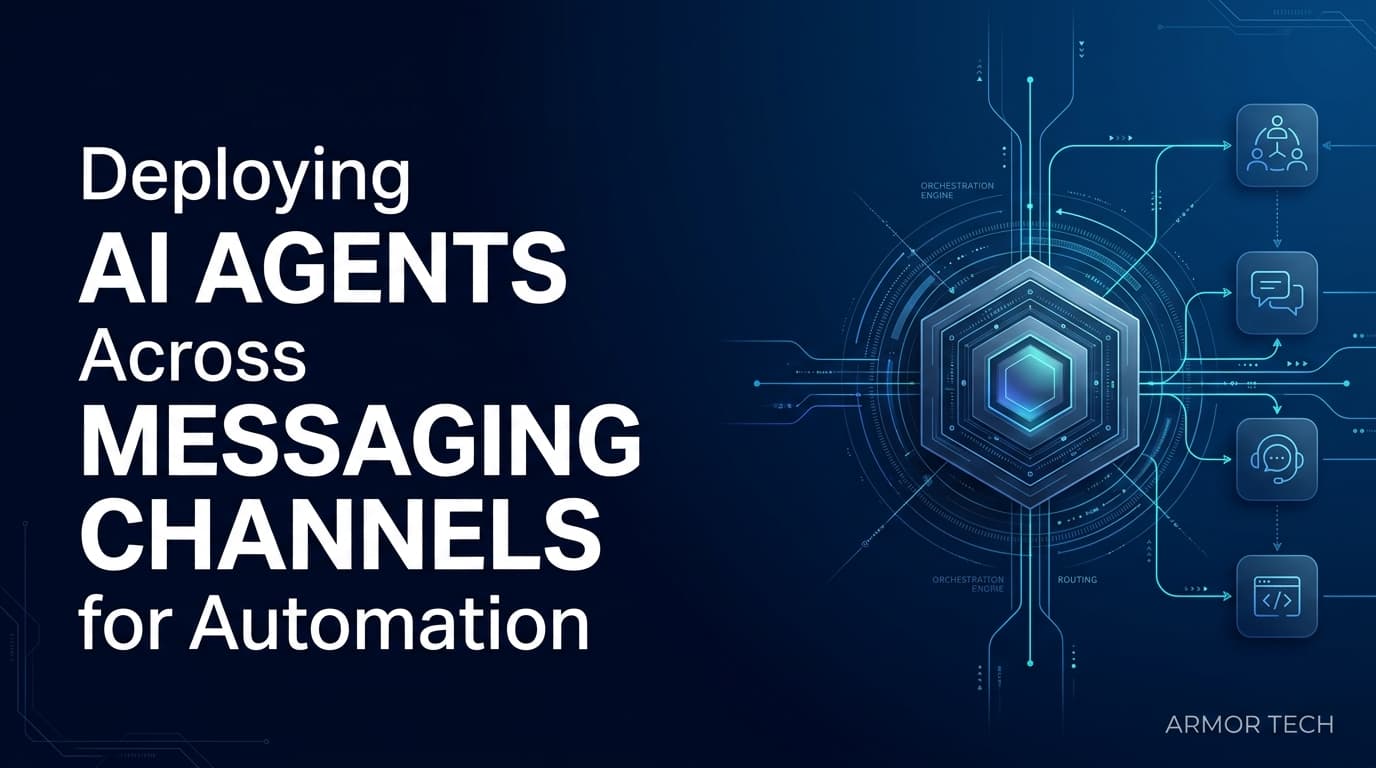
For organizations looking to build unified messaging automation backbones, the path forward involves selecting agents with the strongest API documentation and integration flexibility, then layering orchestration software — like Armor Tech's automation services — to manage event routing, error handling, and cross-platform state synchronization.
How Armor Tech Can Help
Armor Tech helps businesses explore and implement AI-powered automation solutions that connect messaging channels, streamline communication, and optimize operational workflows. By leveraging AI agents, intelligent integrations, and automated task orchestration, businesses can reduce repetitive manual work, improve response consistency, and coordinate interactions across multiple communication platforms. From designing scalable agent architectures to integrating existing business systems and implementing appropriate security and monitoring controls, Armor Tech can help organizations build reliable automation solutions aligned with their operational needs. The result is a more connected, efficient, and scalable approach to business communication.
Frequently Asked Questions
How do I choose which messaging channels to support for AI agents?
Start with the channels your users already rely on daily. SMS works universally, while iMessage and RCS offer richer formatting and native OS integration. WhatsApp dominates international adoption, and Slack/Teams are essential for internal workflows. Prioritize coverage based on user behavior data rather than trying to support every channel from day one.
Are these AI agents secure enough for enterprise use?
Enterprise readiness varies significantly by agent. Look for explicit privacy segmentation (like Ask Proxy’s work/personal split), SOC 2 certification (like Ollie’s), and transparent data handling policies. Most agents are still in beta and lack independent security audits, so treat them as controlled pilots until compliance is verified.
What’s the best way to integrate multiple agents into a single workflow?
Use a workflow orchestration platform such as n8n or Apache Airflow to route triggers between agents via APIs and webhooks. Since no agent natively supports cross-agent handoff, you’ll need custom logic to translate context, synchronize state, and enforce approval gates between steps. Open-source agents like Comma provide the most flexibility for embedding into existing automation infrastructure.
Deploying AI agents across messaging channels promises a future where automation feels conversational and persistent. But realizing that future requires bridging the gap between isolated agents and coordinated workflows — one integration at a time.