Open-Source Adoption as a Production Signal
The 24 million clones and 2.5% of global AI token usage (per Nous's own estimates) aren't vanity metrics—they're evidence that developers have stress-tested Hermes in ways no internal QA team could replicate. When engineers pull a model into their side projects, internal tools, and experimental pipelines, they surface edge cases around context handling, tool calling reliability, and failure recovery that benchmarks miss.
This matters because enterprise buyers often evaluate agents on controlled demos. The Nous path suggests a different procurement heuristic: look for agents with genuine open-source adoption, not just published weights. Community usage creates a distributed test suite that exercises the model across languages, frameworks, and weird prompting patterns. That's the same logic that made Kubernetes production-ready before any vendor offered support contracts.
The risk, of course, is that open-source popularity doesn't guarantee enterprise features. Nous is betting the Series B capital on bridging that gap with "Hermes for Businesses"—a hosted, customized layer that adds data isolation, audit trails, and SLA-backed availability on top of the open core.
Data Privacy as the Enterprise Gatekeeper
The TechCrunch article notes Nous is targeting companies that need agents to "handle multi-step workflows while keeping their data private and secure." This phrasing undersells the architectural implication: multi-step agents require context persistence across tool calls, which means intermediate state—often containing PII, proprietary code, or financial data—lives in the agent's memory or external stores.
Most agent frameworks treat this as an afterthought. They'll encrypt data at rest and in transit, but the prompt context itself—the conversation history, retrieved documents, tool outputs—flows through the model provider's inference infrastructure. For regulated industries, that's a non-starter.
Nous's enterprise play likely involves on-premises or VPC-deployed inference where the entire agent loop runs inside the customer's security boundary. This isn't just "private cloud" marketing; it requires solving model serving at scale without the convenience of managed APIs. The $90M raise suggests they're building that serving stack, not just wrapping an API.
Multi-Step Workflows: Where Demos Fail
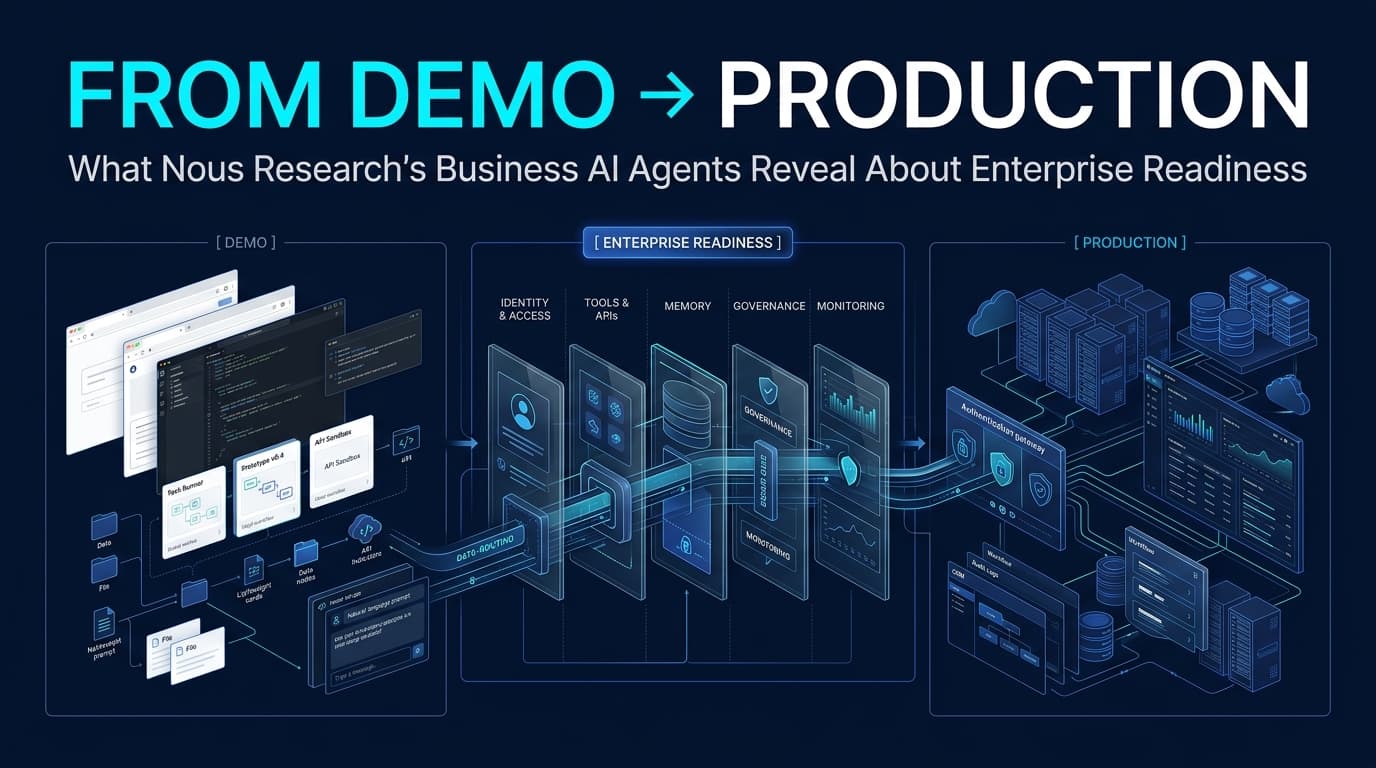
Single-turn chat is a solved problem. The production reality is agents that must: retrieve data from three internal systems, validate against business rules, draft a response, route for human approval, and execute the approved action—while maintaining state across interruptions, timeouts, and partial failures.
Each step introduces compounding failure modes. A retrieval timeout on step two shouldn't lose the validation logic from step three. A human reviewer's edit on step four must propagate cleanly to the execution payload. Most open-source agent frameworks (LangGraph, AutoGen, CrewAI) provide the orchestration primitives but leave durability, idempotency, and observability as exercises for the implementer.
Nous's enterprise product will live or die on whether they've hardened these operational concerns. The revenue trajectory—$36M ARR by mid-September 2026, targeting $100M+ by year-end per WSJ reporting—implies early customers are paying for that hardening, not just the model weights.
Customization vs. Configuration: The Deployment Spectrum
"Customized AI agents" in the Nous announcement signals a spectrum that buyers need to navigate deliberately:
- Configuration: Prompt engineering, tool selection, RAG corpus curation. Fast to deploy, limited differentiation.
- Fine-tuning: Domain adaptation on proprietary data. Higher upfront cost, better alignment with specialized terminology and workflows.
- Architecture modification: Custom control flows, specialized memory structures, hybrid symbolic/neural reasoning. Maximum control, requires ML engineering capacity.
Most enterprises over-index on fine-tuning when configuration would suffice. The Nous model—open weights plus enterprise customization services—lets buyers start at the configuration layer and move deeper only where ROI justifies it. That's a healthier dynamic than vendors who lock you into their fine-tuning pipeline from day one.
Revenue Traction as Validation, Not Vanity
The $36M to $100M ARR projection (WSJ, attributed to Nous) is aggressive for a three-year-old startup. But in agentic AI, revenue velocity matters more than absolute scale because it signals repeatable deployment patterns. A handful of $2M+ contracts suggests the product solves a specific, painful problem for a defined buyer. Fifty $200K contracts suggests a platform with broader applicability but thinner per-account value.
Neither is wrong, but they demand different go-to-market motions and product roadmaps. Nous's investor roster—Nvidia, USV, Menlo, Samsung—hints at both: Nvidia and Samsung suggest hardware/edge deployment paths; USV and Menlo suggest SaaS scaling playbooks. The 1789 Capital participation is notable but orthogonal to the technical thesis.
For buyers, the relevant question isn't the valuation multiple. It's whether the revenue comes from professional services (custom integration per client) or product licenses (repeatable deployment). The former scales linearly with headcount; the latter scales with product maturity.
What This Means for Vendor Evaluation
If you're evaluating agent platforms in Q4 2026, the Nous trajectory suggests a practical rubric:
- Provenance: Does the core agent have open-source adoption beyond the vendor's repo? Fork stars and clone counts are noisy but directionally useful.
- Data boundary: Can the entire inference loop run in your VPC/on-prem without calling home? Ask for the architecture diagram, not the compliance certifications.
- State management: How does the platform handle durable execution? Look for built-in checkpointing, replay, and human-in-the-loop primitives—not "you can build that with our SDK."
- Customization depth: Is there a path from prompt engineering → fine-tuning → architecture changes without switching vendors?
- Revenue quality: Ask for logo churn and expansion revenue. High expansion in agent platforms usually means the product handles more workflows over time—exactly what you want.
The Nous raise doesn't change this rubric. It validates that investors see the same gaps you do.
Build vs. Buy: The Calculus Shifts
Two years ago, building agent infrastructure in-house was the only way to get data sovereignty and workflow control. The Nous enterprise offering—and similar moves from competitors—changes that equation. The build path now requires: hiring ML engineers for model serving, platform engineers for durable execution, security engineers for compliance, and product engineers for the developer experience.
That's a 12-18 month investment before your first business workflow runs. Buying from a vendor who's already absorbed that R&D (funded by their Series B) lets you deploy in weeks. The tradeoff is vendor lock-in and per-seat/per-agent pricing that compounds at scale.
The middle path—adopting open-core platforms like Hermes and building the enterprise layer yourself—works if you have the engineering bandwidth to maintain a fork. Most mid-market companies don't. Large enterprises might, but then they're effectively becoming a software vendor.
Nous's pricing hasn't been disclosed, but the ARR trajectory suggests enterprise contracts in the low-to-mid six figures annually. At that level, the build vs. buy calculation depends almost entirely on whether you view agent infrastructure as a core competency or a utility.
Our agentic AI systems practice helps teams navigate exactly this decision—mapping workflow requirements to the right point on the build-buy spectrum.Frequently Asked Questions
Is Hermes actually used in production, or just experimental?
The 24M+ clones and 2.5% global token usage (per Nous estimates) indicate substantial developer adoption. However, "production" varies widely—from internal Slack bots to customer-facing automation. Nous's enterprise push explicitly targets the latter with data isolation and SLA guarantees that the open-source version doesn't provide.
What does "multi-step workflow" mean concretely?
An agent that retrieves quarterly data from Snowflake, cross-references CRM records, drafts a variance analysis memo, routes it to a finance manager for approval via email, then posts the approved version to Notion and triggers a downstream forecast update—all as a single durable execution that survives interruptions.
How should we evaluate the $100M ARR projection?
Treat it as a signal of investor confidence in the enterprise motion, not a validated run rate. The WSJ attributed the figure to Nous; independent verification isn't public. More useful: ask for reference customers in your industry running similar workflow complexity.
Closing
The Nous funding round is a data point in a larger pattern: agentic AI is crossing the chasm from "interesting demo" to "budget line item." The winners won't be determined by model benchmarks—they'll be determined by who solves the unglamorous problems of durable execution, data sovereignty, and operational observability at scale. Hermes has the open-source traction; "Hermes for Businesses" has to prove it has the engineering.