Why Agentic AI Makes Infrastructure a Design Constraint, Not an Afterthought
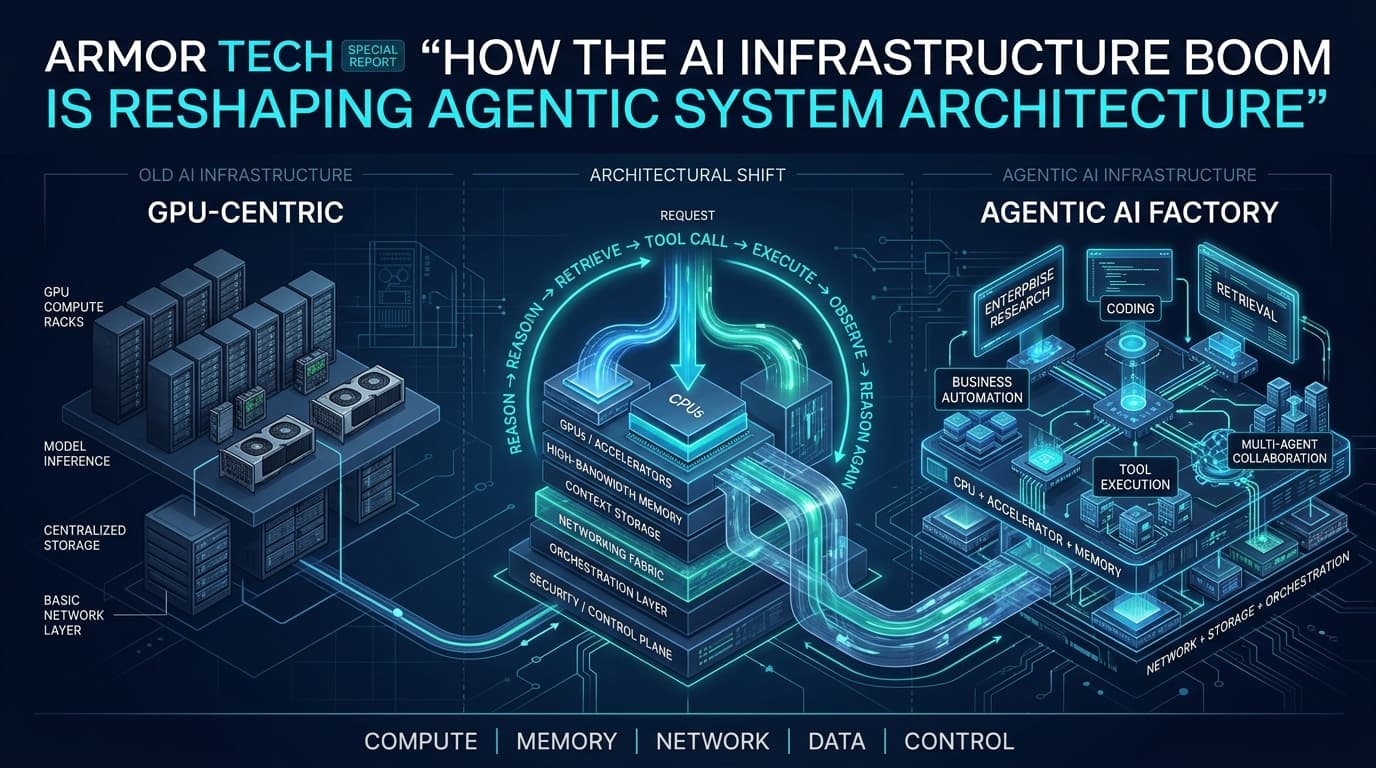
Traditional LLM inference looks like a batch job: request in, tokens out, stateless, predictable. Agentic workloads behave differently. Multi-step reasoning chains, tool-calling loops, persistent memory retrieval, and inter-agent communication create variable, bursty, stateful compute patterns that run for minutes or hours rather than milliseconds. Each tool call adds a network round-trip and a potential tail-latency spike. Memory persistence means state must survive infrastructure events—node failures, thermal throttling, power capping—that batch inference simply retries.
These characteristics shift infrastructure from an ops concern to an architectural input. When a planner agent spawns three specialist agents that each call external APIs, the resulting east-west traffic pattern stresses network fabric in ways north-south inference traffic doesn't. Rack layout, power distribution, and cooling zones start dictating whether you route reasoning to a large model on GPUs or delegate execution to smaller models on CPUs. Context window sizing becomes a thermal decision as much as a quality decision. Agent granularity—how many discrete agents you decompose a task into—becomes a function of available compute density and inter-node latency budgets.
Power Density and the Rise of Heterogeneous Agent Runtimes
Rack power densities are pushing toward 50–100 kW and beyond, driven by GPU clusters that draw an order of magnitude more power per square foot than traditional servers. This isn't a uniform uplift—it creates sharp discontinuities. A rack with liquid-cooled H100s sits next to a rack of air-cooled CPUs, each with fundamentally different cost, latency, and availability profiles. Agentic systems that assume homogeneous compute will either over-provision expensive GPU cycles for simple tool execution or starve reasoning steps that need sustained high FLOPS.
The architectural response is heterogeneous agent runtimes. Planning and reasoning agents—characterized by large context windows, high token throughput needs, and complex branching logic—route to high-compute GPU pools. Execution agents that call APIs, query databases, or manipulate files run on CPU-dense, lower-cost infrastructure. Observation and critique agents that evaluate outputs can often run on smaller distilled models at the edge. This routing requires an orchestration layer that understands compute topology: GPU memory capacity, NVLink domains, CPU core affinity, and per-rack power envelopes.
Kubernetes schedulers with GPU topology awareness (via device plugins and topology managers) provide a foundation, but they lack agent semantics. They don't understand that a planner agent's output is a DAG of tool calls with retry policies, or that a memory-retrieval agent has strict latency SLOs because it sits in the critical path of every reasoning step. Compute-aware agent frameworks need built-in "compute budget" primitives per task—declarative hints like requires_gpu: true, max_tokens: 8192, latency_budget_ms: 200—that the scheduler can map to physical resources.
Cooling Architecture Dictates Latency Budgets for Multi-Agent Loops
The shift from air to liquid cooling—direct-to-chip cold plates, immersion tanks, rear-door heat exchangers—does more than reduce PUE. It changes the thermal headroom that determines whether a GPU sustains boost clocks or throttles under sustained load. For agentic systems, this distinction is critical. A multi-agent loop running for twenty minutes with continuous token generation will push GPUs into thermal throttling on air-cooled racks, introducing unpredictable latency variance that breaks autonomy assumptions. The same workload on liquid-cooled infrastructure maintains consistent throughput.
Immersion cooling takes this further by enabling denser GPU packing with shorter interconnect runs, reducing inter-GPU latency for model-parallel agents that shard a single large model across multiple devices. Air-cooled legacy racks force architects into request queuing or model downsizing—both of which degrade the agent's ability to maintain long-horizon coherence. A practical design pattern emerging is thermal-aware agent scheduling: the orchestration layer subscribes to thermal telemetry (inlet temps, GPU junction temps, CDU flow rates) and can pause, resume, or migrate agent workflows based on real-time thermal envelope. This requires instrumenting the stack from GPU driver → BMC → PDU → facility chiller → utility feed, a visibility gap most observability platforms don't bridge.
Grid Interconnection Queues Are Forcing Geographic Agent Deployment Strategies
Multi-year grid interconnection queues—three to five years in markets like Northern Virginia, Santa Clara, and Texas—mean new data center capacity cannot simply be ordered where users are. Agentic systems must deploy where power capacity exists today. This creates a geographic mismatch: your users may be on the East Coast, but your GPU capacity sits in Texas or the Pacific Northwest where generation and transmission are available.
The architectural implication is geo-distributed agent state synchronization. Lightweight edge agents handle user-facing interaction, tool calling, and local memory at inference points near users. Heavy planner agents run in the powered core, receiving compressed context updates and emitting high-level plans. Cross-region tool calling introduces latency that must be budgeted into the agent's reasoning loop—async patterns with checkpointing become mandatory. Fallback routing across regions requires agent state serialization formats that are portable across hardware generations and cloud providers. The edge-agent pattern isn't new, but the constraint forcing it is: it's no longer about latency optimization, it's about where the electrons are.
Infrastructure Software: The Emerging Layer Between Agents and Iron
The TechCrunch Disrupt session highlights "infrastructure software" as a category where AI-driven demand creates durable opportunity. This layer sits between agentic frameworks and physical hardware—cluster schedulers that understand agent DAGs, power-aware orchestrators that respect rack-level caps, thermal telemetry APIs that expose facility-level signals to workload managers, and agent-aware autoscalers that scale based on workflow queue depth rather than CPU utilization.
Traditional Kubernetes schedulers lack agent semantics. They schedule pods, not workflows with retry policies, tool dependencies, and compensation logic. New projects are emerging: power-capped scheduling that bins workloads by rack PDU capacity, thermal-aware pod placement that avoids hot spots, agent lifecycle managers that handle checkpoint/restore across heterogeneous compute. Observability must span the full stack—GPU utilization metrics are useless if you can't correlate them to rack PDU draw